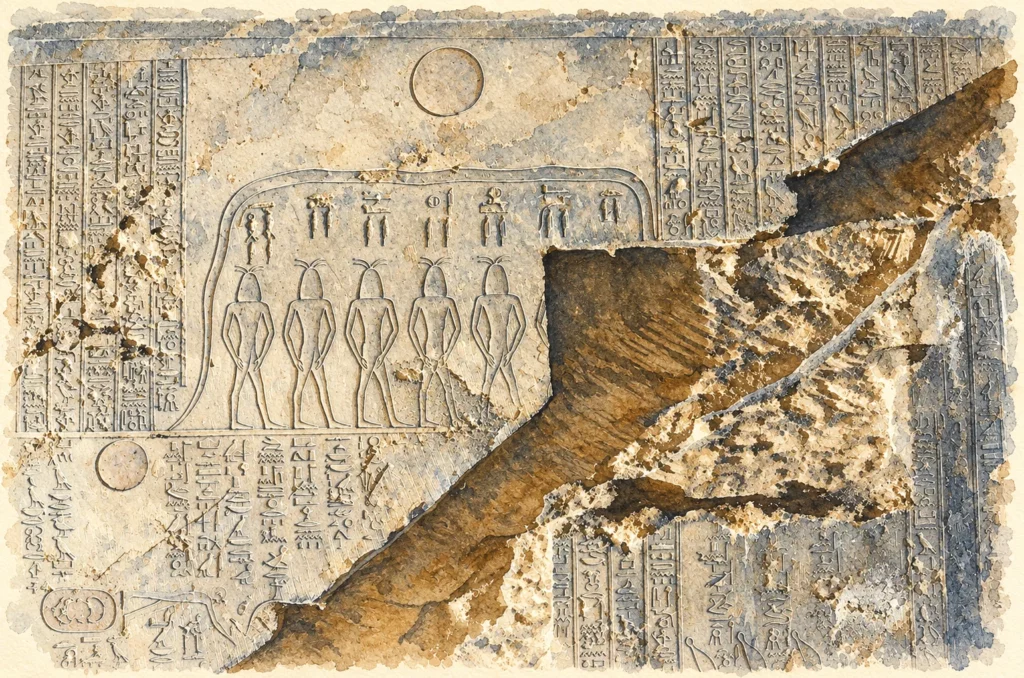
Corridor XVIII bears a long sequence of scenes and texts from the Book of Caverns. Carved figures occupy its south wall in particular; the inscriptions also extend to the north. The narrow space gives this writing a particular closeness to the visitor.
Bodies preserved in the other world
In a scene on the south wall, several beings lie within an elongated form that contains them. The outlines and figures remain visible despite a large break in the rock. These images belong to the representation of the inhabitants of the afterlife and their protective coverings.
The Book of Caverns insists on bodies, their preservation and the effects of the passage of the sun. Survival requires that the dead can benefit from the light and the words of the god. The composition also presents the fate of the enemies of the divine order, deprived of the conditions of this rebirth.
The sun carried by a hand
On the north wall, a scene shows Ra on a hand. This image gives a singular form to the support the sun receives in the underground regions. The star depends there on powers that receive it and contribute to its progress.
The images of the corridor thus develop several ways of preserving life and setting it in motion again. For Padiamenope, knowing this world and having its figures inscribed in the tomb is part of the hope of sharing its renewal.
Forms that contain and protect
The figures enclosed within elongated outlines attract attention because they give the bodies a space of their own. The image distinguishes a being from what surrounds it and expresses a condition of preservation. In the Book of Caverns, the states of the inhabitants of the other world matter as much as their movements.
The light of the sun therefore does not cross an indifferent landscape. It meets bodies and powers whose capacity to live depends on precise relationships with the god. The words may announce a benefit, establish a bond or define the fate reserved for those who oppose the divine order.
This variety prevents the decoration from being reduced to a uniform representation of the dead. The scenes organise different situations and distinct expectations. By having them copied, the owner seeks to know this world and to find a favourable place in it.
The hand and the star
The image of Ra on a hand recalls that the sun itself receives support in the nocturnal world. Its progress involves powers other than its own. The star that gives back life also depends on a set of relationships that allow its journey and its return to day.
This motif makes sense within the idea of a world renewed by the action of several divine beings. The rebirth of the sun becomes a prepared and accompanied event, to which each contributes according to its function. For the dead man, taking part in this order offers a path towards duration.
The corridor physically brings the visitor close to this succession of images. The breaks interrupt the scenes, but silhouettes, outlines and columns of signs keep their articulation. Looking at XVIII means following these links between what remains visible and what the words allow us to understand: preserved bodies, a supported sun and a life that can resume.
The hand is a detail worth remembering in this respect. It turns a relationship of support into an immediately visible form. The image speaks of a power that carries the star, while the book as a whole explains why its return matters to the inhabitants of the other world.
Sources and references
BSFE, p. 72; figs 1–2.
Traunecker and Régen, BSFE 193–194, 2016 (in French) · Report of the 2021 season (in French)
Daniel A. Werning, The Book of Caverns in Theban Tomb 33: Arbeitsphotos, Edition Topoi, 2018. Location of the scenes: BOCA records 0001–0017 (XVII), 0018–0033 and 0043 (XVIII), and final scene 0073 (XIX).