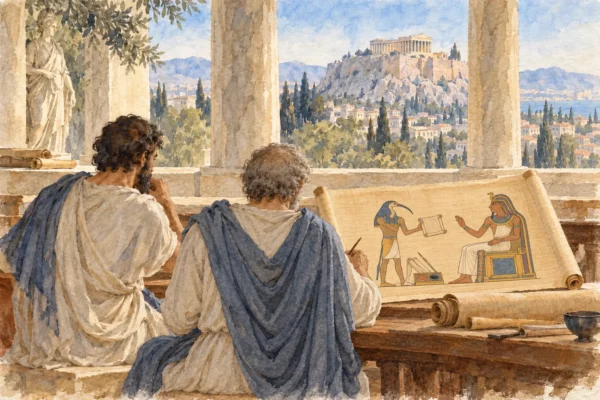
The Word and the reed pen
Ptah creates the world by naming it, Thoth fixes these words in signs, Seshat sets them in order: the account Egypt gave itself of its own writing.
Read the articleFive thousand years of Egyptian writing in thirteen articles: from the myth of Thoth to the first signs, from hieroglyphs to Demotic, from oblivion to decipherment, and on to digital tools and artificial intelligence.
The first article and the last answer each other: Thoth, master of the ‘divine words’, opens the series; artificial intelligence, a new memory outside ourselves, closes it. In between come the archaeology of the first signs, three millennia of use, oblivion and then decipherment.
Ptah creates the world by naming it, Thoth fixes these words in signs, Seshat sets them in order: the account Egypt gave itself of its own writing.
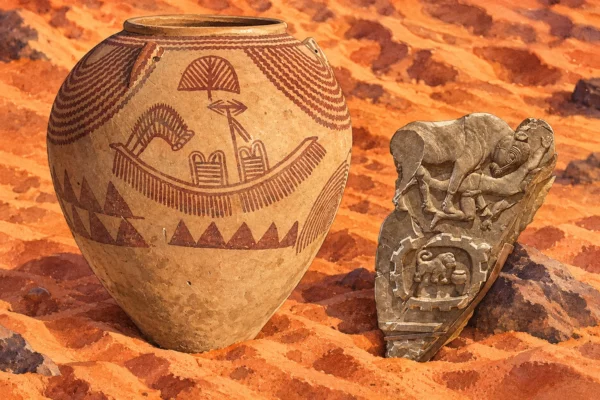
Read the articleOn Naqada vases, boats, emblems and gestures recur: a repertoire of coded images from which writing would emerge.
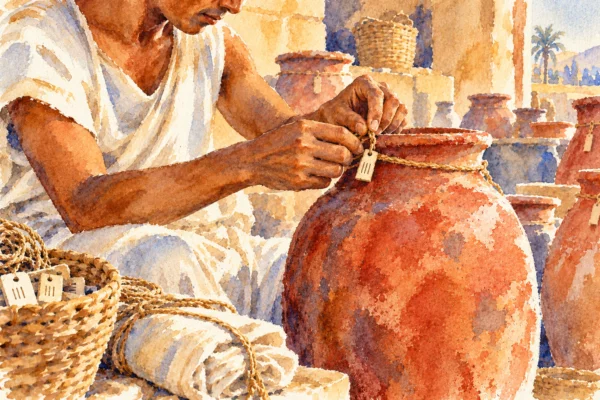
Read the articleFrom the labels of tomb U-j to the Narmer Palette: Egyptian writing was born to count, to attribute and to name.
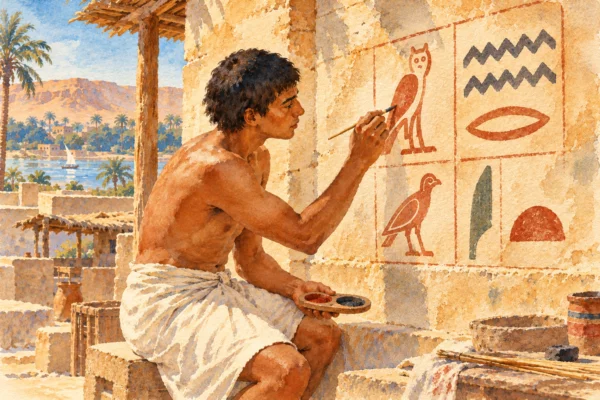
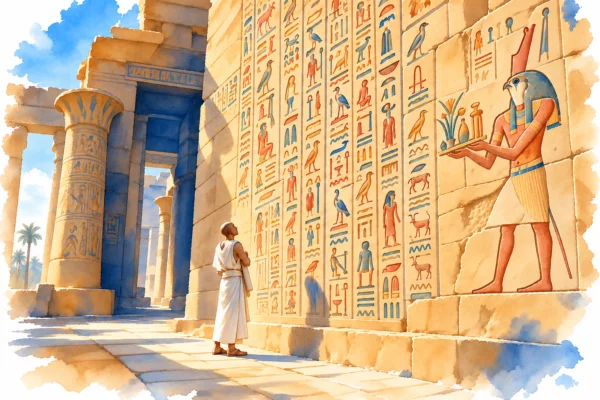
Read the articlePhonograms, phonetic complements, ideograms, determinatives: the four families of signs in a script that records both sound and meaning.
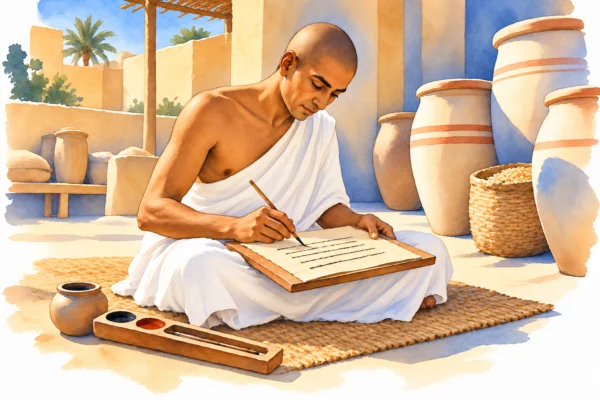
Read the articleHieratic, abnormal hieratic, Demotic: the scribes’ cursive scripts, from Cheops to the last graffito at Philae.
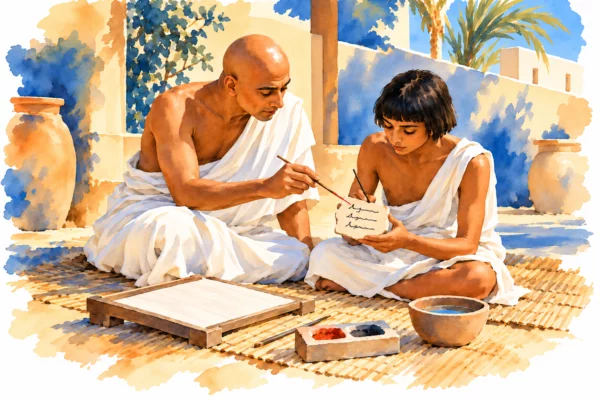
Read the articleWho learnt to write, where, with which textbooks, and how many Egyptians could read? The world of the scribes, from school to the House of Life.
Read the articleUnder the Ptolemies and the Romans, hieroglyphs grew from 800 to several thousand signs: a script that became a body of priestly knowledge.
Read the articleFrom the last hieroglyphic inscription at Philae, in 394, to Coptic: how Egyptian writing slowly faded away.
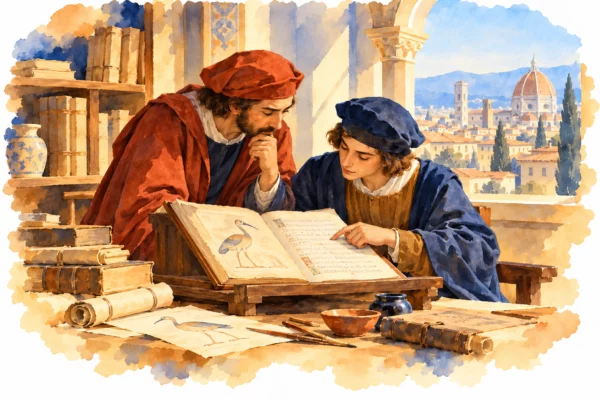
Read the articleFrom the Greek writers to Kircher, hieroglyphs read as symbols: the story of an error that lasted thirteen centuries.
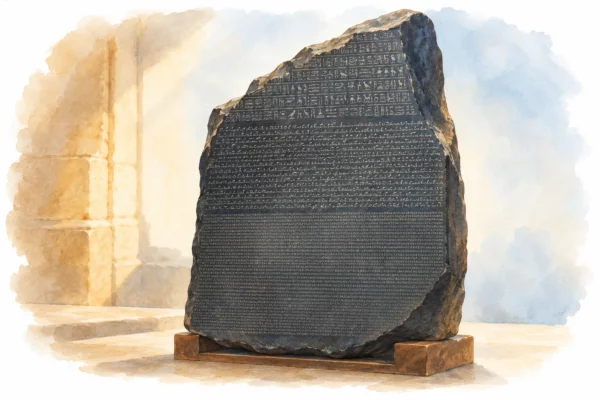
Read the articleFrom the discovery of the Rosetta Stone in 1799 to the Lettre à M. Dacier in 1822: Young, Champollion and the key to hieroglyphs.
Read the articleLepsius, Brugsch, Mariette, Maspero, the Berlin dictionary, Gardiner and the IFAO: a century to turn Champollion’s key into a science.
Read the articleThe Manuel de codage, Unicode, online corpora and new imaging techniques: how computing has changed the study of Egyptian texts.
Read the articleAI does not decipher hieroglyphs; it helps us read them faster: what it can do, its limits, and the challenge of cursive scripts.
Read the article