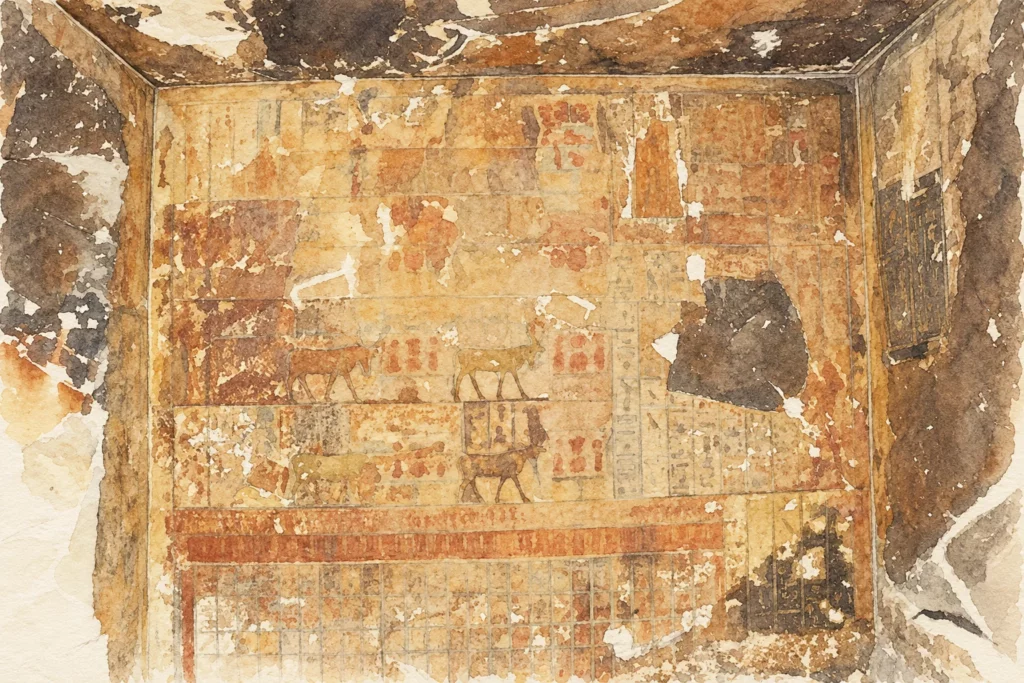
The second pillared room extends the great spaces of the entrance. As one passes its door, a text of welcome addresses those who enter the tomb. Inside, chapters of the Book of the Dead continue the preparation of Padiamenope for the other life.
Words for acting after death
The Book of the Dead brings together formulas that allow the dead to overcome obstacles, keep their faculties and obtain a place among the blessed. This modern title can give the impression of a continuous narrative. In the tomb, one should rather look at selected compositions, each with an action to perform and sometimes an image that clarifies its meaning.
Room II takes part in this programme. The name of Padiamenope gives the texts their recipient: the inscribed words must act for him. The very form of the hieroglyphs, carefully studied today, bears witness to the transmission of traditions much older than their carving.
A room that became a workplace
The first rooms also have a long history of storage. Room II now houses crates and blocks that the mission is sorting and studying. These objects belong to the work of reconstructing the damaged decoration; their present arrangement does not correspond to the ancient furnishings.
The detail of the formulas on each wall remains to be reconstructed. What can already be recognised is the continuity between an architecture of welcome, texts intended for the dead and writing offered to the eyes of the living.
A man represented among the words
The fragments make it possible to recover the presence of Padiamenope in the decoration. A block from the south wall preserves his arm; another, attached to the inner lintel of door III, belongs to his figure. These remains give the room a human substance: the writing surrounded a man depicted in the spaces that prepared his survival.
The thresholds also contribute to this presence. Between II and III, a small block bearing a portrait has been put back in its place in the wall. An isolated image in the debris thus regains a relationship with a door, a direction and an inscribed whole. The portrait recovers a function in the welcome and in the memory of the owner.
These discoveries show what could be seen when walking through the room: words, images and gestures associated with the name of the dead man. The tomb brought together complementary supports to preserve his identity and allow him to act.
The presence of offerings
On the side walls of room II, fragments of offering bearers give another image of this sustained life. One holds a duck; another carries a bunch of papyrus. Remains of columns of a Pyramid Texts formula have also been identified on the south side. The objects carried belong to the concrete world of the provisions made for the dead: food and plants become signs of the continuity of the cult.
Their presence is a reminder that the formulas of the Book of the Dead belong to a larger whole. Survival requires knowing the gods and crossing their domains, but also receiving the care and resources that sustain a person. The images of offering make these necessities visible.
To look at II, one must therefore combine the grandeur of the room with these sometimes tiny details: an arm, a face, part of an object. They make it possible to recover the actors of a decoration that is now fragmentary. The library inscribed in the stone also remains the place where Padiamenope makes himself seen and served.
Sources and references
2021 report, §§ 58 and 66; BSFE, fig. 1 and p. 62.
Traunecker and Régen, BSFE 193–194, 2016 (in French) · Report of the 2021 season (in French)
Report of the 2019 season, BAEFE, 2020, texts and decoration (in French) · Report of the 2024 season, BAEFE, 2025, figurative and inscribed fragments (in French)