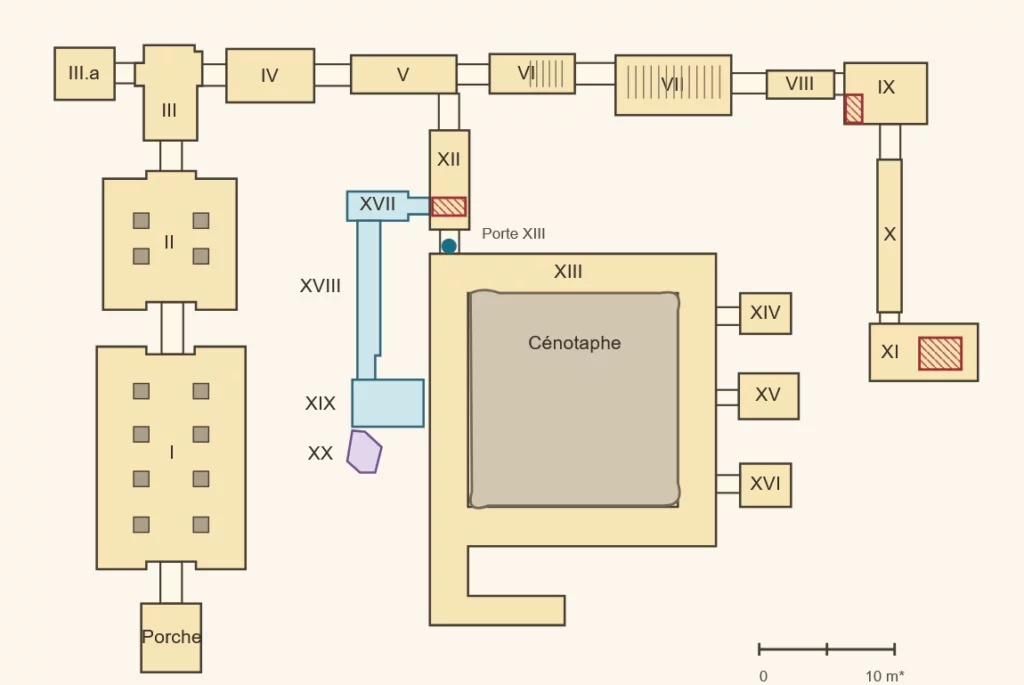
Corridor X descends beneath a vault, between two walls covered with the great offering ritual. Over more than ten metres, the columns of hieroglyphs answer each other face to face. The same long ritual is reproduced on both walls.
Feeding the dead through gestures and words
The offering maintains the relationship between the living and the dead. It brings him the means to continue his existence: food, drink and the services of the cult. The ritual words name and present what is due to him, so as to ensure its efficacy.
The arrangement of the corridor gives this care an enveloping presence. Visitors advance between two versions of the ritual; writing occupies the surfaces that accompany their descent. The monumental repetition shows the importance given to this lasting sustenance.
A sloping passage in the manner of the Old Kingdom
The slope and the form of this passage recall the descending corridor of a 5th Dynasty pyramid. The change is striking after the great staircases inspired by the Ramesside tombs: TT33 brings together in the same rock-cut tomb models separated by centuries.
The 143 columns of the ritual on each wall give this ancient reference a particular scale. Here, the architecture leads to a chamber and the writing ensures the dead man what he will need to live there.
Why double such a long ritual?
Visitors are placed between two inscriptions that repeat the same whole. This repetition gives the passage an exceptional character: the words of the offering are not concentrated in a small niche, but spread over the whole length of the walls that accompany the descent.
The two versions can be seen as two presences of the rite around the dead man. They make tangible the amount of writing devoted to his upkeep. The symmetry also underlines the mastery of the programme: the same long document has been distributed over two surfaces facing each other.
Claude Traunecker sees in it a wish to impress the visitor, in addition to the ritual efficacy expected. This proposal sheds light on the scale of the arrangement. The monument can be both intended for the dead man and designed to show the living the wealth of knowledge gathered for him.
Turning a service into a lasting resource
The offering involves familiar realities: bringing something to drink and eat, presenting objects, speaking the words that consecrate them. In the tomb, these gestures are set in a different time. The inscription must prolong their effect when the people who performed them have gone.
The body of the dead man and his presence in the cult need this continuity. Receiving an offering means keeping a relationship with the world of the living and with the order of the gods. Food becomes one of the means of maintaining a person beyond his disappearance.
In the corridor, the slope leads to a chamber that takes up ancient forms. Words and architecture therefore pursue a single project, with complementary functions: preparing a dwelling and making existence possible there. The material care given to the excavation finds its equivalent in the textual care given to the sustenance of the dead.
The close-set columns make this care almost measurable to the eye. One sees the length devoted to a single need, to eat and to receive. The tomb gives this ordinary necessity a solemn scale, because the future existence of the dead man must be able to continue when real supplies become rarer or cease.
Sources and references
BSFE, p. 62; plan and sections, figs 1–2.
Traunecker and Régen, BSFE 193–194, 2016 (in French) · Report of the 2021 season (in French)