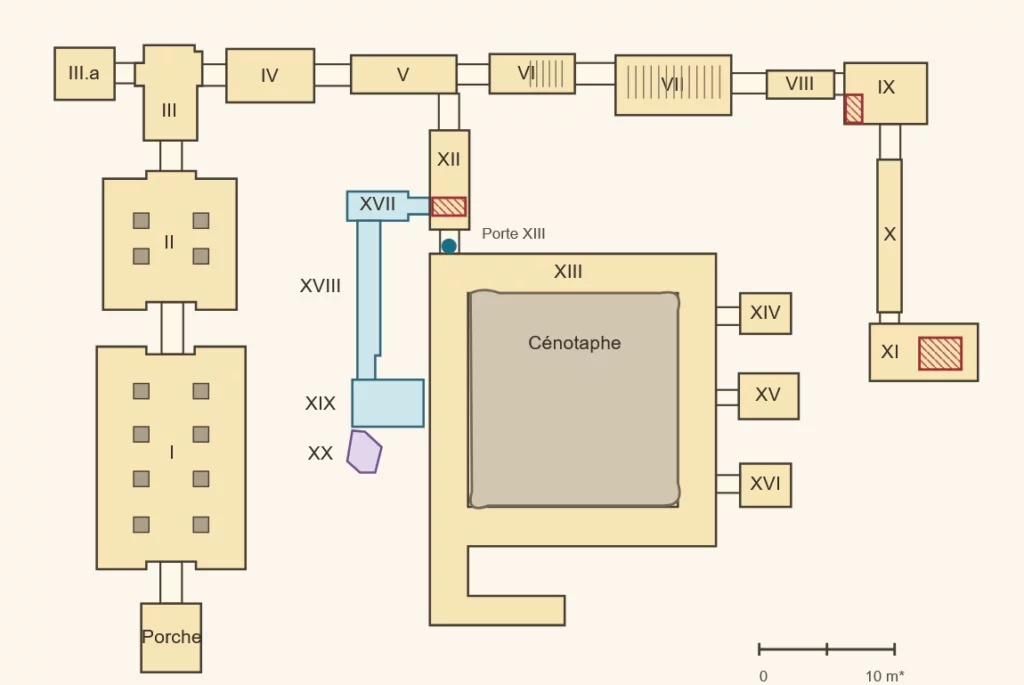
Room XX belongs to the deep levels of TT33. It stands apart from the neighbouring spaces by the absence of a programme of inscriptions comparable to the great funerary books of the tomb. Its precise function remains insufficiently documented, but its place in this monument helps to explain what a room represents when its walls do not offer so developed a narrative.
A difference in the library of stone
The tomb of Padiamenope is famous for its texts. This reputation may lead one to expect, behind each number on the plan, a new composition or a great divine scene. Yet the monument also includes spaces that escape this continuity of decoration.
XX is among the exceptions noted in the epigraphic programme. This observation should be kept in mind during the visit: knowledge of the tomb rests as much on its internal differences as on the abundance of its writing. A room without an identified body of text has an architectural reality, even when its purpose still escapes us.
This singularity is not enough to make XX a storeroom, an abandoned chamber or a workshop. Each of these functions would require its own material evidence. The walls, the openings and any traces of occupation must be studied before saying what happened in this space.
The setting of the Osirian levels
In the same large underground sector, other rooms are devoted to the Book of Caverns and to the awakening of Osiris. These compositions describe the encounter of the sun with the world of the dead, the preservation of bodies and the conditions of their rebirth. They give the depths of TT33 a strong Osirian dimension.
This context helps us to understand the whole in which XX was cut. It does not allow the neighbouring scenes to be transferred to its walls. The awakening of the god and his thirty-six guardians have an attested location in XIX; the great solar programme of the personal burial chamber belongs to XXII.
The distinction between these rooms also matters for the routes. Their proximity on a drawing seen from above does not prove that they are connected by a door. In a tomb organised on several levels, an apparent neighbourhood may correspond to a difference in depth and a thick mass of rock.
What the architecture can still tell
For a room poorly documented by inscriptions, observation shifts to other traces: the shape of the cutting, the dimensions, the thresholds, the relationships with the shafts and the state of the surfaces. These elements usually make it possible to distinguish a circulation space from a chamber, an initial arrangement from a transformation, or a completed project from an interrupted one.
In the case of XX, the detail of this reading remains to be established. One can nevertheless see why a study of the rock matters as much as that of the hieroglyphs. The monument preserves the decisions of its builders in its volumes, its divisions and its changes of level.
Room XX therefore keeps a share of the unknown. It recalls that the experience of TT33 includes abundant images and quieter rooms, whose role will have to be clarified by study. Respecting this difference gives the visitor a faithful picture of the monument, while providing the keys to understanding the questions still open.
Nor does the absence of a large identifiable text, on its own, allow a date of cutting or a phase of abandonment to be fixed. Such a history must be established from the traces in the monument. The distinction between observation and hypothesis therefore remains essential to understanding this room.
Sources and references
Isabelle Régen, BSFE 210, 2024, pp. 69–91, note 30 (in French); Traunecker and Régen, BSFE 193–194, 2016, figs 1–2, pp. 54–55, and p. 72 (in French); University of Strasbourg, presentation of the epigraphic project of 18 February 2011 (in French).