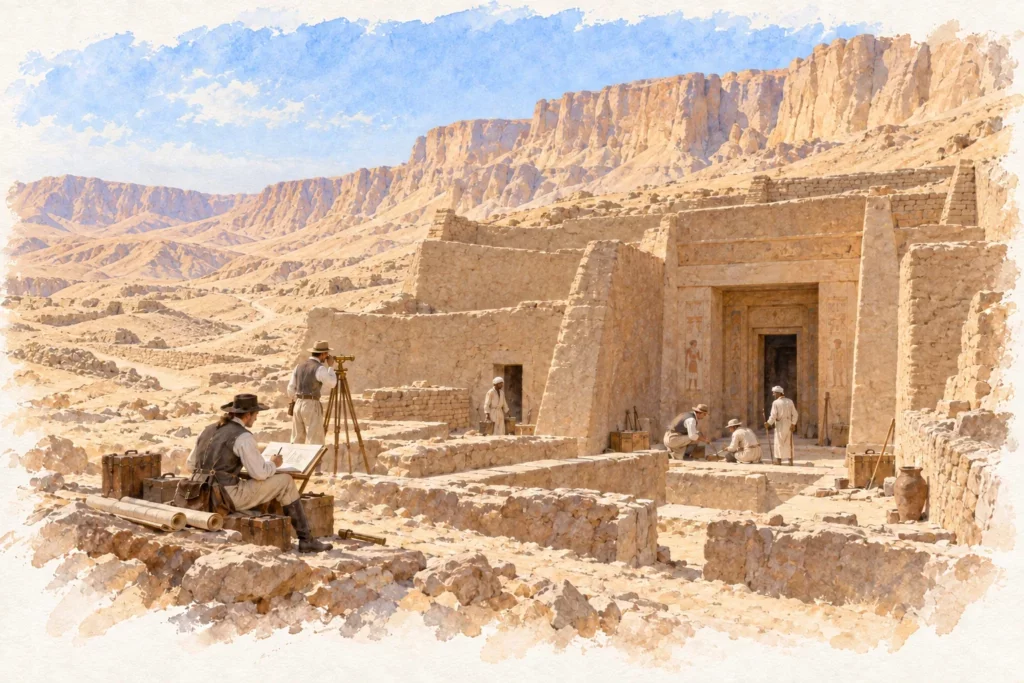
In the Asasif, on the west bank of Thebes, tomb TT 33 bears witness to a time when Egyptian scholars were re-examining very ancient traditions. Its owner, the lector priest Padiamenope, lived at the turn of the 25th and 26th Dynasties, in the 7th century BC.
A monument at the foot of Deir el-Bahri
The tomb lies in the necropolis of the Asasif, at the foot of the cliffs of Deir el-Bahri, not far from the temple of Hatshepsut. It belongs to the funerary landscape of the west bank, where monuments of different periods stand side by side. On the timeline, it sits at the transition between the Third Intermediate Period and the Late Period.
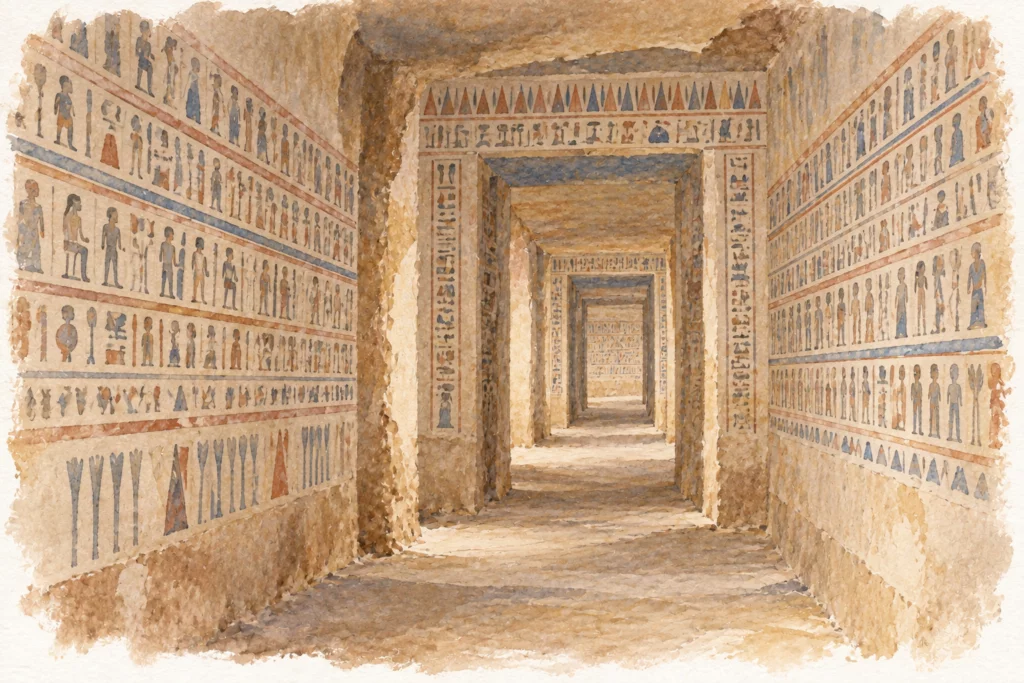
TT 33 stands out for the extent of its underground spaces and the scale of its written decoration. It is not a royal tomb. It was designed for a lector priest, a specialist in texts and rituals. The inscriptions covering its walls invite us to see the tomb as a place for the transmission of knowledge, as much as a funerary monument.
Ancient texts, reread and reorganised
In the tomb, researchers study funerary compositions known from other monuments and manuscripts. Their presence here does not mean that Padiamenope simply copied a frozen past. On the contrary, the choice, arrangement and variants of the texts show intellectual work. The tomb thus allows us to follow the circulation and transformation of religious traditions over a very long period.
This richness should not make the open questions disappear. We know the programme of the tomb far better than the life of its owner. His titles and monuments shed light on his place in the learned circles of Thebes; they do not amount to a complete biography. Distinguishing what the inscriptions say from what we imagine remains essential.
A tomb studied for centuries
European travellers described TT 33 long before the birth of modern Egyptology. The scholars of the Description de l’Égypte made a survey of it, then Jean-François Champollion identified Padiamenope in 1829. Today’s missions take up the file with other methods: epigraphic recording, study of the spaces and conservation of the walls. Each season refines the reading of a monument whose exploration is far from complete.
TT 33 thus offers a good way into this subject: a place set in a precise period, yet one that points to older texts, to the history of Thebes and to the way we build our knowledge today.
Explore TT33 room by room
Open the clickable plan and the rooms of Padiamenope’s tomb.