New Description de l’Égypte
From the Rosetta Stone to the temples of Philae, the same journey, two centuries apart.
Finding Egypt in the pages of the Description
The journey begins in front of a black stone found near Rosetta, then within the walls of Cairo and at the foot of the pyramids of Giza. From there, let us sail up the Nile towards the cities and the great sanctuaries, as far as the islands of the First Cataract. The Description de l’Égypte goes with us. In its texts, the scholars of the expedition pause before a portico, enter a tomb, follow an enclosure wall of which sometimes only a few courses remain. They describe what they see and try to understand what eludes them.
At the time of the expedition, hieroglyphs had not yet been deciphered. On the walls, kings make offerings to the gods, processions cross the halls, inscriptions cover the stone. The scholars patiently record their forms, but much of their meaning remains out of their reach. Their questions, their comparisons and their mistakes belong to this encounter with a civilisation whose language was still to be recovered.
It is these period texts that we enter first. Their descriptions give the monuments back their surroundings, their neighbours, a state that has sometimes disappeared. They invite us to look at what familiarity with a famous photograph can end up making us forget: the path that leads to the temple, the position of a gateway, a ruin set apart. From one place to the next, we rediscover an Egypt observed two centuries ago.
Returning to Egypt, two centuries later
Let us now return to the same stones, with what we have learnt since. The signs copied from the walls have become texts that we can translate. A name allows us to recognise a ruler; a dedication sheds light on the history of a building; an offering scene takes its place in a cult whose words are now accessible to us. The figures are no longer alone: we can also hear what the inscriptions say about them.
Beneath the floors and around the monuments, excavations have found other states of these places. They reveal earlier buildings, transformations and districts that the first surveys did not show. Dates are becoming more precise, identifications are changing, old hypotheses are giving way to new discoveries. Elsewhere, the monument has disappeared and the old description preserves what we can no longer see.
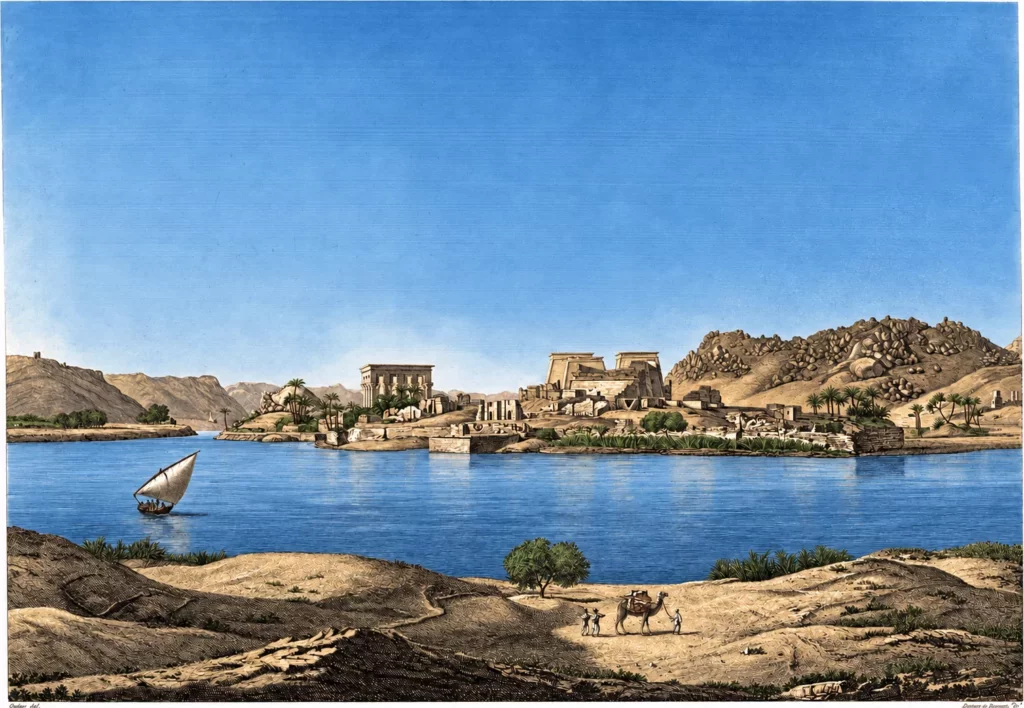
At Philae, the temples now stand on Agilkia, after being dismantled and moved during the rescue of the monuments of Nubia. Reading the old pages in front of the rebuilt buildings also means rediscovering the island and the landscape that surrounded them. Knowledge has changed; the places have their own history, made of discoveries, losses and rescues.
This is the journey of The New Description de l’Égypte, in two stages: discovering each place through the period texts, then returning to it with the translations, excavations and research that have renewed our understanding of it. Between these two encounters, the same monuments tell us more. Some riddles are solved; others still await us.
References: LMU Munich, interview with Friedhelm Hoffmann, 2022; UNESCO, the rescue of the monuments of Nubia.
Eight ways into Egypt, from the pyramids to Philae
Sixty-one narratives follow the scholars of the expedition, from the Rosetta Stone to Cairo and the pyramids of Giza, then up the Nile as far as Philae. Each narrative first lets us hear the texts of the Description de l’Égypte, then returns to the same places with what we know today. The narratives are available in French for now.
Further reading
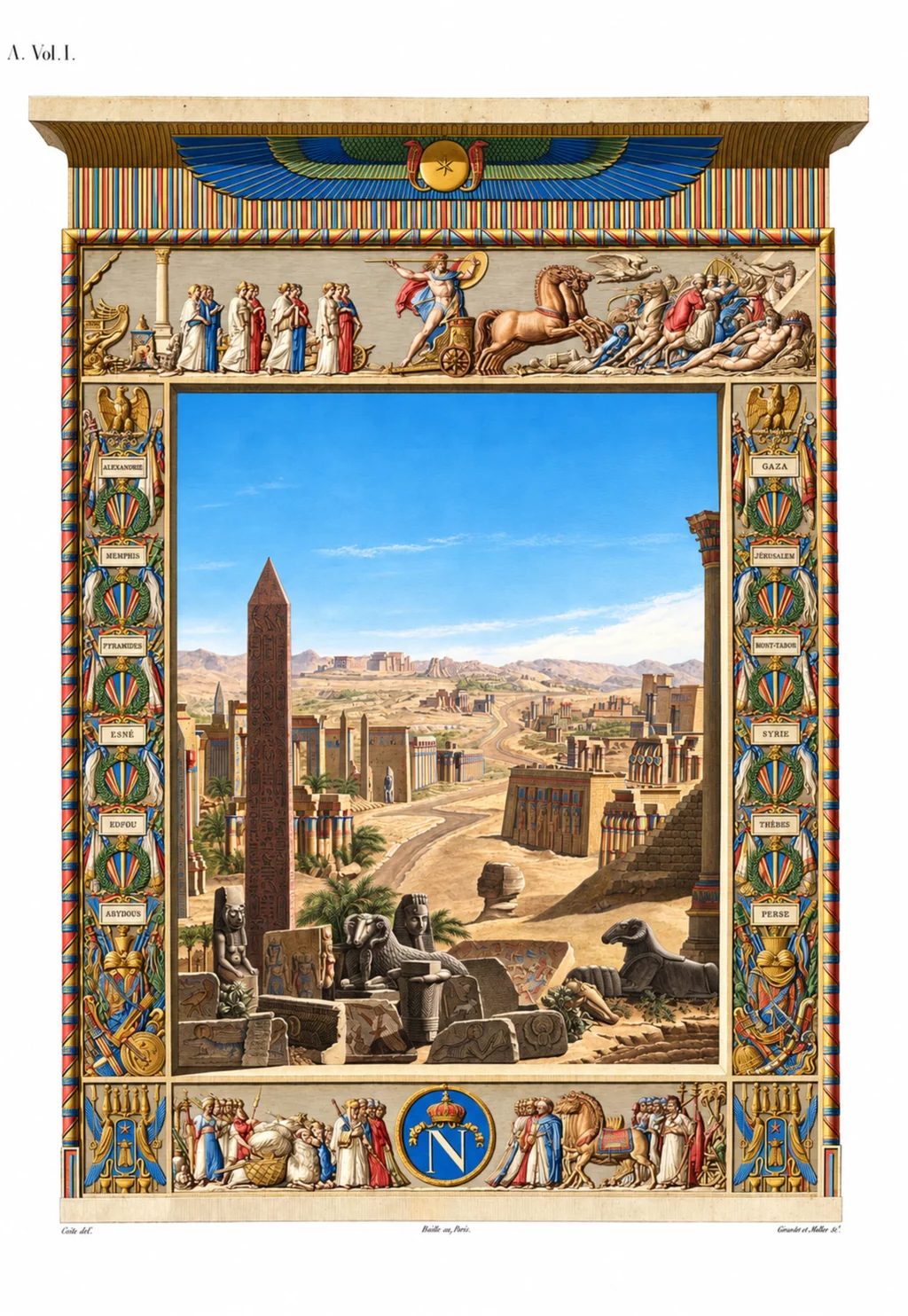
- Description de l’Égypte, second edition: the Antiquités descriptions and memoirs, the explanation of the plates and five volumes of the atlas.
- The Description de l’Égypte: discover the work and its context on Visite Égypte.
- Bibliotheca Alexandrina: consult the digitised collection of the work.
- UNESCO: the rescue of the monuments of Nubia.
Most of the illustrations in this series are illustrative colourings made with AI from the early engravings; a few engravings are left in black and white. The colours suggested are not an attested reconstruction of ancient polychromy. Two images, for Oxyrhynchus and Akhmim, are illustrative creations drawn from the text, for want of a corresponding plate.