In brief
TT 33, in the Theban Asasif, is the tomb of Padiamenope, a lector priest of the end of the 25th Dynasty or the beginning of the 26th, in the 7th century BC. The Institut français d’archéologie orientale (IFAO, French Institute for Oriental Archaeology) describes it as the largest monument in the Asasif, and its concession marks the limits of those of the neighbouring excavations. It is a source of the first order on the funerary practices and religious thought of this period.
What you discover
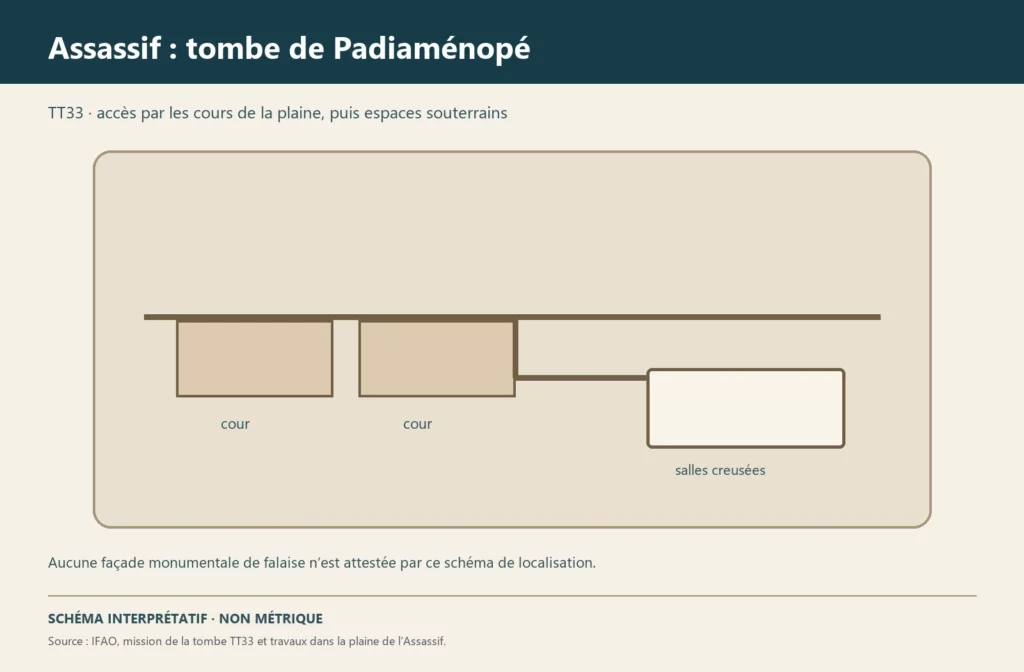
The tomb reaches a linear extent of 322 m, within an enclosure of 9,504 m². It extends over four levels, down to 21 m below the surface of the desert, and has 22 rooms and corridors. The decorated surface covers 2,622 m². This underground route is nothing like a simple corridor leading to the body: many walls bear texts, and the IFAO speaks of a library inscribed on the walls.
What to look at
The walls combine several great funerary compositions: the Book of the Dead (chapter 62, cited by the IFAO), the Amduat, the Book of Gates, the Book of Caverns, Pyramid Texts and the Book of the Opening of the Mouth. The presence of extracts from the far older Pyramid Texts in a private tomb of the 7th century BC points to a learned choice of texts from the past. It does not make the tomb a monument of the Middle Kingdom or the Old Kingdom.
Its history
Johannes Dümichen undertook the systematic study of the tomb around 1869 and published its texts in 1884–1885. The IFAO missions began in 2004; Claude Traunecker and then Isabelle Régen (2003–2007) took part in the research, and Silvia Einaudi studies the texts of the Book of the Dead. The blocking wall was demolished in December 2005, opening access to rooms that had until then been inaccessible. The seasons take place in January and February.
TT 33 belongs to a necropolis where the high dignitaries of the institution of the Divine Adoratrices had monumental tombs cut, such as Montuemhat (TT 34), Harwa (TT 37) and Akhimenru (TT 404). The Asasif, occupied from the Middle Kingdom to the Roman period, saw its great expansion in the Third Intermediate Period. A new IFAO mission, directed since 2016 by Frédéric Colin and Cassandre Hartenstein, excavates there every autumn. The tombs of the Asasif span more than two millennia, from the 11th Dynasty to the Roman period, so the phases must not be confused. For TT 33, the IFAO mentions underground rooms and a library on the walls, an image that holds for the scale and variety of the texts. Comparisons with the neighbouring tombs shed light on the context without allowing their plan to be copied onto TT 33.
Sources
Consulted on 30 September 2026: The tomb of Padiamenope (TT 33), Institut français d’archéologie orientale (in French); The Asasif, Institut français d’archéologie orientale (in French).
Explore TT33 room by room
Open the clickable plan and the rooms of Padiamenope’s tomb.