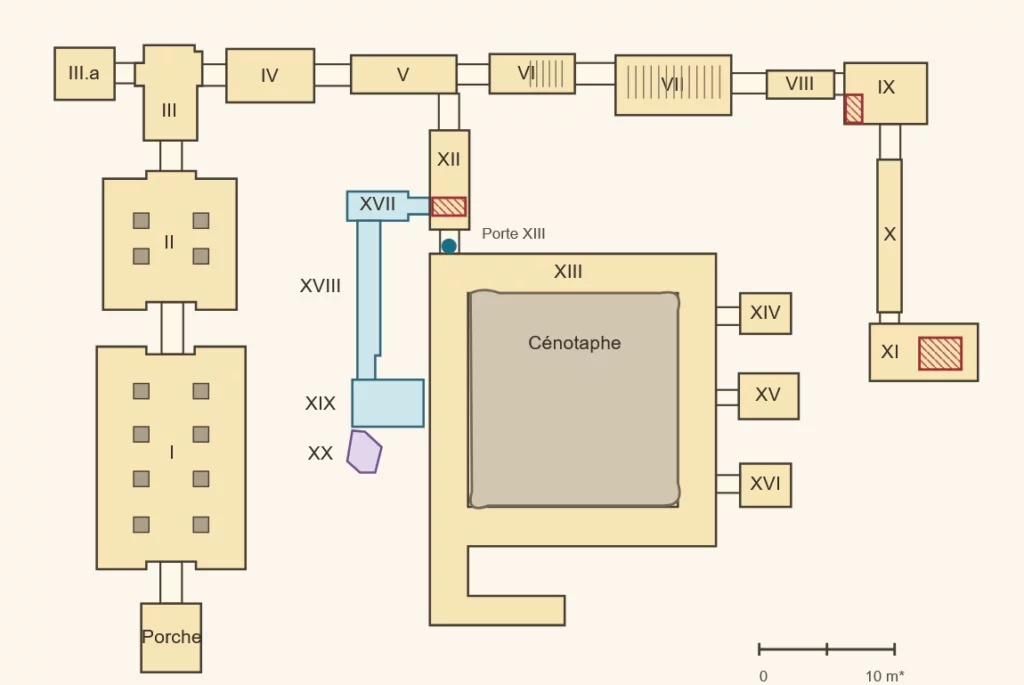
On the back wall of room IX appears the weighing of the heart. The dead man presents himself before the divine judgement; his survival also depends on the worth of his deeds. This scene gives the room its most immediately recognisable subject.
The heart before justice
In Egyptian thought, the heart keeps the memory of the person. At the judgement, the balance confronts this life with Maat, the just order to which gods and humans alike must contribute. The scene therefore does not describe a simple material weighing: it makes visible the examination of a life.
The declaration of innocence of the Book of the Dead accompanies this theme in the room. The dead man lists faults from which he says he is free, before the powers of the tribunal. The words allow him to present himself as someone who can be received among the blessed dead.
A room devoted to admission into the other world
The walls bear several formulas of the Book of the Dead. The judgement is at the centre of their reading, but the decoration also gathers other means of protection and of access to divine life. The texts give the dead man the words he needs to meet the gods and continue his existence.
A shaft opens in the room. Nearby, columns of hieroglyphs continue above the void, which complicates their study today. This detail helps to explain the uneven state of their documentation: some surfaces are preserved but difficult to reach.
The room combines a majestic architecture with a personal question. For Padiamenope to live after death, the rites must sustain his body and the gods must recognise his righteousness.
The declaration of innocence
The negative confession gives the dead man a voice before the tribunal. In it he asserts that he has not committed the faults listed in the formula. This act of speech is part of the judgement: the dead man presents himself as a person whose conduct can be recognised as just.
The word confession can be misleading. What is meant here is a declaration of the absence of fault, made before the powers who examine the dead. The text composes an identity acceptable in the other world and attaches it to the name of Padiamenope.
The Maat to which this identity relates concerns justice and the balance of creation. Human behaviour participates in this order. The judgement thus gives a religious extension to acts that belonged to earthly life: survival also involves a moral responsibility.
A decoration that goes beyond the famous image
The balance naturally draws attention, but the inscriptions of the room extend its meaning. The central declaration and the other formulas of the Book of the Dead belong to a whole that prepares the admission of the dead man to the gods. Parts of the judgement text are also distributed in the approach passage, which extends the programme beyond a single wall.
This organisation makes it possible to understand the room as a place of encounter. The dead man must speak, be heard and obtain a place. The images give faces and gestures to the powers to whom the words are addressed.
The breaks and the difficulties of access near the shaft make the reading uneven today. They should not make this unity of the programme disappear. At the centre remains a man whose heart is put to the test, surrounded by texts intended to ensure him a favourable outcome and an existence among the blessed.
Sources and references
2021 report, §§ 45 and 65; 2024 report, § 26, printed p. 11 / p. 12 of the PDF; BSFE, p. 62.
Traunecker and Régen, BSFE 193–194, 2016 (in French) · Report of the 2021 season (in French) · Report of the 2024 season (in French)