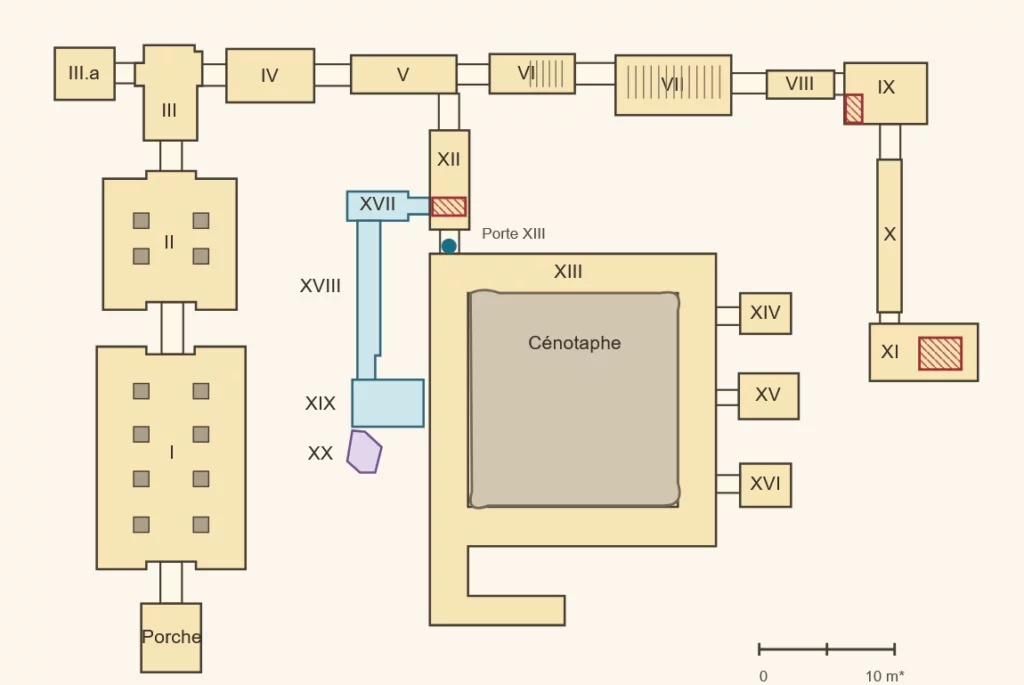
At the centre of the group of three chapels, room XV is devoted to the final equipment of the mummy in the form of Osiris Hemag. This designation refers to an adorned Osiris, prepared for the stage that must follow: the return to life.
A body ready for rebirth
After desiccation and wrapping, the body receives its completed ritual form. The adorned mummy brings together an identity, a protection and a promise of transformation. In funerary thought, the dead man can share the destiny of Osiris, a dead god to whom the rites restore life.
The central position of XV corresponds to this role as culmination. The two neighbouring chapels evoke the preparatory operations; here the state of the body, now able to await its awakening, is affirmed.
Padiamenope in the service of the god
The texts of the group present the priest as officiant and intercessor for visitors. His knowledge allows him to act in the relationship with Osiris. The tomb thus has a dimension of a place of worship, able to receive the expectations of people who came to honour the god.
This preparation finds an echo in the depths of the monument, where a scene shows the awakening of Osiris surrounded by his guardians. Between the two groups unfolds the same hope: a body prepared and protected can return to life.
Adornment as a new state of the dead
Adorning a mummy is not just a matter of completing its appearance. The final equipment expresses the transformation of its status. The treated body becomes that of a protected being, endowed with the means to enter the divine realm. The Osirian form gathers this condition into a recognisable image.
Osiris provides the model of a dead god who can receive life again. The preparation of his body, the action of the protective deities and the words of awakening offer the dead resources to share this future. The Osiris Hemag evoked here is the adorned mummy at the end of the preparatory operations.
The central chapel therefore concentrates an expectation. The body has been preserved and wrapped; it must now be able to respond to the rites that will set it working again. This stage gives unity to the care distributed through the three rooms.
The knowledge of the one who regulates the rite
An epithet of Padiamenope inscribed in the chapel presents him as the one who dispenses the norm according to the method. The formula highlights his authority in the organisation of knowledge and in the way of applying it. It matches the image of a priest who knows the order of the operations and the appropriate words.
In the tomb, this knowledge becomes visible on the walls and in the arrangement of the spaces. The priest can be presented as officiating for the pilgrims while preparing his own future. The two functions meet in a monument placed under the sign of Osiris.
For the visitor, XV thus gives a precise form to the idea of rebirth. It results from a preparation, with stages and competences. The expected resurrection depends on the care given to the body, its protection and the correct performance of the rites. The adorned mummy represents a being prepared to receive life.
The order of the three chapels must finally be understood as a ritual organisation, rather than as a chain of material work demonstrated on the spot. Their texts give meaning to the stages of the preparation. They do not prove that all the embalming operations on the body of Padiamenope were carried out in these rooms.
Sources and references
2021 report, § 48; BSFE, pp. 63–64 and 72.
Traunecker and Régen, BSFE 193–194, 2016 (in French) · Report of the 2021 season (in French)
Report of the 2023 season, BAEFE, 2024, § 28, epithet of chapel XV (in French)