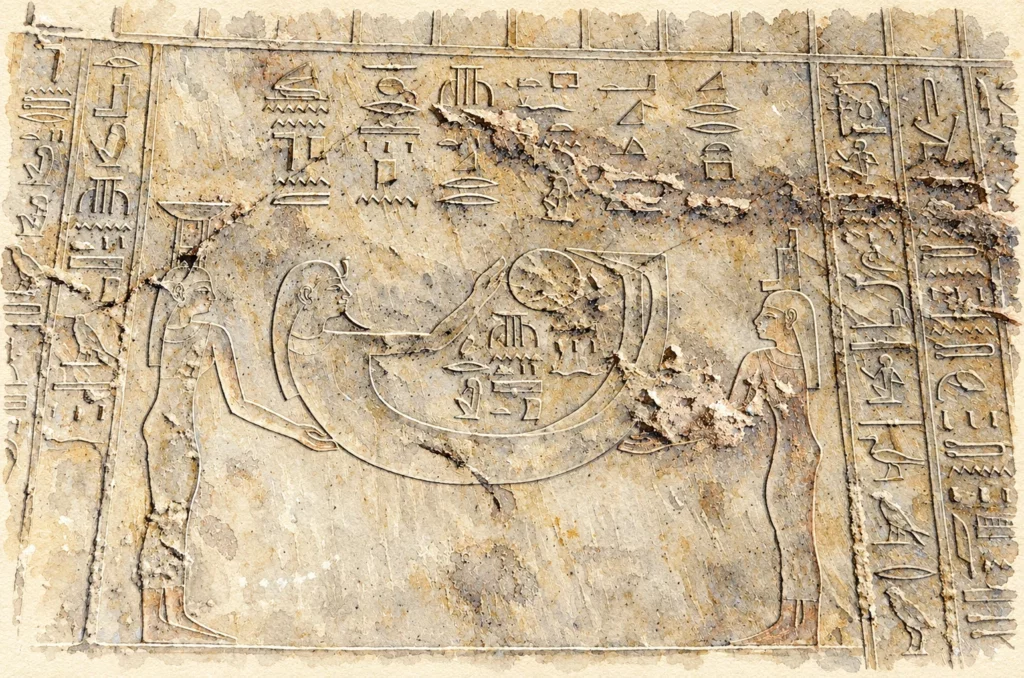
Beneath the vault of room XIX, two groups show life returning. To the north, the Book of Caverns comes to an end. To the east, Osiris awakens, surrounded by thirty-six guardian genies. The room brings together the culmination of a solar journey and the return to activity of the god of the dead.
At the end of the Book of Caverns
The book begun in room XVII has crossed the walls of the corridor before reaching its final scene here. The passage of the sun through the underworld prepares its return to the light. The end of the night becomes the model of an existence that can be renewed.
On the other surviving surfaces, texts and figures show the powers of this world. The photographs show carved scenes, protective forms and tight columns of hieroglyphs, with considerable losses of material in places.
Osiris surrounded by his guardians
The eastern programme is devoted to the awakening of Osiris. The thirty-six guardians form a protective group around him. The god, prepared, preserved and wrapped, can regain activity: the care of mummification finds its fulfilment here.
The image gives meaning to the destiny Padiamenope hoped for. Like Osiris, the dead man must be protected from destruction and restored to life. The decoration does not merely evoke a doctrine; it presents the actors and the conditions of this transformation.
A wide shaft almost six and a half metres deep opens in the floor. The depth of the monument continues beneath this chamber, towards the Osirian vault and the priest’s secret sector.
Thirty-six powers around the god
The number of guardians adds to the force of the eastern image. Osiris is surrounded by an organised group of protective presences. Their role is to defend and accompany the god at the moment his activity returns. The awakening thus appears as an event supported by several actors.
This protection answers the fragility of the dead body. Its integrity must be maintained, attacks repelled and the rites performed allowed to take effect. The image unites preservation and transformation, two conditions of survival in Egyptian funerary thought.
The thirty-six guardians on this wall must be kept distinct from another series present in Padiamenope’s personal burial chamber. The repetition of the theme in the monument shows its importance, but each version has its own location and setting.
Awakening after preparation
The programme of the room takes on a particular value once one knows the Osirian operations evoked in the chapels of the main level. The body has been dried, wrapped and adorned. The image of the awakening shows what this preparation makes possible: the dead man is no longer merely preserved, he can regain a form of activity.
The Book of Caverns also leads towards an outcome of renewal. The final scene to the north and the awakening to the east combine two expressions of the same hope, the return of the sun and that of divine life. Their distinct locations show how the decoration articulates these themes.
In this deep room, funerary expectation thus receives precise figures. A god awakens; guardians surround him; the sun completes its night journey. The tomb gives Padiamenope the models and protections to which he entrusts his own survival.
The opening of the shaft adds another presence to the room: beneath the images of the awakening, the rock continues to descend. This material depth belongs to the real monument, distinct from the regions depicted by the book, even though both contribute to the impression of an organised underworld.
Sources and references
BSFE, p. 72; 2021 report, §§ 23–43 and 48.
Traunecker and Régen, BSFE 193–194, 2016 (in French) · Report of the 2021 season (in French)
Daniel A. Werning, The Book of Caverns in Theban Tomb 33: Arbeitsphotos, Edition Topoi, 2018. Location of the scenes: BOCA records 0001–0017 (XVII), 0018–0033 and 0043 (XVIII), and final scene 0073 (XIX).