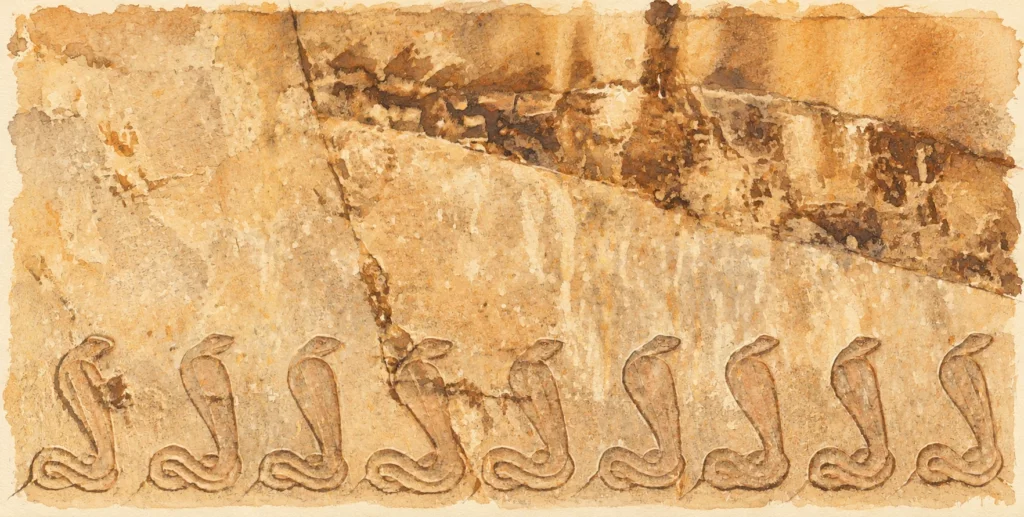
Room XVII introduces the Book of Caverns into the depths of TT33. On its west wall are the introductory text and the first surviving scenes of the composition. Other scenes occupy the south wall: the book unfolds in the room before continuing in the following spaces.
Light enters among the dead
The Book of Caverns describes the passage of the sun through the underground regions. It meets the beings who dwell there, addresses them and brings them its life-giving power. The world of Osiris holds a central place in it: the motionless body of the god and the movement of the sun take part in the same regeneration.
The images and the columns of text must be looked at together. The figures represent the inhabitants of these regions, while the words name their states, their needs and the action of the god. The decoration gives form to a universe whose powers the dead must know.
Scenes carved in a wounded rock
The photographs of the walls show unevenly preserved surfaces. Groups of signs remain legible beside shattered areas; some scenes survive on only part of the wall. This fragmentation can make them less immediately readable than a complete modern drawing.
The room nevertheless preserves the beginning of a great visual and ritual narrative. In this entrance to the book, the depth of the tomb becomes the setting for an encounter: the light of the sun comes down to the dead to allow their renewal.
A world organised around the solar encounter
The Book of Caverns does not present the afterlife as an empty space. It peoples it with beings in different states: some await the benefit of the passage of the sun, others manifest the forces opposed to the divine order. The scenes make these differences visible, while the words explain the relationships between the god and those he meets.
The body of Osiris is one of the centres of this thought. The solar power and the god of the dead take part in a regeneration from which the dead man hopes to benefit. The movement of the light answers the apparent immobility of the bodies preserved in the underground regions.
The beginning of the composition on the west wall thus gives access to knowledge. The images must make it possible to recognise the powers, and the texts to understand their role. Having this whole inscribed in the tomb amounts to setting around the dead man the resources needed for his new condition.
Figures inseparable from their captions
A funerary scene may seem enigmatic when one looks only at the silhouettes. A posture, a covering or a protective form takes on its meaning in the inscriptions that accompany it. The Book of Caverns closely associates drawing and word to give an organisation to the invisible world.
In XVII, the fragmentary preservation sometimes makes these relationships hard to follow. An image may remain recognisable while its text is mutilated, or a few columns may survive beside a damaged scene. The photographs help to observe this reality without replacing it with an ideal version.
The room nevertheless preserves the starting point of a great religious development. The sun sets out into the world of the dead; its presence makes possible what seemed halted. For Padiamenope, this awaited coming of the light offers a way of thinking about his own existence in the depths of the tomb.
Sources and references
BSFE, p. 72; plan and sections, figs 1–2.
Traunecker and Régen, BSFE 193–194, 2016 (in French) · Report of the 2021 season (in French)
Daniel A. Werning, The Book of Caverns in Theban Tomb 33: Arbeitsphotos, Edition Topoi, 2018. Location of the scenes: BOCA records 0001–0017 (XVII), 0018–0033 and 0043 (XVIII), and final scene 0073 (XIX).