TT33: exploring the tomb of Padiamenope, room by room
At El-Asasif, on the west bank of Thebes, Padiamenope had a tomb cut in which several Egyptian ways of hoping for a life after death meet. Here you see funeral scenes, words to feed and protect the deceased, the judgement of his deeds, the night-time journey of the sun and the rebirth of Osiris. Images and hieroglyphs give these hopes a presence in the stone.
A tomb that gathers the memory of Egypt
Padiamenope is a lector priest of the seventh century BC: his profession makes him familiar with texts and their use in rites. In the first rooms, the Book of the Dead accompanies the passage of the deceased into the other world. Further on, some rooms recall the apartments of the Old Kingdom pyramids and take up their spells. Monumental staircases then call to mind the royal tombs of the Ramesside period. This variety makes sense when you look at what each space seeks to achieve. One gives the dead man back his faculties of seeing, speaking and eating; another ensures him offerings; elsewhere, he presents himself before the divine tribunal. The ancient texts are adapted to Padiamenope, whose name and image take their place among the gods.
Choosing a room
The interactive plan opens the notice for each space. Shafts are marked with hatching: they link levels set one above the other. The deep rooms shown in colour lie below the main level. North points to the right, slightly downwards. For now, the plan and the article for each room are published in French.
Open the interactive plan (in French)
The first spaces: recovering a living body
In room I, a funeral scene shows the Opening of the Mouth in front of the tomb. This ritual also fills room V: the gestures and words are meant to give the deceased back the use of his senses and his body. Between these two spaces, rooms III and IV take up the Pyramid Texts. Their spells call on the dead man to rise and join the gods. The monumental descent then leads to room IX. On its back wall is the weighing of the heart: the deceased must be recognised as just. Corridor X brings him another necessity, food. On its two walls, the long columns of an offering ritual answer each other. At the end, room XI protects the dead man with ancient spells and with an architecture that recalls a royal burial chamber.
Around Osiris, a promise of rebirth
Sector XIII surrounds a huge block left in the rock, shaped like a funerary monument of Osiris. Eight goddesses protect its corners. Fifteen false doors and twenty-two small chapels peopled with divine images bring its faces to life. Walking around this cenotaph lets you follow the acts of protection and transformation of the deceased. On the walls of the corridors, the sun crosses the regions of the night. It gives life back to the inhabitants of the hereafter before being reborn at dawn. The three chapels XIV, XV and XVI recall the preparation of the body of Osiris: drying, wrapping and equipping the mummy, ready to live again. Padiamenope also appears there as officiant, a mediator between visitors and the god. At the threshold of this complex, an inscription welcomes the living, down to generations not yet born. It considers several reasons for coming: to honour a deity, to wander through the necropolis for pleasure or to look for spells. Of each visitor it asks a share: to look, to speak the offering and to take care of the monument. The tomb expects something of those who look at it.
In the depths: the awakening of the god and the priest’s burial chamber
The shaft in corridor XII goes down to rooms XVII to XIX. There, the Book of Caverns describes the underground regions where the sun meets Osiris and the dead. In XIX, the awakening of Osiris, surrounded by thirty-six guardians, gives a precise image of life returning. A second shaft leads to burial chamber XXI, whose recessed walls recall a monumental sarcophagus. A hidden access leads on to XXII, Padiamenope’s secret burial chamber. The twelve hours of the Amduat surround the deceased there: the sun enters the night, crosses it and finds the day again. This daily rebirth gives the priest the model for his own survival.
Seeing the tomb in section
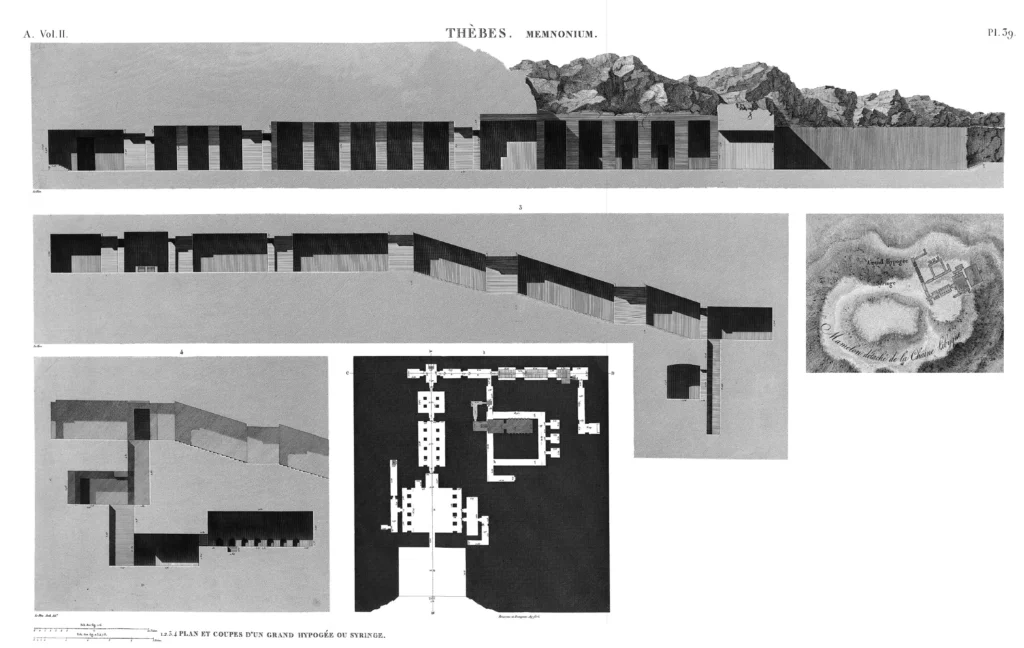
The old sections below make the depths of the monument perceptible. Beneath the rooms reached from the entrance, other rooms were dug, linked by shafts and hidden passages. TT33 thus extends through the thickness of the rock, on several levels.