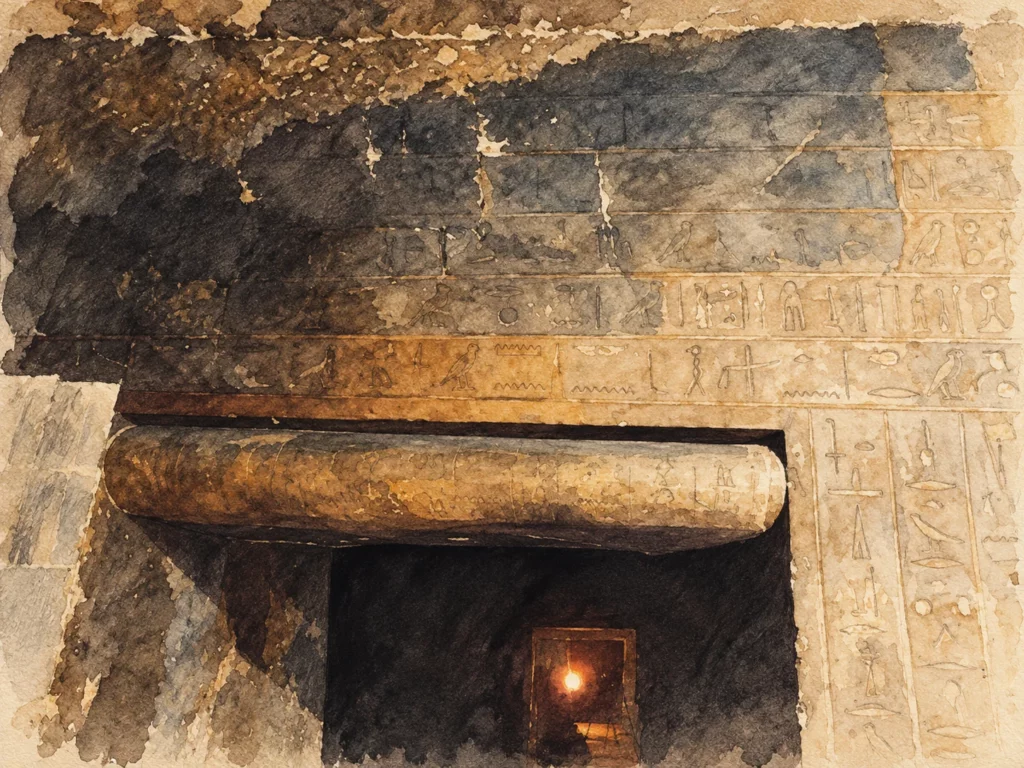
In room III, the columns of hieroglyphs lead into a very distant past. They take up the Pyramid Texts, compositions carved in the royal tombs of the Old Kingdom, more than fifteen centuries before Padiamenope.
An antechamber in the memory of the pyramids
The room belongs to a small group whose layout recalls the inner apartment of a pyramid: an antechamber, a burial chamber and an annexe. Here architecture and inscriptions speak the same language. A priest of the Late Period takes up for his own survival means once deployed around the kings.
On the north and south walls, the formulas of the Pyramid Texts follow one another in columns. This corpus makes the gods speak, calls the dead to leave their immobility and opens to them a future in the divine world. Reading it as a mere collection of sayings would lose its function: each utterance contributes to transforming the state of the dead.
A tradition made present
The room gives this tradition a new home. The ancient formulas are carved in the tomb of a man who made ritual knowledge his profession. Their antiquity gives them authority; their adaptation attaches them to his person.
Visitors therefore see an antechamber laden with writing, whose meaning rests on a meeting between two periods: that of the first great funerary compilations and that of a priest who brings them together to prepare his own eternity.
Words that make the dead leave their immobility
The Pyramid Texts often take the form of addresses. A divine power, an officiant or a ritual utterance addresses the dead in order to change their condition. Language does not merely recount a belief here: it must accomplish what it states, make a movement possible, protect a transformation or ensure an encounter.
This function helps in looking at the columns of the room. Their arrangement gives a lasting presence to the words that accompany the dead man. Even when no ceremony is taking place, the inscription maintains around him a set of actions and relationships with the gods.
The carved formula may come from a distant past while changing its recipient. At TT33, the priest’s name takes its place in a royal heritage. Transmission preserves the authority of the ancient model, but adjusts it to the needs of a man living much later.
Knowledge preserved with its setting
Room III therefore does not gather quotations for their antiquity alone. The antechamber and the associated rooms recreate a funerary setting in which these words recover their force. The volume of a chamber, the presence of an annexe and the organisation of the passages contribute to this revival of the past.
Among his titles, Padiamenope bears that of scribe of the Book of the God, an ancient designation of the corpus we call the Pyramid Texts. This title links his professional identity to the inscriptions around him. The knowledge he possessed in his lifetime becomes a component of his funerary dwelling.
The walls thus display a historical and religious choice: to preserve the resources of the ancients so as to make them active again. The priest receives a place in a divine order whose words had already accompanied generations of kings. His tomb preserves this memory by giving it a new use.
The title of lector priest takes on its full significance here. It designates a competence concerned with the reading and ritual use of writings. Surrounded by these columns, the owner presents himself to posterity in the very domain where he wished his authority to be recognised.
Sources and references
2021 report, §§ 49–54, especially p. 26; BSFE, fig. 1.
Traunecker and Régen, BSFE 193–194, 2016 (in French) · Report of the 2021 season (in French)
Report of the 2019 season, BAEFE, 2020, texts and decoration (in French)