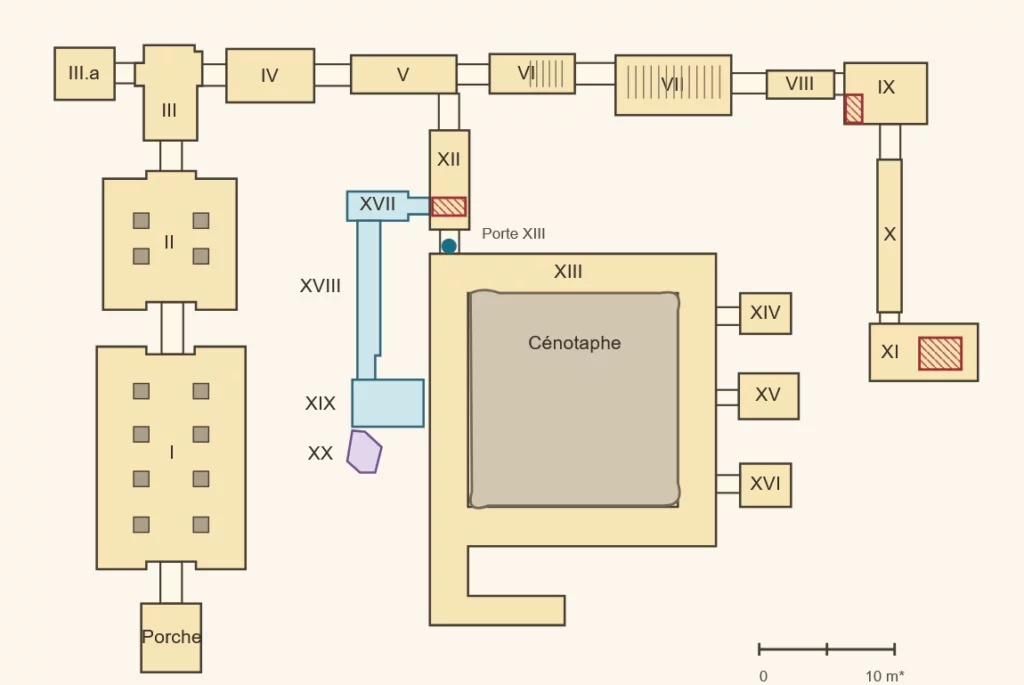
The Mansion of Gold, the ritual name of chapel XVI, is associated with the wrapping of the body. The dried body receives a covering that protects it and gives it the form of the mummy. The room evokes this stage of the Osirian preparation.
Wrapping and holding together
The bandages hold the body together. Putting them in place belongs to a wider operation, accompanied by words and protections, which transforms the dead into a being able to last. The inscriptions link this preparation to the model of Osiris.
The name Mansion of Gold belongs to the vocabulary of the rite. It does not describe walls covered with gold that could be reconstructed in this room. What is certain is the wrapping function with which the texts associate it.
A rite performed by a priest
Padiamenope presents himself in these chapels as the one who officiates and intercedes. His image as a lector priest remains active: visitors can meet him in the function that was his, in the service of relations between humans and gods.
The wrapped mummy has yet to be adorned and then awakened. The wrapping takes its meaning in this sequence of actions, in which each act of care contributes to the integrity and rebirth of the dead.
Giving the body a lasting covering
Wrapping comes after desiccation. The body must keep its unity, but it also receives a ritual appearance that brings it close to Osiris. The bandages take part in this transformation by holding the parts together and forming a protective covering around them.
In the rite, the gesture is not separated from the word. Naming an action, invoking a power and establishing a protection give the operation its religious significance. The mummy is prepared as a being whose integrity must remain assured over time.
This association explains why the chapel belongs to a set of texts as much as to a succession of spaces. It preserves the meaning of a phase of the preparation, within a monument where each operation finds its place in the future of the dead.
Gold in the name of a ritual place
The name Mansion of Gold carries a prestigious value, but it does not on its own describe the material of the walls. It belongs to the language of the places of divine preparation. Visitors can understand it as the name of a realm specialised in a sacred operation, rather than as an inventory of a metallic decoration.
This point helps in looking at the room accurately. It is its name, its inscriptions and its relationship to the wrapping rites that shed light on its function. A reconstruction with gilded walls or sumptuous furnishings would add elements that the name alone does not allow us to establish.
Padiamenope keeps his status as officiant there, with the knowledge needed to prepare the body and intervene before the god. Through this function, he belongs both to the memory of the monument and to the ritual activity it hosts. The Mansion of Gold thus fixes a moment when the care given to a bodily covering becomes a promise of integrity and duration.
The texts placed on the inner faces of the doors contribute to this reading. The threshold does not merely separate two volumes: it bears words about the priest, his functions and the rites of the monument. On entering the chapel, the visitor therefore also meets a presentation of the knowledge that makes these operations possible. The prepared body and the identity of the officiant remain associated in the same space.
Sources and references
2021 report, § 48; BSFE, fig. 1 and pp. 63–64.
Traunecker and Régen, BSFE 193–194, 2016 (in French) · Report of the 2021 season (in French)