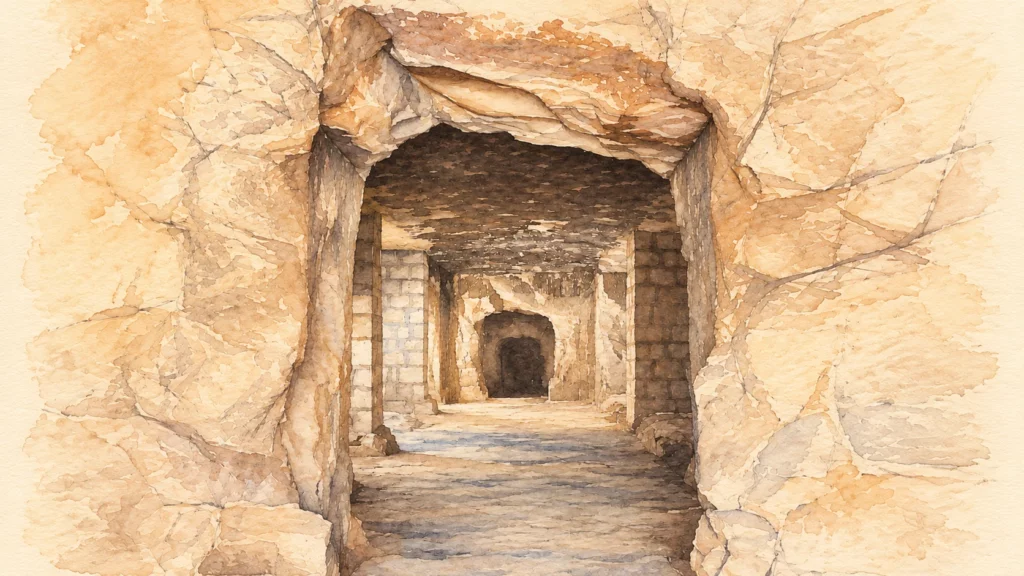
Before the great inscribed rooms, the porch marks the passage between the open courts and the interior cut into the rock. It belongs to a monumental entrance: the tomb of Padiamenope presents itself as a vast funerary complex, with its outdoor spaces and its underground rooms.
On the threshold of the solar hymns
The passage leading to the first room bears hymns to the sun. Their presence at this point links the entry into the tomb with the movement of the sun: after disappearing in the West, it crosses the night and returns to life. For the dead man, this alternation offers a promise of renewal.
The threshold thus introduces one of the great themes of TT33. The sun will return in other forms in the corridors and the burial chamber: a barque travelling through the afterlife, light restoring life to the dead, a star welcomed at its rising. Here, its praise already accompanies the approach to the rooms.
An entrance that changed its use
The porch and the first rooms long served as a store for antiquities found in neighbouring excavations. This use explains part of the modern history of the entrance: while objects accumulated there, the deeper spaces remained closed.
The illustration shows the inner passage between the porch and room I. Beyond it begins a decoration in which the funeral rites and the words of the Book of the Dead take their place on the walls.
The sun at the door of an underground dwelling
The position of the solar hymns deserves attention. The sun belongs to the visible world of the living; the tomb leads to regions that daylight no longer reaches. The rite brings these two realms together by taking as its model the return of the sun after the night. What disappears can reappear, provided the necessary transformation is accomplished.
For an Egyptian, the West is also the land of the dead. The daily disappearance of the sun therefore does not announce only an end: it opens a journey whose favourable outcome is shown by the dawn. The hymns bring this hope into the approach to the monument, even before the great scenes of the inner rooms.
The entrance also links the cult of the dead man to those who come to him. Visitors still have a living body, a voice and the possibility of bringing offerings. Crossing an inscribed threshold means entering a place where their words can serve someone who is no longer among them.
An inner façade of remembrance
The first parts of TT33 have known very different uses since Antiquity. Their conversion into a store long hid the continuity of the inner apartment. These modern accumulations must be distinguished from the ancient project: an entrance followed by spaces intended for the cult, for memory and for the preparation of the dead man.
This history explains why a present-day view does not convey the effect of the monument at a single glance. Clearances, restorations and studies were needed to make the walls and passages legible again. The place of the porch nevertheless remains intelligible: it gives depth to the entrance and prepares the appearance of the great pillared rooms.
Here one can observe how a tomb welcomes the living while preparing an existence that goes beyond them. The threshold belongs to this double use: a person crosses it today; the words that accompany it are meant to last for the dead.
Sources and references
BSFE, figs 1–2, pp. 54–55; door XIII, pp. 65–66.
Illustrations: watercolour drawn from a photograph by S. Nannucci, ‘passage I.1 entre le porche et la salle I’, BAEFE 2021, fig. 3, © IFAO.
Traunecker and Régen, BSFE 193–194, 2016 (in French) · Report of the 2021 season (in French)