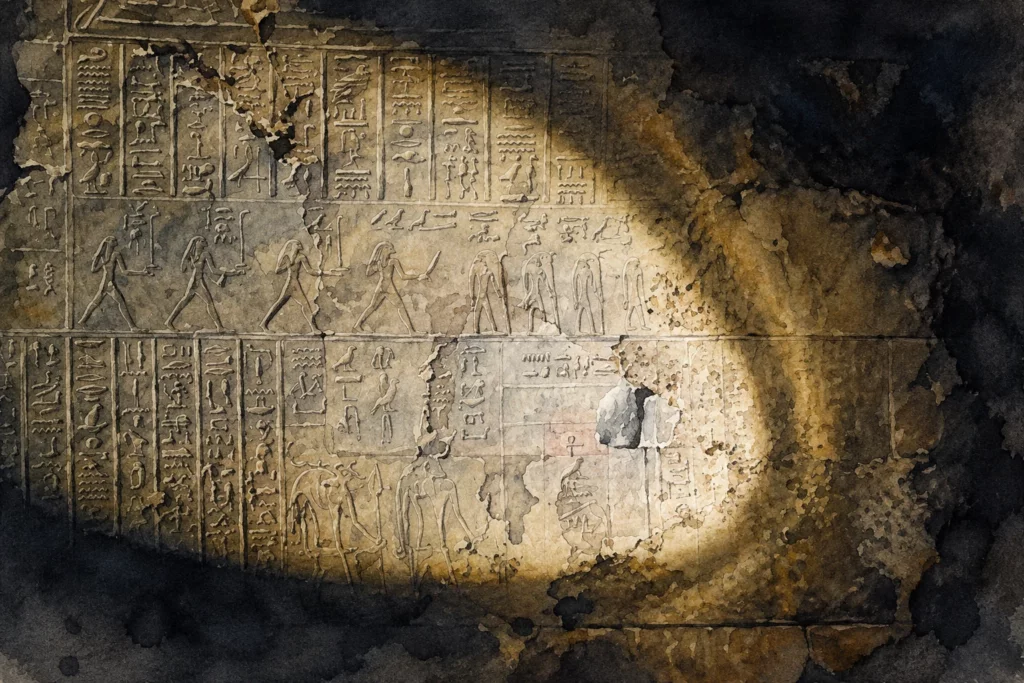
In Padiamenope’s secret burial chamber, the twelve hours of the Amduat surround the dead man. The sun crosses the night, reaches the regions of Osiris and is reborn at dawn. This daily renewal gives form to the future the priest prepares for himself.
Bringing the night into the chamber
The Amduat combines scenes with texts that name the beings of the underworld and explain their action. The solar barque meets favourable powers and dangers there. For the dead man, knowing these regions and taking part in the journey of the sun opens a path towards rebirth.
The layout of the hours has been adapted to the chamber. Some sequences are reversed in their placement so that the book begins in the west and ends in the east, on the side of the rising sun. The orientation of the walls thus contributes to the meaning of the decoration: the space itself carries the expected movement of the light.
A protection around the dead
Fourteen niches were planned for images of guardian genies. Between them is another group of thirty-six guardians associated with the awakening of Osiris. These presences complete the solar journey with a protection of the body and its transformation.
The burial chamber also repeats formulas from the Book of the Dead already present higher up in the tomb. Their repetition changes setting: here, the texts surround the priest’s personal resting place in a space whose access was concealed.
The dwelling of the dead thus unites the sun that returns and Osiris who awakens. Padiamenope entrusts his survival to these two images of life able to resume after its interruption.
The twelve hours and the return of day
The night of the Amduat is divided into twelve hours. Each corresponds to a region and to particular encounters. The progress of the barque is therefore not merely a journey between two points: it involves powers whose action allows the renewal of the sun god.
For the dead, this knowledge has a practical value in the afterlife. Recognising the beings and understanding the stages of the journey should allow them to share in its favourable outcome. Inscribing the scenes around the burial chamber places this resource as close as possible to the dead man’s personal dwelling.
The reorganisation of certain hours on the walls shows that the copy was adapted to the place. The texts are not arranged according to the space available: their orientation must lead from the nocturnal West to the East of rebirth. The burial chamber becomes an architectural setting for the return of the light.
A copy intended for personal rest
Several themes present here are also found in the upper parts of TT33. Their repetition takes on another significance in a space protected by a hidden access. The knowledge offered to the gaze of certain visitors is also gathered around the owner’s resting place.
The niches and the guardian genies complete this setting. Knowledge of the solar journey does not dispense with preserving the body and defending its integrity. The decoration therefore articulates several means of survival, with the powers that bring rebirth and those that protect.
In this chamber, the words are meant to last beyond the ceremonies performed by the living. They keep around Padiamenope the presence of the night sun, the gods and the guardians. The tomb gives a stable form to a hope founded on movement: life will be able to resume as the light returns each morning.
Sources and references
BSFE, pp. 72–73 and 79–82, fig. 12.
Traunecker and Régen, BSFE 193–194, 2016 (in French) · Report of the 2021 season (in French)