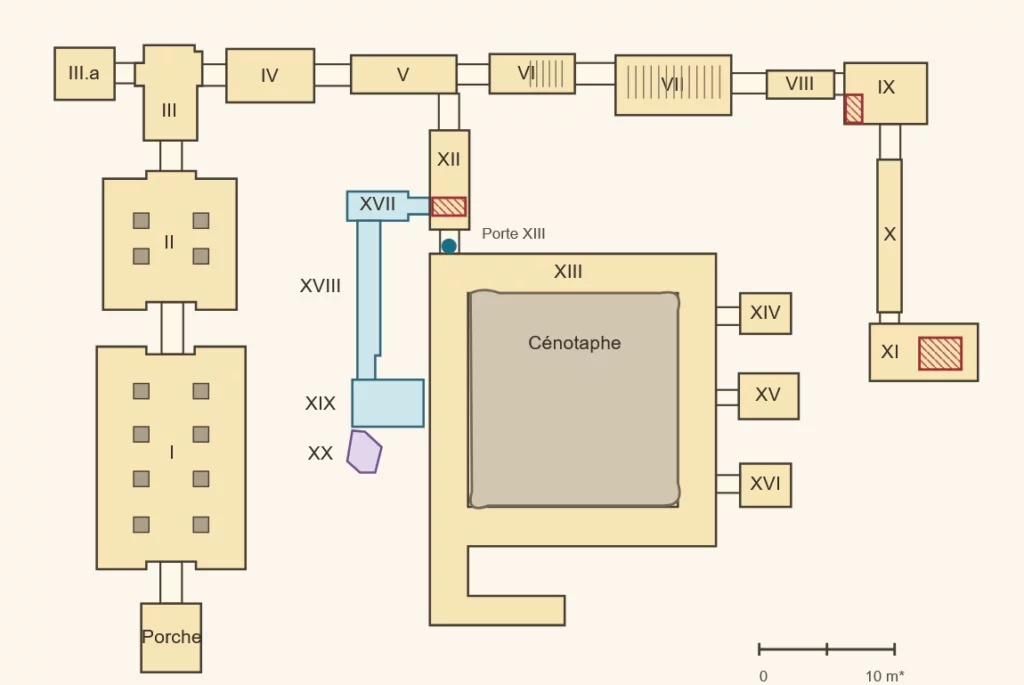
Passage VIII bears on its two walls parts of the judgement spell of the Book of the Dead. Its beginning is on the west, its conclusion on the east. The great scene of the weighing of the heart and the declaration of innocence occupy room IX, immediately next door. The judgement therefore begins to be read before one discovers its central image.
A text distributed around a scene
The spell traditionally numbered 125 is known for the image of the balance, but it also includes words that prepare and complete the ordeal. In passage VIII, its opening and closing parts frame the approach to the tribunal. Their distribution links the space of movement with the great room that follows.
Visitors can thus understand the decoration as a whole larger than a single image. The dead man must present himself, have his quality recognised and be admitted to the presence of the gods. The weighing gives visible form to what is at stake; the words specify the conditions of this admission and the identity of the one who seeks it.
The beginning and the end of the spell face each other on either side of the passage. This arrangement invites attention to the walls as much as to the direction in which one moves. In TT33, a corridor can contain an essential part of the religious programme.
Being recognised as just
The judgement concerns the conduct of the dead man. In Egyptian thought, the heart is linked to the person, to his decisions and to the memory of his deeds. Confrontation with Maat, the just order, therefore involves a whole life. The hope of survival requires that this existence be recognised as compatible with the divine order.
The funerary texts prepare this recognition. They allow the dead to speak before the powers of the tribunal, to claim their purity and to take their place in their realm. The words carved for Padiamenope make this general programme a personal resource, intended for his own future.
This preparation belongs to the same monument as the offerings, the protections and the rites that restore the use of the senses. Survival is envisaged in several aspects: having a body that is cared for, being able to act, knowing the gods and being admitted among them.
Reading the walls despite the gaps
The walls of VIII are badly damaged and the inscriptions are barely legible in places. What can be recognised today therefore does not everywhere form an intact sequence. This material reality must be kept in mind when imagining the ancient decoration.
The passage also completes the sequence of descents whose architecture recalls the Ramesside royal tombs. To this monumental reference is added a precise textual function: surrounding the approach to the judgement with words that make its accomplishment possible.
The room thus takes its full place in the visit. Between the close walls, the reader discovers part of the speech that the dead man must be able to make before the gods. The tribunal is prepared in words before unfolding in the image of the balance.
The arrangement also helps us to understand the work of those who designed the decoration. They distributed a composition across several surfaces and several spaces, while keeping the link with its major image. Visitors therefore pass through a text distributed within the tomb, each part of which contributes to the preparation of the same ordeal.
Sources and references
BSFE, figs 1–2 and p. 62; 2021 report, § 65; 2024 report, § 26.
Traunecker and Régen, BSFE 193–194, 2016 (in French) · Report of the 2021 season (in French) · Report of the 2024 season (in French)
Report of the 2019 season, BAEFE, 2020, texts and decoration (in French)