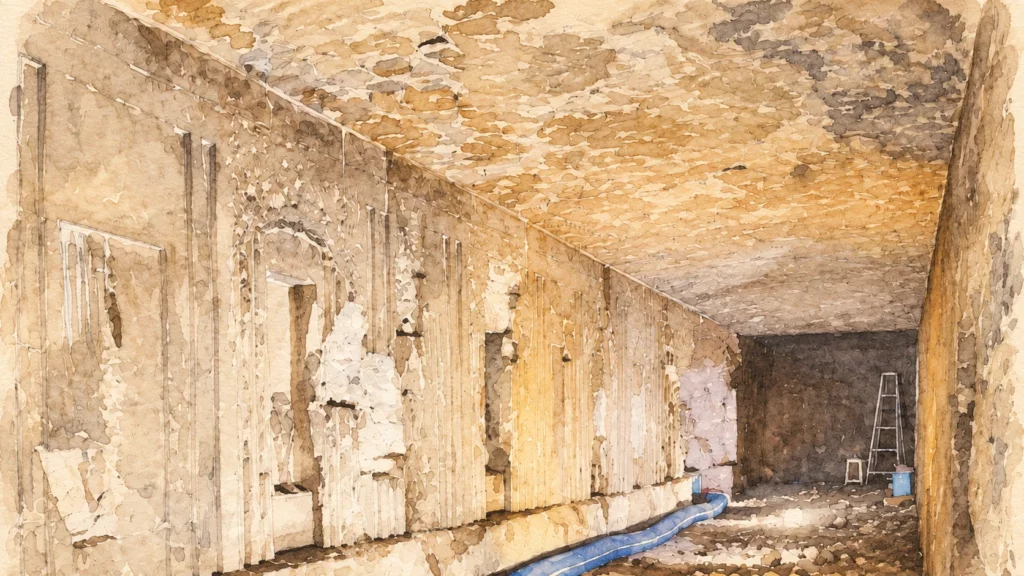
At the end of corridor XII appears the corner of an immense monument cut into the rock. Two goddesses protect its adjacent faces: Neith on one side, Shentayt on the other. Sector XIII surrounds this cenotaph, a monumental evocation of the tomb of Osiris. Its corridors make it possible to walk round it, between the images of the god, his protectors and the books describing the afterlife.
Padiamenope welcomes those not yet born
Before this first glimpse of the cenotaph, the door passage shows Padiamenope accompanied by a nephew. On the right side, his image keeps the costume of his time, a short skullcap and a double-heart pendant. On the left side is the address to the living. It expressly includes ‘those who have been born and those who will be born’ (translated from the French).
The inscription distinguishes three reasons for visiting the tomb. One may come as a devotee of Montu, the god of Thebes, walk through the necropolis for pleasure, or look for formulas. This last possibility fits the abundance of carved texts: a learned visitor could come here to consult ritual knowledge. But the welcome also envisages curiosity and the pleasure of the walk.
The rest of the message invites these people to enter and contemplate what the tomb contains. Then it urges them to act: to worship the god, to say the offering formula, to complete the monument and to revive what is decaying.
The text creates a relationship between people separated by time. The owner had a monument prepared that others would be able to see, read and use; he expects from them words and care that will prolong his life. Future generations have a place in this project long before their birth.
Eight goddesses around a protected body
The cenotaph is a large square mass about sixteen metres a side, left standing in the rock. Its corners are each guarded by two sculpted goddesses, their bodies against the wall, their gaze turned towards the corner to be protected. Going round from the arrival of the corridor, one meets Shentayt and Isis on the south face, Nephthys and Nut on the east, Maat and Serqet on the north, Hathor and Neith on the west.
Columns of inscriptions accompany these figures. Despite their gaps, they make it possible to follow a transformation: the body is prepared, protected, glorified, then associated with an arrival at Karnak. The reading proposed by Traunecker sees in this sequence a funerary route ending at the temple of Amun; the possible relationship with the installation of a statue of the priest remains a hypothesis.
The bands crowning the faces specify other actions. On the south, Isis gives breath; on the north, Nephthys consolidates the body, the head and the bones. On the east, Nut protects the dead man and introduces him among the stars that never disappear below the horizon. Each contributes to a part of his survival.
Doors and chapels in the stone
Fifteen false doors punctuate the monument. They evoke thresholds without offering the visitor a passage and are associated with relics of Osiris. The god, whose body was scattered and then reassembled, is present through this geography of his sacred remains.
Twenty-two small chapels are added to this group. Their façades have two plant-form colonnettes and a vaulted roof; their niches house divine images in relief. Their diversity populates the faces of the cenotaph with protective presences. These small chapels of the mass are distinct from the three rooms XIV, XV and XVI devoted to the Osirian preparation.
On the walls, the night crossed by the sun
The corridors display in particular the Amduat and the Book of Gates. In them the sun crosses the night, meets the inhabitants of the underworld and prepares its return to the light. Padiamenope takes his place in this future: his image associates him with the solar barque, and some commentaries added to the compositions relate their efficacy to his person.
The end of the route holds another image of his future. In the last hour of the Amduat, he appears outside the barque, adoring the rising sun. At the end of corridor XIII.3, a false door and an inscription linked to the imperishable stars also orient his future towards the northern sky.
This last corridor plays with the eye: the floor rises, the ceiling lowers, and a passage of seven metres seems much longer. At the end of this narrowing space, the false door offers the dead man a symbolic way out. The reborn sun and the ever-visible stars open to him two complementary images of eternity.
Sources and references
BSFE, pp. 63–66 and 77–82; 2021 report, §§ 67–68.
Traunecker and Régen, BSFE 193–194, 2016 (in French) · Report of the 2021 season (in French)