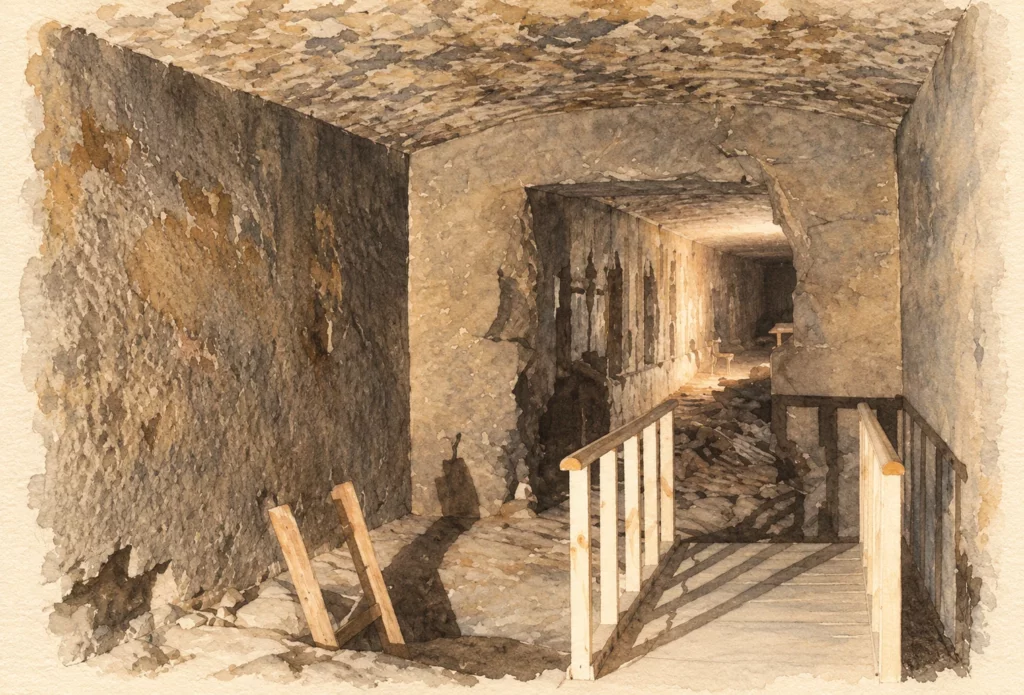
In corridor XII, a shaft opens in the middle of the passage. More than two metres wide in a corridor less than three metres wide, it leaves very little room at the side. Its opening physically interrupts the approach to the cenotaph.
Above a depth of six metres
The shaft descends about six metres towards the rooms of the Book of Caverns. How it was once crossed remains uncertain: a wooden installation or a filling have been considered. The walkway visible in the mission’s photographs is modern equipment.
Inside the corridor, the Book of Gates belongs to the programme of the walls. It tells of the progress of the sun through the nocturnal world, divided into regions whose thresholds are guarded. The arrival of the sun restores life to their inhabitants; it is also accompanied by a setting in order and a judgement.
Before the cenotaph, a welcome to the living
At the end of the corridor, door XIII opens onto the monument of Osiris. Padiamenope appears there accompanied by a nephew. An inscription addresses present and future visitors, envisaging devotion as well as the pleasure of walking through the necropolis or the search for texts.
His invitation comes with a request: to honour the god, recite the offering and maintain the monument. The visitor becomes one of the actors of its survival. The article on sector XIII develops this address and the decoration discovered beyond the threshold.
A barque that restores life as it passes
The Book of Gates represents the sun as a power in motion. Its night crossing brings the inhabitants of the other world what they cannot obtain alone: light, renewed activity and a share in the divine order. The passage of the barque is for them a moment of renewal.
The gates separate the regions of this universe. Their guardians make tangible the conditions of movement: each realm has its powers, which the sun and those accompanying it meet during the journey. The book gives an organisation to the invisible world.
In the TT33 version, commentaries personalise certain sequences for the benefit of Padiamenope. The owner can thus take part in the movement and action of the god. The copy of an ancient composition becomes the means of inscribing a particular destiny in the rhythm of night and dawn.
The shaft before a space of worship
The position of the opening is unusual: it lies in a passage and occupies a large part of its width. Anyone approaching the cenotaph could hardly ignore this depth. The corridor combines horizontal movement towards the divine monument with a descent towards the underground rooms.
The ancient form of the crossing remains debated. This point should not obscure the certain effect of the arrangement: depth is present before the visitor, at the very place where he enters a complex devoted to texts and to the cult of Osiris.
The threshold that follows gives the living a place in this organisation. The welcome and the requests addressed to visitors link the care of the monument to its duration. Amid the books describing the regions of the night, the tomb keeps a relationship with those who can still come, look and speak a word for its owner.
The portrait of the owner at the threshold gives a face to this request. The texts of the afterlife speak of the gods and the regions of the night; the image recalls who gathered this knowledge in the rock and who now awaits the benefit of the words spoken by the living.
Sources and references
BSFE, pp. 65–66 and 72; 2021 report, §§ 67–68.
Traunecker and Régen, BSFE 193–194, 2016 (in French) · Report of the 2021 season (in French)