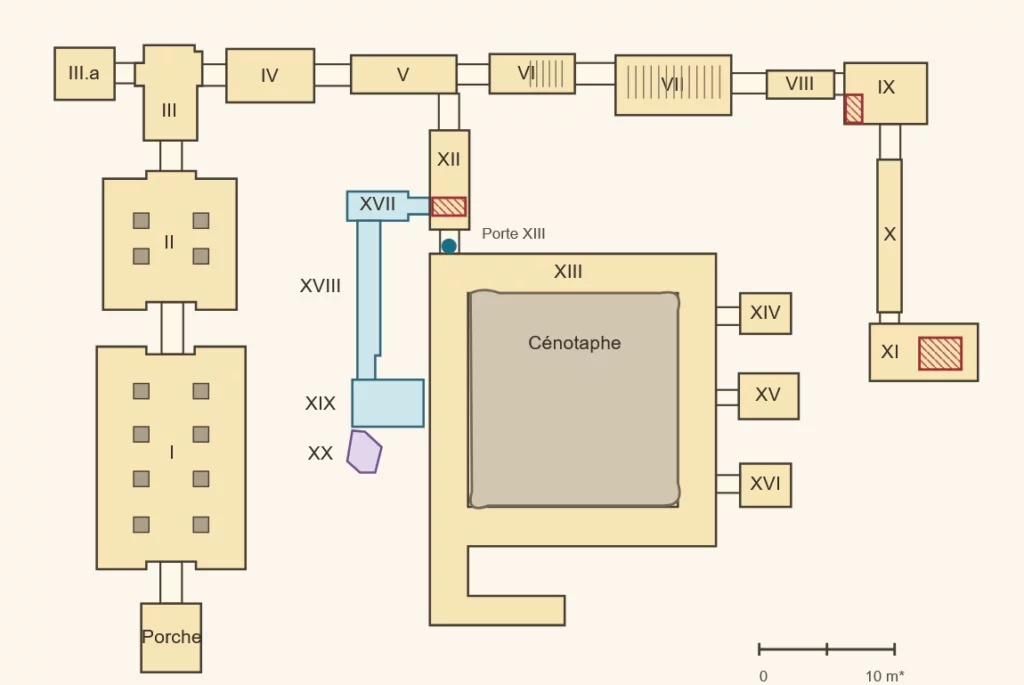
Chapel XIV bears the name Mansion of Natron. Natron, a natural mixture of salts, served to dry the body during mummification. This name places the room at the beginning of a transformation: removing the flesh from decomposition in order to prepare a lasting existence.
Preserving the body of Osiris
The chapel belongs to a group devoted to the Osirian preparation of the dead. The body must be preserved, wrapped and equipped before its awakening. The desiccation evoked here answers the most material fragility of death: what comes apart must be able to hold together again.
The inscriptions and the ritual function of the room do not make it an attested embalming workshop. They give presence to the care performed around Osiris and to the hope of rebirth associated with him.
The priest in the place of books
Padiamenope appears in this group of chapels as officiant and intercessor on behalf of the pilgrims. He can thus take his place on the side of the one who knows the rites and acts before the god.
An inscription in XIV also describes him by his knowledge in a place of books, compared with the tomb itself. This evocation gives a particular meaning to the abundance of texts: the priest keeps his identity as a scholar amid the operations that prepare rebirth. Knowledge of the formulas and care for the body take part in the same project.
Natron and resistance to decomposition
Mummification answers a material difficulty: a dead body decays. Desiccation removes the moisture that favours this destruction. Natron belongs to the preparation intended to preserve a bodily form on which the rites can continue to act.
In funerary thought, this preservation has a religious significance. The body is one of the supports of identity. Preserving it amounts to maintaining a possible relationship between the dead man, his images and the various manifestations of his person. Technical care and rite take part in the same hope of duration.
The chapel expresses this moment through its name and its texts. It does not provide proof of a material embalming operation carried out on the spot. Its role is to make present, within the monument, a phase of the treatment that prepares the Osirian rebirth.
Words inscribed around the threshold
On the inner faces of the doors of the three chapels are texts arranged symmetrically. They give the entrances particular importance. In crossing the threshold, one also passes words that present the owner’s competences and his relationship to the rites of the place.
This arrangement helps us to understand Padiamenope as a mediator. He appears as an officiant, in the service of the people who came to petition the god. The priest therefore keeps an activity within the space of his own tomb: the honoured dead man also remains the one who knows the gestures and the formulas.
The Mansion of Natron thus brings together two aspects of his project. The preservation of the body provides a condition of survival; the inscribed knowledge organises the ritual action that gives it its efficacy. In this small chapel, the preparation of Osiris becomes the model of a life sustained by care, words and the relationship with visitors.
The association of body and book particularly illuminates this chapel. Matter must resist destruction, while knowledge must remain available and correctly transmitted. The tomb brings these two forms of preservation together around a person who had made ritual knowledge his activity.
Sources and references
2021 report, § 48; BSFE, pp. 63–64.
Traunecker and Régen, BSFE 193–194, 2016 (in French) · Report of the 2021 season (in French)