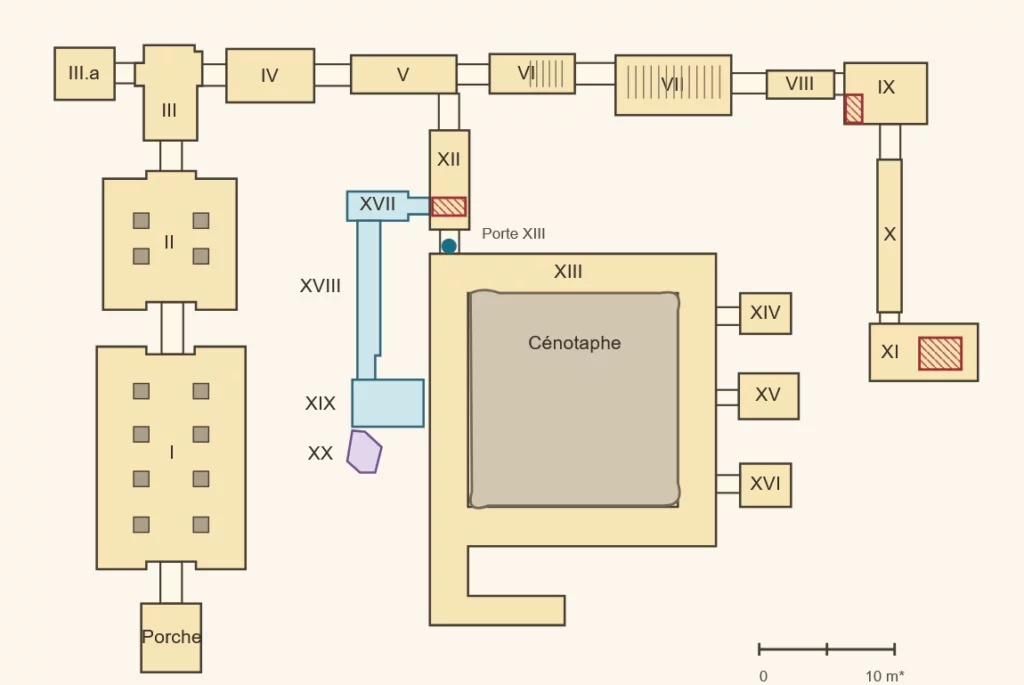
Annexe III.a is a room without inscriptions, set beside room III. No procession of gods or column of hieroglyphs accompanies the eye there. In a tomb as richly written as TT33, this difference deserves a pause: the role of a room can lie in its form and position as much as in the images it contains.
A small room in a composed group
To understand this annexe, one must look at the group to which it belongs. Room III plays the role of an antechamber; room IV evokes a burial chamber; III.a completes this group like the serdab of the apartments of a royal pyramid of the Old Kingdom. The three rooms thus take up an ancient organisation, recognisable even in the presence of an annexe without texts.
This comparison allows the volumes to be read as something other than a series of rooms cut as needs arose. The chamber, the antechamber and the annexe form a funerary dwelling within a much larger tomb. Padiamenope thus gathers in his rock-cut tomb architectural forms that belonged to the memory of kings.
What the word serdab means here
The term serdab is often associated with funerary statues. In mastabas, it refers in particular to a closed room housing an image of the owner, a support for his presence in the cult. This image could symbolically receive the benefits of the offerings intended for the dead, even when his body lay in another space.
In the case of III.a, the word is used to establish a correspondence with the annexe of the pyramids with texts. It is not enough to prove that a statue of Padiamenope was installed there. No particular statue is attested in this annexe in the documentation used. One must therefore distinguish what the name evokes in Egyptian funerary architecture from what can actually be reconstructed here.
The annexe thus has an interest of its own, even without identified furnishings. Its existence completes the architectural model; it shows that the evocation of a pyramid does not rest solely on the copying of famous texts.
An architecture as ancient as the neighbouring words
In the main rooms of this group, the Pyramid Texts are carved. These compositions had first been inscribed in the underground apartments of Old Kingdom sovereigns, more than fifteen centuries before Padiamenope. They accompanied the transformation of the dead and his admission into the divine world.
The comparison matters: around III.a, writing and architecture answer each other. The ancient words find again a setting that recalls their royal use. The Late Period priest gives this tradition a new dwelling, adapted to his own tomb and to the scale of his funerary programme.
Looking at a room without decoration
The absence of inscriptions changes the way the annexe is visited. The eye dwells on the threshold, the surfaces and the volume, then on the relationship between this small room and the inscribed rooms that accompany it. It is an element of the organisation of the monument, whose meaning comes from the place it occupies.
It would be tempting to add a statue, objects or a lost decoration in one’s mind to make it more spectacular. Its interest is nevertheless already present in what is certain: an annexe without text, integrated into a precise evocation of the ancient royal apartments. At TT33, preserving the past also means taking up a way of distributing space around the dead.
Sources and references
2021 report, p. 26, §§ 49–50; BSFE, fig. 1, p. 54.
Traunecker and Régen, BSFE 193–194, 2016 (in French) · Report of the 2021 season (in French)
Report of the 2019 season, BAEFE, 2020, texts and decoration (in French)