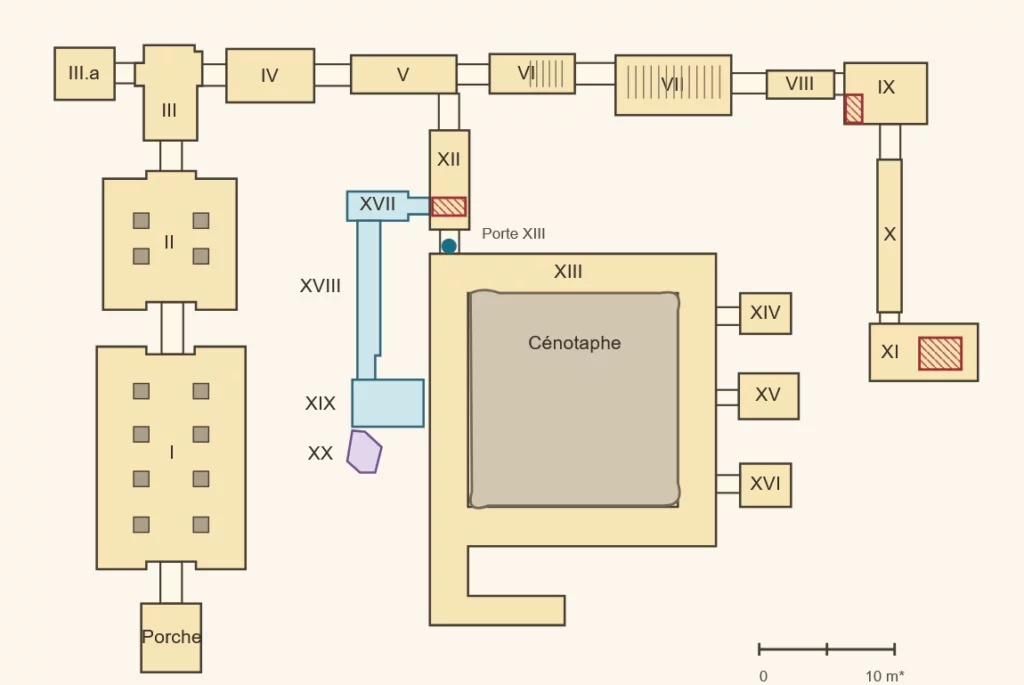
Beneath a vaulted ceiling, a large stone mass occupies the northern part of room XI. Claude Traunecker suggests recognising in it the evocation of a royal sarcophagus. The layout of the room recalls an Old Kingdom burial chamber.
Words against dangers
The inscriptions on the east wall include a group of conjuration formulas. Their role is to drive away the forces that might threaten the dead man. Protection is achieved through effective words: identifying a danger, opposing a power to it and preventing it from acting.
Part of this decoration assembles more than a hundred very short extracts from the Pyramid Texts. The room thus shows a work of composition: ancient passages were chosen and brought together to act within a new whole.
On the north and west walls, other formulas from the same corpus take over. They take part in the rites of awakening, protection and transformation of the dead. The walls surround the architectural form of funerary rest with an activity of speech.
Giving the chamber ritual efficacy
This room calls on the authority of the pyramids, even in its ceiling and its mass of stone. It nevertheless belongs to the tomb of a priest of the Late Period, whose secret burial chamber is set in another sector.
The mass and the texts are understood together: the one evokes the presence of the dead man, the others work for his preservation and his awakening. A shaft completes the arrangement of the room.
Driving away serpents by the word
The conjuration formulas on the east wall are directed in particular against serpents. The animal may represent a concrete threat, but it also belongs to the dangerous powers that the dead must know how to keep at bay. Ritual speech seeks to neutralise its action and protect the integrity of the dead.
This theme makes the programme of the chamber more precise. Awakening is not enough: the restored life must be defended. Texts therefore undertake to prevent any harm to the body or the freedom of the dead. Each danger named becomes the object of a response.
The assembly of very short ancient passages multiplies these responses. The decoration brings together resources from a prestigious corpus, arranging them around the dead man as a protective whole. The lector priest prepares for himself an environment of words capable of acting for him.
The form of rest and the means of departure
The vaulted ceiling and the mass of stone create the impression of a burial chamber. The reading proposed by Traunecker compares this mass to a royal sarcophagus. This form should be seen as an architectural evocation: it makes present a model of the rest of the dead, without attesting here the discovery of a personal sarcophagus preserved in place.
Around this centre are formulas that nevertheless do not leave the dead man in mere immobility. They protect him, awaken him and associate him with the gods. The appearance of a chamber of rest goes together with continuous religious activity.
This relationship is characteristic of Egyptian funerary thought. Preserving the body and making the dead capable of manifesting themselves are two complementary needs. The tomb protects a presence and prepares possibilities of movement. In XI, the evocation of an ancient chamber and the words carved on the walls show how these two needs are brought together.
The reader can therefore move from the general form of the chamber to the detail of a threat warded off. This alternation between a protective volume and specialised words gives the decoration its precision: a dwelling is prepared, but the dangers that might disturb its peace are not forgotten.
Sources and references
2021 report, §§ 50–53, pp. 26–27; BSFE, p. 62.
Traunecker and Régen, BSFE 193–194, 2016 (in French) · Report of the 2021 season (in French)