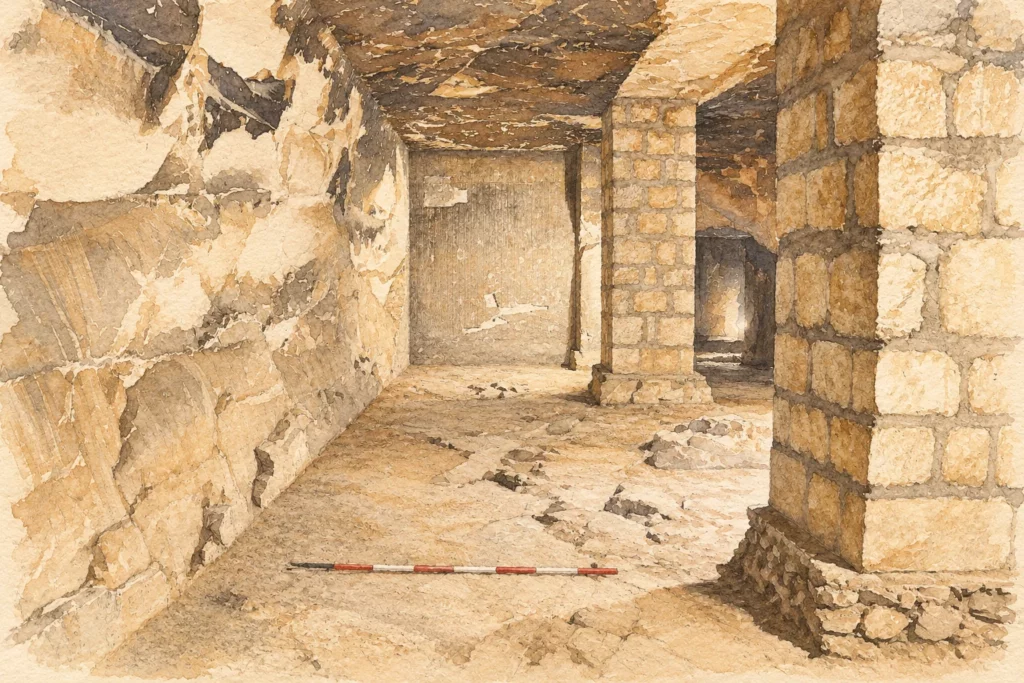
In the first pillared room, the eye meets a decoration part of which has broken and been scattered. The pillars have collapsed; carved blocks, sometimes large, have been found on the ground. The images preserved on the walls and the fragments nevertheless make it possible to recognise an essential scene: the funeral of the dead man.
In front of the tomb, restoring life to the senses
On the south wall, the illustration of the first chapter of the Book of the Dead includes the ritual of the Opening of the Mouth, performed in front of the tomb. What is at stake is very concrete. The dead man must be able to breathe, speak, receive his food and perceive the world. The ritual gestures seek to restore these faculties to him.
The scene belongs to the account of the funeral. The body is taken to its funerary dwelling, but its installation in the tomb must also open a new existence. It is this passage that the words and images make lasting.
The words inscribed on the pillars
The fragments of the pillars also bear formulas from the Book of the Dead. Some concern going forth by day, the transformations of the dead man and the protection of his movements. The inscriptions therefore occupied the supports in the middle of the room as well as the walls around it.
To understand what remains today, one must imagine this writing spread through the space, then look at the breaks. A sequence of signs may stop at the edge of one block and resume on another. The room has lost part of its material unity; its subject remains that of a dead man to whom the rites restore the means of living.
Formulas for going out, transforming and returning
The texts found on the pillars refer to several needs of the dead. He must be able to go forth by day, take on the forms that allow him to act and avoid whatever would hinder his freedom. The Book of the Dead gathers these resources without reducing them to a single story. Each formula answers a situation, a risk or a faculty that must be preserved.
This diversity sheds light on the appearance of the room. A funeral scene fixes a recognisable event, while the words on the pillars extend its effects into the afterlife. The ceremony installs the dead man in his tomb; the formulas must allow him not to remain a prisoner of his immobility.
The presence of texts on the pillars also gives a role to the centre of the room. The decoration surrounded the visitor’s movements on several supports. To understand the ancient room, the fragments must be seen as the parts of a writing spread through its whole volume.
The colours and the identity of the priest
Some fragments have kept colours that surfaces long exposed have lost. The scene of the Opening of the Mouth is thus known from polychrome elements. The pigments highlight the figures and signs; they are a reminder that the inscriptions were not designed to appear everywhere in the bare colour of the rock.
Pieces of the ceiling have also yielded a rare title of Padiamenope, linked to his activity as lector priest of Nekhbet. The decoration of the room thus combined the means of his survival with the assertion of his functions. The man who benefits from the formulas is also the one whose titles preserve his religious competence.
The breaks now make this identity harder to grasp at a single glance. But a name, a figure and a title recovered are enough to give the words a recipient again: they were brought together for an individual, with his profession, his attachments and his memory.
Sources and references
2021 report, §§ 55–64; BSFE, p. 62.
Traunecker and Régen, BSFE 193–194, 2016 (in French) · Report of the 2021 season (in French)
Report of the 2024 season, BAEFE, 2025, figurative and inscribed fragments (in French)