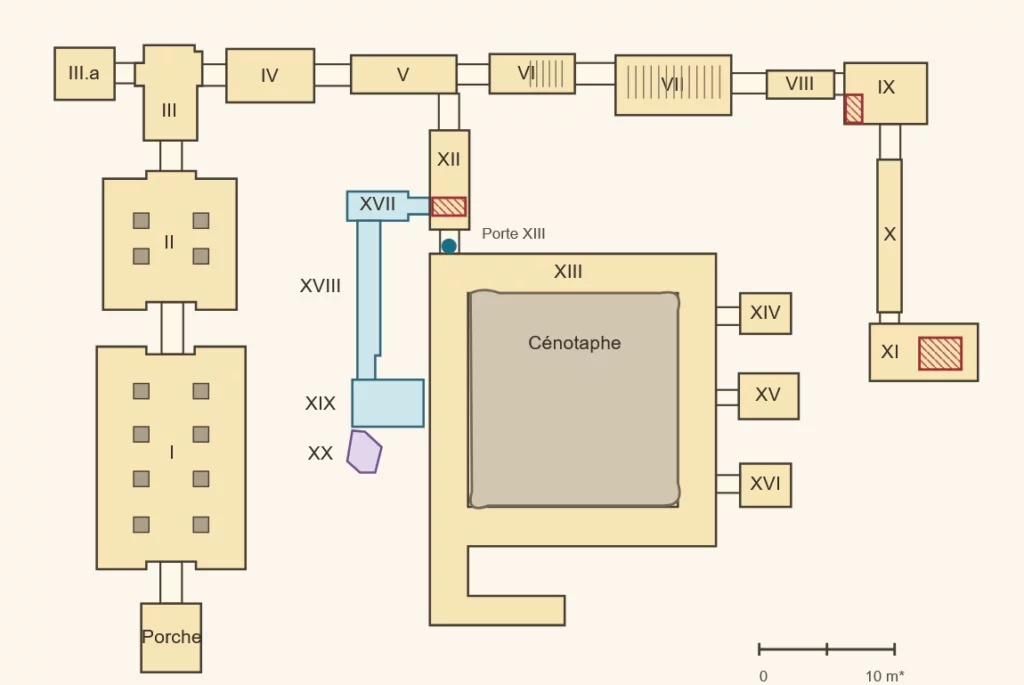
Room VII combines a staircase with images of Padiamenope before the guardians of the gates of the Duat, the underworld. Despite the badly damaged state of the walls, the subject of the decoration remains recognisable: the dead man must be admitted into regions whose access depends on divine powers.
Facing the guardians of the afterlife
Padiamenope is shown in adoration before the guardian spirits. His presence gives these scenes a personal dimension. The owner of the tomb is engaged in the encounter; the formulas that accompany him must allow him to overcome the obstacles and obtain passage.
Spell 145 of the Book of the Dead unfolds on the west, south and east walls. The end of spell 146 is also preserved on the west. These texts belong to a single set of concerns: knowing how to approach the gates of the world of the dead, knowing their powers and possessing the words that make the crossing possible.
In this universe, the name has efficacy. Naming a power correctly amounts to showing that one knows its identity and its domain. The dead man therefore does not present himself as a helpless stranger: the inscriptions provide him with the knowledge he needs in order to be recognised and welcomed.
A careful look at damaged scenes
The exact number of guardians depicted remains difficult to determine, as the walls have suffered greatly. Parts of figures and inscriptions have disappeared. The present reading does not make it possible to reconstruct each scene with the same confidence.
This fragility does not erase the essence of the scene: Padiamenope faces beings who hold the thresholds of the other world. Look for his image, the relationship of adoration and the columns of text that give the encounters their meaning. The gaps interrupt the sequence without removing the subject to which it belongs.
The mounting force of an ordeal
The staircase occupies a large part of the room. Visitors descend in the midst of a decoration that also concerns the passage from one realm to another. The tomb gives physical form to the movement, while the images explain what the dead man must accomplish.
The scale of this descent belongs to a sequence inspired by the Ramesside royal tombs. The reference to the New Kingdom can be recognised in the monumental organisation of the spaces; the Book of the Dead inscribed on the walls adapts this dwelling to the personal destiny of the priest.
The gates of the Duat and the judgement to come answer complementary questions. One must be able to enter the divine realm, then find a legitimate place there. Knowledge opens thresholds, but the worth of the dead man’s deeds also counts in his admission among the blessed.
Room VII thus shows a man prepared by the texts to meet the powers of the afterlife. His knowledge as a lector priest extends beyond death: what he knows becomes a means of movement and survival, fixed around him on the walls.
The gesture of adoration also deserves attention. It expresses the relationship that the owner seeks to establish with the powers of the passage. The text provides the names and the words; the image shows an attitude before the gods. The encounter thus takes a visible form, even when the gaps prevent us from following all its details.
Sources and references
BSFE, figs 1–2, pp. 54–55, and p. 62.
Traunecker and Régen, BSFE 193–194, 2016 (in French) · Report of the 2021 season (in French)
Report of the 2019 season, BAEFE, 2020, texts and decoration (in French)