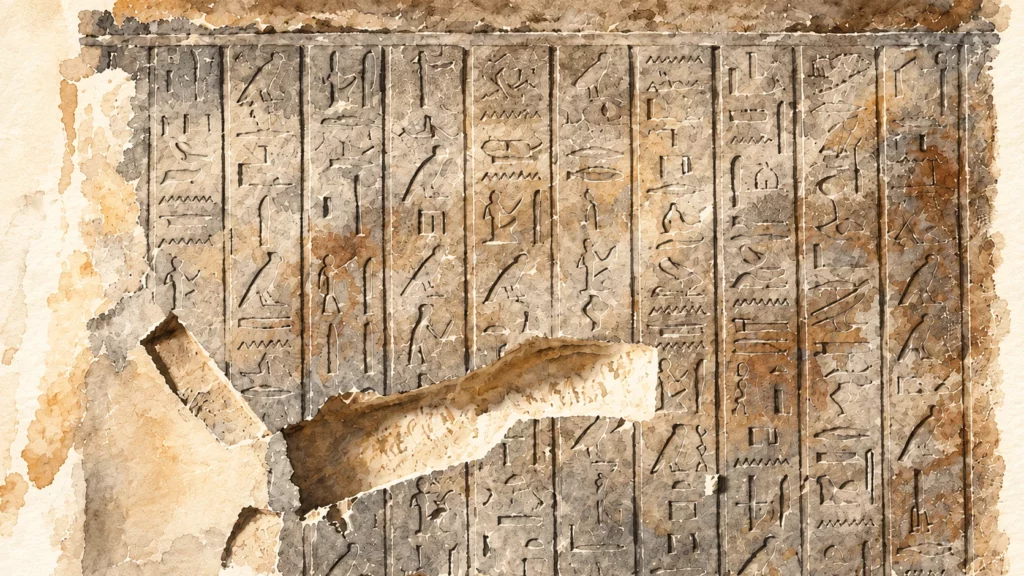
On the walls of room IV, the Pyramid Texts accompany the rites intended to awaken and sustain the dead. The group to which it belongs recalls an Old Kingdom burial chamber, while its decoration also makes room for the family memory of Padiamenope.
Incense, offering and departure
In the eastern part of the decoration, an incense formula opens a sequence of ritual utterances. Fumigation belongs to the gestures that purify and honour the dead. It takes its place in a whole in which the objects presented and the words spoken must go on producing their effects.
In the south-west begins a series often called the great departure. The dead man is called upon to rise and join the world of the gods. What is at stake goes beyond preserving the body: he must be given an active existence and a new place.
The arrangement of these formulas recalls that of the burial chambers of the pyramids with texts. In TT33, visitors can thus recognise a quotation of royal architecture even in the distribution of the words on the walls.
The dead man among his own
The presentation of the family adds a personal dimension to this programme. The dead man who receives the rites bears a name, belongs to a lineage and keeps ties among the living. The room combines this memory with the authority of the oldest funerary texts.
Padiamenope’s secret burial chamber lies elsewhere, in the depths. Here, the chamber gives monumental form to the ancient model to which its owner entrusts his hope of survival.
The ferryman who must be persuaded
A long text on the east wall is known as the Interrogation of the Ferryman. The dead man must obtain a crossing, and this request tests his knowledge. In Egyptian funerary traditions, crossing a stretch of water requires knowing the powers and the parts of the boat, then meeting the demands of the passage.
This textual scene gives concrete form to access to the afterlife. The dead man does not cross an empty space: he meets interlocutors, must be recognised and must show that he has the expected knowledge. The words carved for Padiamenope prepare this encounter and give him the means to hold his own in it.
The text has a long history. Its model is attested in the pyramid of King Aba; it was passed on in other great funerary compilations. Its presence in IV shows how a single resource can cross the centuries and find a function again in a new tomb.
Clothing the one who is reborn
Another formula in the room is intended to clothe Padiamenope, described as an Osiris and as chief lector priest. Clothing takes its place among the forms of care that restore a person. The dead man must be able to present himself in a dignified and protected condition, with the means for his new existence.
Incense, clothing and departure thus answer one another on the walls. The body is honoured; its state is transformed; its future is opened. The inscriptions distribute different operations around the chamber rather than repeating a single abstract idea of resurrection.
This attention to the person joins the family memory present in the room. The dead man preparing for the divine world keeps his ties and his titles. The setting borrowed from the pyramids receives a particular identity: that of a Theban scholar who gathers ancient traditions so that they go on producing their effects around him.
Sources and references
2021 report, §§ 44–54; BSFE, p. 62.
Traunecker and Régen, BSFE 193–194, 2016 (in French) · Report of the 2021 season (in French)
Report of the 2019 season, BAEFE, 2020, texts and decoration (in French)