In a commentary on the Book of Gates, Padiamenope takes part in towing the solar barque. This gesture gives him a place in the action of the god: the sun descends into the world of the dead to dispense justice there, distribute resources and renew life. From this participation the priest expects his own sustenance and his rebirth. A few lines are thus enough to reveal the ambition of TT33: to gather the knowledge of the afterlife, adapt it to one person and make it effective within a monumental architecture.
At El-Asasif, on the west bank of Thebes, this tomb of the 7th century BC brings together courts, great pillared halls, staircases and deep apartments. It also preserves an intellectual project. To understand it, one must look at how an ancient text is taken up, how an image receives the owner’s name and how a wall finds its orientation. The choices of the decoration and those of the builders serve the same aim: to give Padiamenope several means of living after death.
A priest whose knowledge carries authority
Padiamenope belongs to the end of the 25th Dynasty and the beginning of the 26th, at the turn between Kushite rule and the Saite period. In this period great Theban dignitaries had ambitious tombs built in the Asasif, near the monuments of Deir el-Bahri. TT33 takes its place in this landscape of memory and prestige, on a scale that immediately raises the question of its owner’s resources.
His title of chief lector priest corresponds to a precise competence: knowing the texts, being able to read them and using them in the performance of the rites. The ritual word must intervene correctly, at the right moment, on the appropriate support. It can consecrate an offering, protect an image or restore to the dead the faculties needed for survival. The function therefore combines knowledge of writings with the ability to put them into practice.
This identity holds a privileged place in the way Padiamenope presents himself. Among his many titles, that of lector priest remains particularly important, even in shortened designations. The inscriptions of his tomb give lasting form to the field in which he wished his competence to be recognised.
His relations with royal power also count. The titles of royal secretary or archivist, and the functions linked to the festivals of Amun and to the royal insignia, suggest closeness to the sovereign. Claude Traunecker proposes seeing in them part of the authority needed for such a considerable building project. The financial means and economic organisation of the construction nevertheless remain poorly known: the sheer size of the tomb does not, on its own, give the account of its resources.
Making several memories of architecture work together
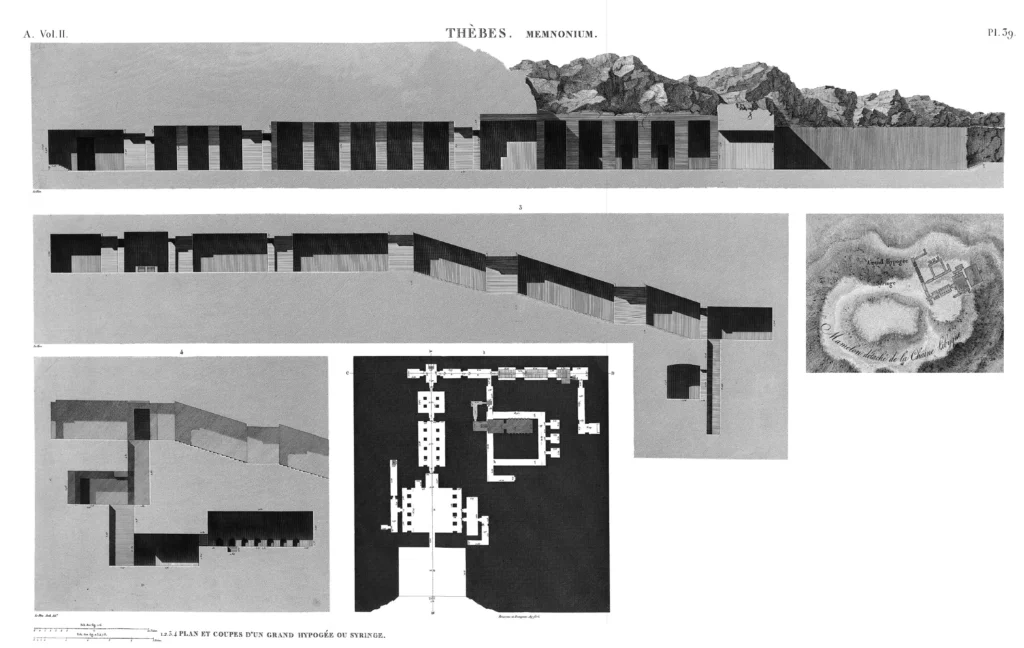
The scale of TT33 is measured in depth as much as in length. The IFAO gives a linear extent of 322 metres, four levels reaching 21 metres below the surface and more than 2,600 square metres of decoration. These figures give the scale of the undertaking; its logic appears in the ancient models that the rooms take up and transform.
A pyramid evoked inside a rock-cut tomb
The group formed by III, IV and annexe III.a takes up the organisation of the apartments of a royal pyramid with texts: antechamber, burial chamber and annexe, called a serdab in this comparison. The Pyramid Texts carved in the main rooms thus find again a setting that recalls their ancient use.
The borrowing concerns a relationship between volumes and words. An antechamber prepares the approach; a chamber gives form to funerary rest; ancient formulas call on the dead to rise, protect him and open his divine future. The royal model is adapted to the tomb of a priest who lived more than fifteen centuries after the first inscriptions of this corpus.
The annexe without texts has its place in this composition. It shows that the evocation of the Old Kingdom does not rest solely on the choice of a few famous formulas: a way of distributing space is preserved as well. The word serdab is not enough, however, to reconstruct a statue in III.a, and no specific furnishings should be deduced from the name given to the room alone.
Royal descents and a double offering
The monumental staircases from VI to VIII then evoke the royal tombs of the Ramesside period. The comparison with the tomb of Ramses II (Ramesses II) concerns the scale of the route and the arrival in a sector dominated by judgement. In VI, the narrowing of the staircase heightens the plunging perspective: the builders give the descent additional visual depth.
The texts accompany this architecture. In VI and VII, formulas from the Book of the Dead prepare the crossing of the gates of the afterlife; Padiamenope appears before their guardians. Passage VIII bears the beginning and end of the great formula of judgement, while the declaration of innocence and the weighing of the heart occupy IX. The subject unfolds across several spaces.
Corridor X takes up another ancient model, that of a pyramid’s descending passage. Two versions of a long offering ritual face each other on its walls. The sustenance of the dead becomes an enveloping presence, inscribed on either side of the descent. Chamber XI extends this reference to the Old Kingdom, with its curved ceiling and its block of stone interpreted as the evocation of a royal sarcophagus.
A library that transforms what it preserves
The image of a library on the walls comes from the quantity and diversity of the inscribed compositions. Each takes charge of particular needs. The Pyramid Texts preserve ancient words of transformation and protection; the Book of the Dead provides means of moving about, answering the gods and being admitted into their realm. The ritual of the Opening of the Mouth restores to the dead the use of his senses and faculties.
The Amduat, the Book of Gates and the Book of Caverns describe the nocturnal regions where the sun meets the dead and prepares its return to the light. Other compositions, such as the Book of the Earth, the Book of the Night and the Book of Nut, enrich this knowledge of the divine world. Their combination gives several forms to the expected renewal: a body can be protected and awakened, the sun can be reborn, a person can gain access to the powers that ensure duration.
A personal place in the action of the sun
The second hour of the Book of Gates offers a particularly illuminating example. There the sun carries out a work of organising the underworld: it dispenses justice and distributes the resources its inhabitants need. An added commentary links Padiamenope to this action. The priest adores the god and takes part in towing his barque, so that the distribution can take place.
What is at stake in this participation is concrete. Receiving a share of the resources of the afterlife should allow the dead man to subsist. The commentary also gives him a useful activity in the divine order: he contributes to what he hopes to benefit from. The images that place him in the solar barque complete this personal insertion into the composition.
Isabelle Régen notes such additions in several places in the Amduat and the Book of Gates. These short commentaries, which researchers call metadiscourse, bring the recipient of the copy into a text transmitted over centuries. They show a work of selection and interpretation, attentive to the passages likely to act on his behalf.
Copying, recomposing, carrying authority
Chamber XI reveals another way of working on the writings. On the east wall, a set of formulas against snakes assembles more than a hundred very short extracts from the Pyramid Texts. The words are brought together to form a protection around the dead. The copy becomes a composition in which each fragment contributes to the intended effect.
In chapel XV, an epithet presents Padiamenope as the one who dispensed the norm according to the method. The formula highlights his ability to order and transmit knowledge. It takes on its full meaning in a monument where the texts are chosen, combined and adjusted to their locations.
The owner’s exact role in drafting each particularity remains difficult to establish. His status as patron and his ritual competence account for the project, without allowing every line to be attributed personally to his hand. The design, the available models, the work of the scribes and that of the engravers together contribute to what the walls preserve.
The cenotaph, a divine body to walk around
The centre of the Osirian sector is a large square mass, about 15.7 metres a side, left standing in the rock. It can be walked around by the corridors of XIII. This cenotaph represents a tomb of Osiris; its presence gives monumental form to the preservation and rebirth of the god. Padiamenope’s personal burial chamber occupies another space, hidden in the depths.
Eight goddesses to protect and transform
Each corner of the mass is guarded by two goddesses. Their bodies lie against the faces of the monument and their gaze turns towards the corner to be protected. On the south face are Shentayt and Isis; on the east, Nephthys and Nut; on the north, Maat and Serqet; on the west, Hathor and Neith. Columns of inscriptions accompany these presences.
The crowning bands specify some of their actions. On the south, Isis brings breath; on the north, Nephthys consolidates the body, the head and the bones. This distribution recalls that of the goddesses around a mummy in a sarcophagus. On the east, Nut protects the dead man and introduces him among the imperishable stars. The mass thus brings together the care given to the body and the opening of a celestial future.
The texts of the eight goddesses can also be read by following the circuit of the monument. Despite the gaps, Traunecker recognises in them a sequence leading from funerary preparation to an arrival at Karnak. The possible connection with the installation of a statue of the owner in the temple remains a hypothesis. In any case the decoration brings Padiamenope’s relationship with the sanctuary of Amun into the future presented around the cenotaph.
Relics, thresholds and divine presences
Fifteen false doors, associated with relics of Osiris, punctuate the faces of the monument. They refer to the scattering and then the reassembly of the god’s body. The name and form of the doors give an organisation to this memory, while the living visitor remains before symbolic thresholds.
Twenty-two small chapels also occupy the faces of the mass. Their façade has two plant-form colonnettes and a vaulted roof; their niches contain divine figures in relief. Their diversity makes the cenotaph a group peopled with powers, whose actions and presences contribute to the protection of divine life.
Walking around the monument can therefore correspond to an act of reading and to a ritual action. The movement brings one to the goddesses and the inscriptions in a given succession. The meaning of the decoration develops as one goes round, instead of being held in a single image viewed from the front.
An Osirian preparation and the hypothesis of a Theban pilgrimage
The three chapels XIV, XV and XVI give precise content to the expected transformation. The Mansion of Natron, in XIV, corresponds to the desiccation of the body. The Mansion of Gold, in XVI, is associated with wrapping. The central chapel XV concerns the final equipment of the adorned mummy, in the form of Osiris Hemag, ready for the rites of awakening.
This sequence distinguishes complementary operations: preventing decomposition, holding the body together, then giving it the ritual state that prepares its rebirth. The names of these places and their texts specify their religious significance. They do not prove that the chapels served as workshops where the body of Padiamenope was physically embalmed.
The owner appears there as officiant and intercessor on behalf of the pilgrims. This position changes the relationship with visitors: the priest is also the one who knows how to act for them before the god. The tomb keeps a function of welcoming worship, while preparing the future of the man who commissioned it.
In the deep rooms, the scene of the awakening of Osiris in XIX shows the outcome of the preparation. The god is surrounded there by thirty-six guardian genies. Beneath this sector lies chamber XXI, whose niched walls, with their rhythm of projections and recesses, evoke an ancient sarcophagus. Traunecker interprets it as the vault of Osiris.
These arrangements led the researcher to compare TT33 with the Osireion at Abydos: books of the afterlife, a descent, an Osirian arrangement and a space with secret access form an architectural and religious analogy. He proposes recognising in it a place where Theban worshippers could perform a devotion linked to Abydos without leaving Thebes.
This reading gives coherence to several particularities of the monument. It remains an interpretation, especially where it reconstructs the vanished parts of the Abydene model. The texts of welcome and the priest’s role as intercessor attest a relationship with visitors; the identity of all the participants, the occasions of access and the full course of the ceremonies remain to be clarified.
Reborn with the sun, lasting among the stars
In the Egyptian afterlife, the sun offers the model of a life that renews itself. It disappears each evening, crosses the underworld and returns at dawn. The regions of the night are the stages of this transformation. The books that describe them give the dead knowledge of the beings and actions whose efficacy he hopes to share.
The orientation of the texts makes this expectation visible in the architecture. In burial chamber XXII, the layout of the Amduat has been adapted to begin in the west and end in the east. Some hours change order in their placement: sequences five and six, then seven and eight, are swapped to keep the general movement towards the rising sun. The writing works with the walls available.
Around the cenotaph, however, the end of the solar route turns towards the north. At the beginning of corridor XIII.3, an inscription from the Pyramid Texts associates Padiamenope with an imperishable star. At its end is a symbolic door. Régen links this orientation to the circumpolar stars, which never pass below the horizon at the latitude of Thebes.
Two images of duration thus meet in the monument: the daily return of the sun and the permanence of the northern stars. The first promises a repeated rebirth; the second a presence that does not disappear. The symbolic exit makes it possible to understand the bend in the corridor as part of the religious project.
The passage adds an effect of perspective to this orientation. The floor rises and the ceiling lowers: its height goes from about 2.32 metres to 1.67 metres. This narrowing makes a corridor of about seven metres appear longer. The eye is led towards an exit whose value belongs to the future of the dead.
The general axis of TT33 nevertheless deviates by several degrees from exact geographic north. Hypotheses have been put forward about the sighting procedures and the possible use of ancient astronomical traditions. The stellar orientation of the project can be explained by the texts without turning a proposal about its technical execution into a demonstrated astronomical measurement.
The living, partners in the duration of the monument
At the threshold of the cenotaph sector, door XIII addresses those already born and those who will be born later. The inscription envisages several reasons for visiting: devotion to Montu, the pleasure of walking through the necropolis and the search for formulas. It thus makes room for different expectations in the approach to the same place.
The invitation to enter and contemplate comes with requests: to honour the god, recite the offering, complete the monument and maintain what is decaying. The visitor receives a role in the survival of the whole. His voice and gestures can prolong the efficacy of the rites and keep alive the memory of the man who had the tomb built.
The texts of the secret burial chamber, however, repeat compositions already present in the upper parts. This repetition sheds light on the diversity of those for whom they were meant. Some versions are offered to the gaze and to practices of consultation; those surrounding the priest’s personal resting place remain withdrawn from ordinary circulation. The access concealed from XXI protects this separation.
Justice to give meaning to memory
Another inscription in the access sector of the cenotaph presents Padiamenope as a man who acted according to Maat, the principle of truth and just order. He states that he judged rightly between the poor and the powerful and prevented the better placed from taking the property of the weaker. His tomb is thus linked to conduct held to be just.
This passage takes up an autobiographical model of the Old Kingdom, also used in other late monuments. The borrowing should not be read as the verifiable record of a particular trial. It shows how an ancient formulation of justice serves to build the desired memory of a dignitary of the 7th century.
The choice of text matches that of the architectural forms: resources from the past make it possible to affirm a present identity and prepare its transmission. The future visitor receives writings to look at, but also a moral portrait of their owner, who should continue to benefit from the recitation of the offering.
What the damaged walls still allow us to understand
The modern history of TT33 long complicated access to its contents. Johannes Dümichen undertook the edition of the inscriptions in the 19th century, with two first volumes published in 1884 and 1885. The working conditions, in particular the massive presence of bats and the polluted air, limited this undertaking. The first rooms then served as an antiquities storeroom, while a closure protected and isolated the inner spaces.
The revival of the project in the early 2000s, around Claude Traunecker and Isabelle Régen, led to the removal of the storeroom and the reopening of the closed part in December 2005. The epigraphic mission is now led by Silvia Einaudi and Isabelle Régen. The study combines the texts with their supports and with the conservation of a particularly demanding underground environment.
The results can be measured in details of content. In room I, fragments have made it possible to recognise formulas from the Book of the Dead on the collapsed pillars and a polychrome scene of the Opening of the Mouth. In II, an arm of the owner, offering bearers and pieces of columns give back a presence to a scattered decoration. A join can restore a figure, a title or a relationship between a scene and its text.
The comparison of versions also corrects old identifications. In XI, a group once compared with the Coffin Texts is understood as an assemblage of short passages from the Pyramid Texts. The difference matters for the history of the programme: the wall bears witness to a choice within a specific corpus and to a work of recomposition.
Difficulties of access do not always correspond to the loss of inscriptions. In IX, some columns survive above a shaft, but examining them requires a safe installation. Photography, photogrammetry and returning to the wall complement one another in distinguishing a preserved sign, a gap and a proposed restoration.
Knowledge of the monument therefore remains uneven. The detailed role of certain spaces, including XX, the fine chronology of the works, the organisation of ancient visits and the respective responsibilities of the owner and his collaborators still call for research. These questions do not prevent us from understanding the best-established choices: a tradition can change recipient, an image take part in a rite, an ancient formula find a place again in the stone. When a fragment rejoins its wall, it is sometimes one of these relationships that becomes visible again.
Sources and further reading
- Claude Traunecker and Isabelle Régen, ‘La tombe du prêtre Padiamenopé (TT 33): éclairages nouveaux’, BSFE 193–194, 2016, pp. 52–83. (in French)
- TT33 mission, reports of the seasons 2019 (in French), 2021 (in French), 2023 (in French) and 2024 (in French), Bulletin archéologique des Écoles françaises à l’étranger.
- IFAO, presentation of the tomb and of the TT33 mission. (in French)
← Back to the discovery article
Explore TT33 room by room
Open the clickable plan and the rooms of Padiamenope’s tomb.