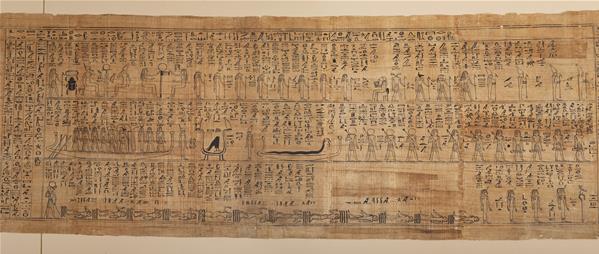
Three and a half thousand years ago, the painters of Thutmose III covered the king’s burial chamber with an entire book, unrolled across the walls like an immense papyrus. This book, which the Egyptians called the ‘Writing of the Hidden Chamber’, tells in twelve scenes of the sun’s night crossing, from its setting in the west to its rebirth in the east. It is the Amduat, the oldest of the royal ‘books of the afterlife’.
A book made for a single place
The modern name Amduat comes from the Egyptian imy-duat, ‘what is in the Duat’, that is, in the underworld through which the sun travels during the night. The full title, written at the head of the book, announces a programme of knowledge: to know the souls (ba) of the afterlife, the gods, the gates and the paths that the great god follows, the hours and their deities, what is done for the blessed and against the damned. The book thus presents itself as exact knowledge of how the night is organised: the places, their dimensions, the names of their inhabitants and what each of them does there.
This knowledge has a purpose. The text states several times that whoever knows these images and names ‘on earth’ benefits from them, and that the same holds in the afterlife. The dead king, who takes his place in the solar barque, must know what the sun encounters in order to cross with it. The Amduat is not a mythological narrative in the sense of a story about gods; it is a description of the hidden world, at once map, list and ritual.
For nearly five centuries it remained reserved for the king. The only known exception early in its history is that of Useramen, vizier of Thutmose III, who had parts of it reproduced in his tomb at Qurna (TT 61). Not until the 21st Dynasty did priests and priestesses of Amun take it with them on papyrus into their burials.
The tomb of Thutmose III, a papyrus the size of a room
Thutmose III reigned from about 1479 to 1425 BC. His tomb, numbered KV 34, is cut at the end of a narrow ravine in the Valley of the Kings, high in the cliff. Plundered in Antiquity, it remained unknown to travellers and scholars until its discovery by Victor Loret in 1898. This detail matters for the history of the copies: neither the scholars of Bonaparte’s expedition nor Champollion could have seen the Amduat of Thutmose III.
A steep staircase, corridors and a shaft lead to a hall with two pillars, then, by a staircase going down into the ground, to the burial chamber. This has a rare shape: an oval with rounded corners, recalling the cartouche in which the king’s name is written. Two pillars support its ceiling, and four small annexes open off its sides. The yellow quartzite sarcophagus, also in the shape of a cartouche, has remained in place. Isis and Nephthys spread their protective arms at its two ends.
Writing and painting like a papyrus
The decoration imitates a book. The background of the walls is painted a pale yellow ochre, the colour of papyrus. The figures are drawn in outline, in black and red, with very little colour: simple silhouettes, almost diagrams, as in the vignettes of manuscripts. The text is written in cursive hieroglyphs, the script of scribes on papyrus, not in the carefully painted hieroglyphs of temple walls. Above runs a frieze of kheker, a decorative motif derived from bundles of reeds; the ceiling is blue, scattered with yellow stars, to represent the night sky.
This sobriety is a choice, not clumsiness. The painters did not seek to decorate the chamber, but to place a document in it, as if the original roll had been opened and its columns had settled on the stone. The royal tombs that followed would gradually move to a careful, polychrome decoration, but that of Thutmose III keeps the trace of the book’s written origin.
The hours placed by the cardinal points
In the long version, the indications that accompany the hours say on which side of the chamber each should be placed. The tomb of Thutmose III respects them: the first four hours occupy the west wall, the fifth and sixth the south wall, the seventh and eighth the north wall, and the last hours the east wall, that of the sunrise, against which the sarcophagus rests. The king lying in his coffin is thus at the point where the sun is reborn. The visitor who walks round the room follows, without knowing it, the route of the barque.
The rest of the programme
The Amduat is not limited to the burial chamber. The walls of the pillared hall before it carry a catalogue of 741 deities, taken from the twelve hours and arranged in the order of the book, without the scenes. On the two pillars of the chamber are the Litany of Ra, which lists the forms of the sun, and an abridged version of the Amduat, without images. There is also a famous scene unique to this tomb: Thutmose III suckled by Isis in the form of a sycamore, with, on the same pillar, his mother Isis and several queens and princesses of his family.
How to read an hour
Each hour is composed in the same way. An introductory text gives the name of the region, its dimensions, the name of the gate that closes it and that of the goddess of the hour, who guides the sun. Then come three registers, one above the other:
- in the centre, the path of the sun, with its barque and crew;
- above and below, the banks, peopled with gods, spirits, serpents and the damned, each named by a short caption.
In the barque, the sun has the form of a ram-headed man standing in a shrine. The Egyptians call him the ‘Flesh’ (iuf): it is the body of the dead god going down into the night. The serpent Mehen surrounds and protects him. Around him stand gods who represent his powers: the creative Word (Hu), Intelligence (Sia), Wepwawet who ‘opens the ways’, Hathor, ‘mistress of the barque’, Horus and others besides.
The book exists in two forms. The long version combines the images and their captions. The abridged version, without images, sums up each hour in a few lines; the manuscripts often place it at the end.
The twelve hours, one after another
Each hour is presented with a watercolour, its main episode and the place where it can be seen in the tomb of Thutmose III. The watercolours are interpretations made from photographs of KV 34: they do not reproduce every figure or every sign. Click on an image to open it full size.
First hour: entering the night
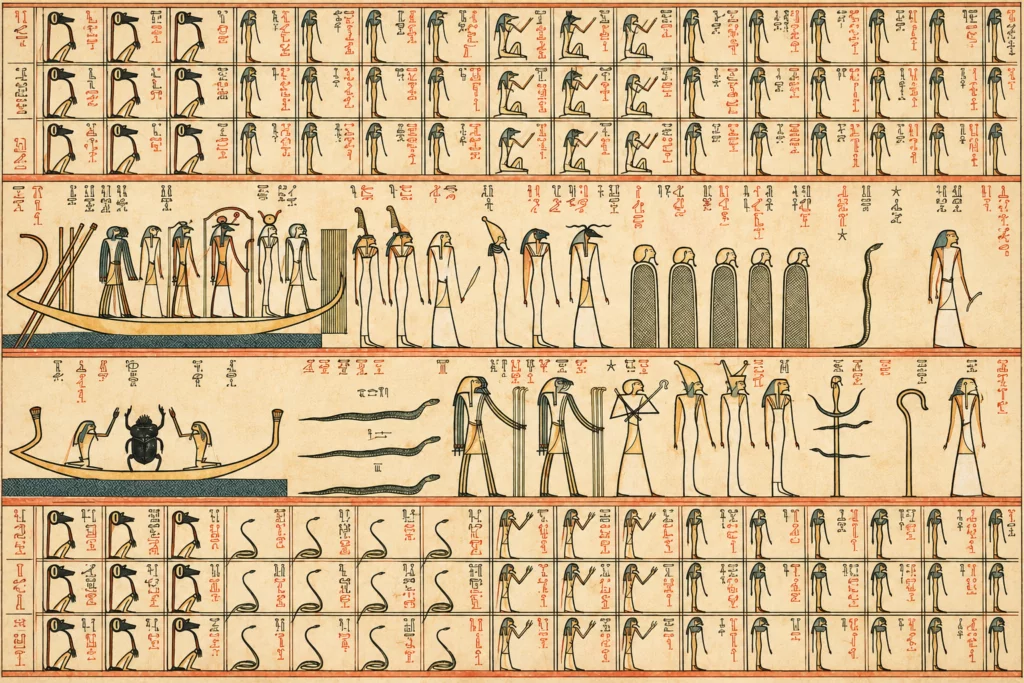
The first hour is not yet the Duat. It is a transitional zone, 120 iteru long (a measure of river distance), which the sun crosses just after it sets. The barque enters it, greeted by baboons who sing and open the gates, by goddesses and by twelve serpents whose fire lights up the darkness. In the central register, in front of the barque, a small boat carries a scarab worshipped by two Osirian figures: from the first hour, the rebirth of the morning is announced.
In KV 34: west wall, beginning of the book, after the title.
Second hour: Wernes, the region of fertile waters
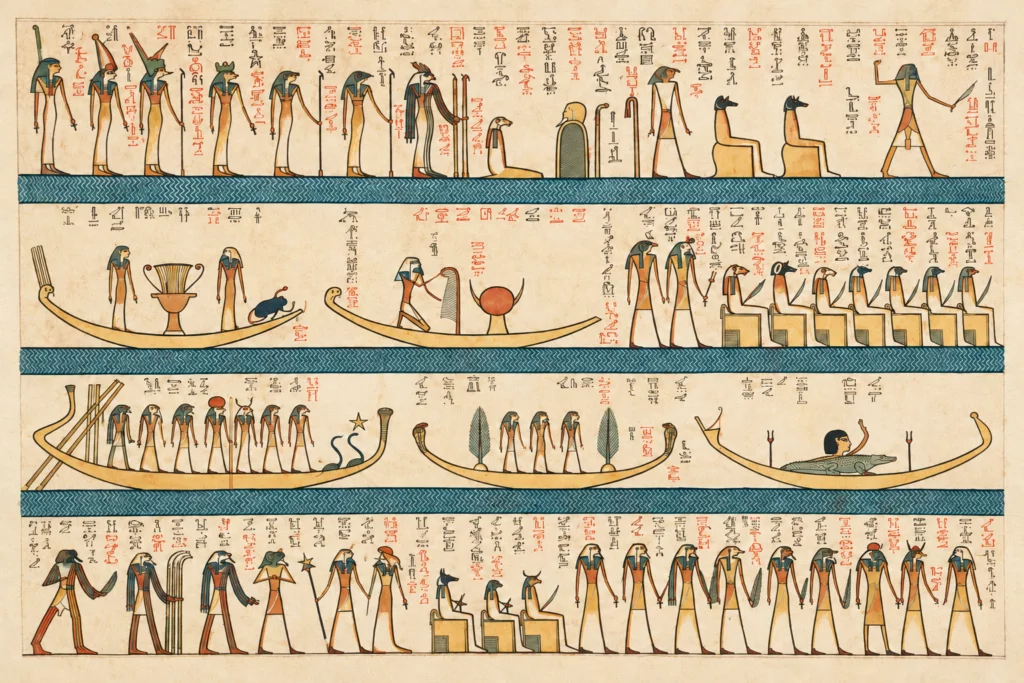
The sun enters Wernes, a vast region of water and fields. Its barque is preceded by four boats; one carries a lunar disc, another a crocodile, yet another ears of grain. On the banks, grain gods present stalks of wheat. The sun grants the inhabitants fields and offerings: the night is not only a place of danger, it is also where the fertility of the earth is renewed.
In KV 34: west wall.
Third hour: the waters of Osiris
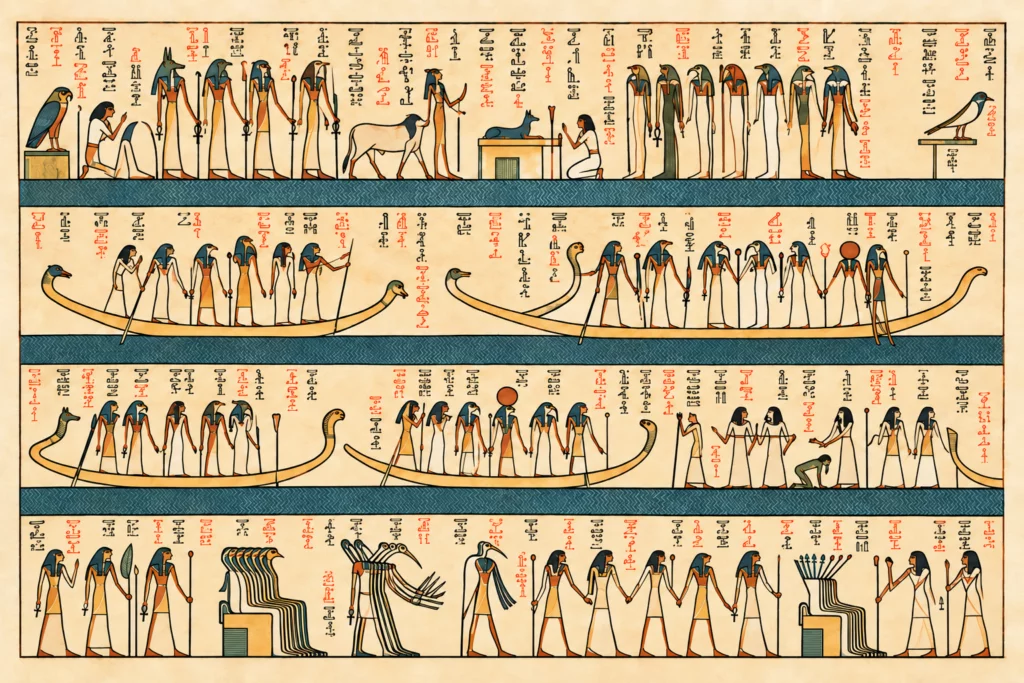
Navigation continues on the ‘waters of Osiris’. Several barques still accompany that of the sun. On the banks, Osiris appears in several forms, mummified and seated, surrounded by guardians armed with knives or spitting fire. The hour prepares the meeting between the sun and Osiris, which will be at the heart of the sixth hour.
In KV 34: west wall.
Fourth hour: Rosetau, the desert of Sokar
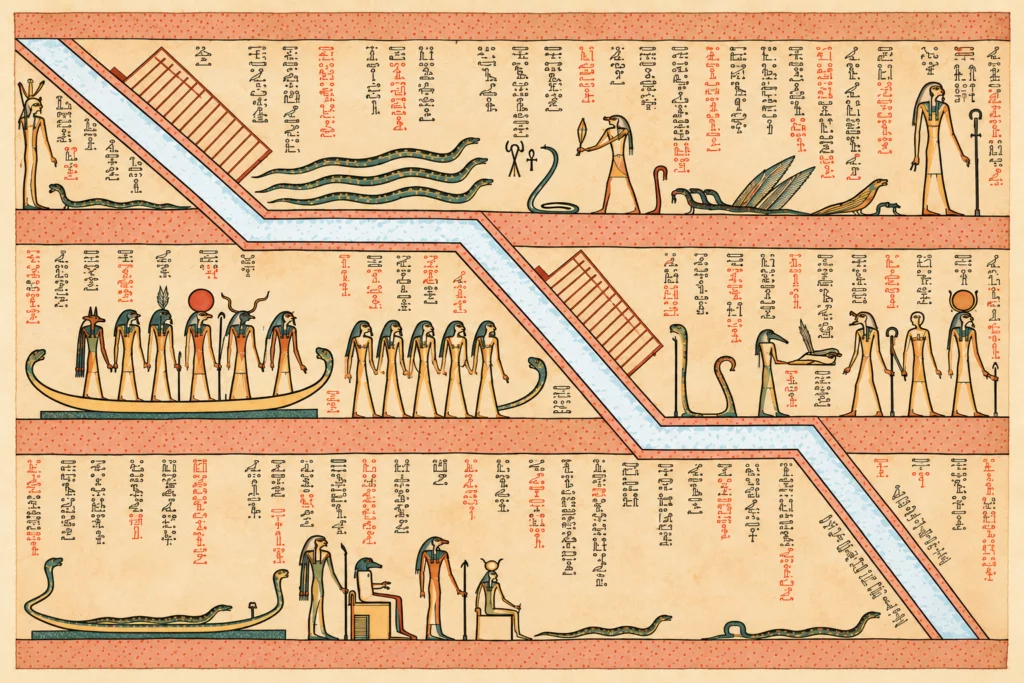
The landscape changes abruptly. The sun reaches Rosetau, the domain of Sokar, a sandy desert where water is lacking. A zigzag path crosses the three registers and closes them off with gates. The barque can no longer sail: it becomes a serpent, with a head at each end, and is towed over the sand. The only light comes from the fire spat out by its prow. In this world of darkness live serpents with legs, wings or several heads. Thoth and Sokar hold the wedjat eye, the healed eye, a sign that the god must be restored.
In KV 34: end of the west wall, near the entrance to the chamber.
Fifth hour: the cavern of Sokar
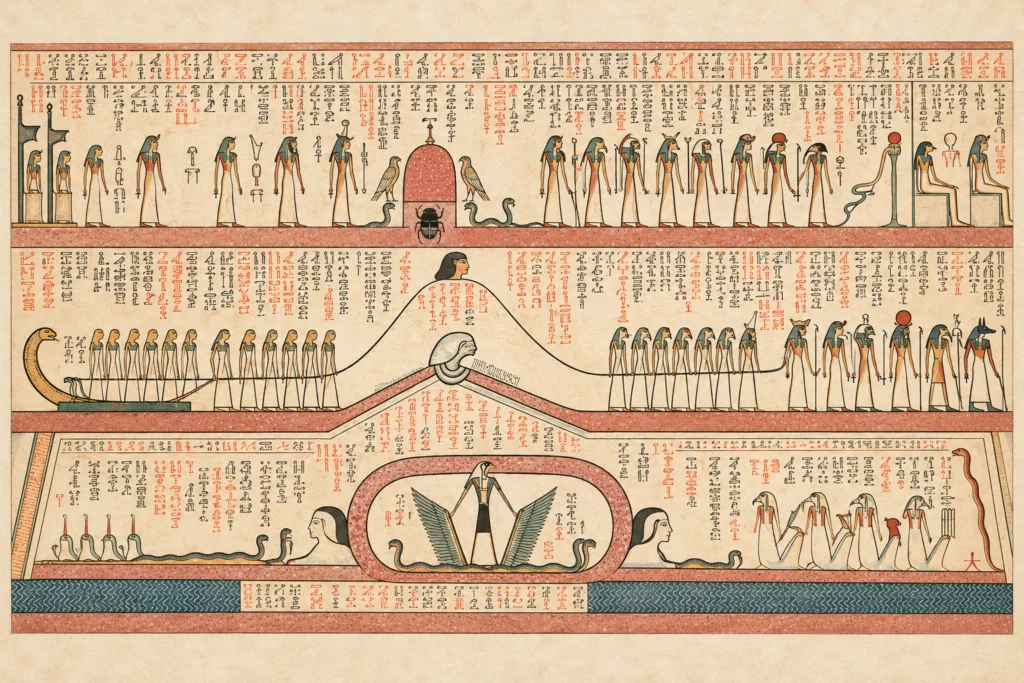
The fifth hour shows a landscape in cross-section. In the centre, a mound topped by the head of Isis covers an oval cavern, guarded by Aker, a double sphinx whose two heads look one to the west, the other to the east. In this cavern, falcon-headed Sokar stands between the wings of a serpent. Below stretches a lake of fire. Higher up, a scarab appears at the top of a mound, while the barque is towed over the sand by seven gods and seven goddesses. The secret of the hidden god, deep in the earth, is at the same time the source of renewal.
In KV 34: south wall, between two annexes.
Sixth hour: in the depths of the night
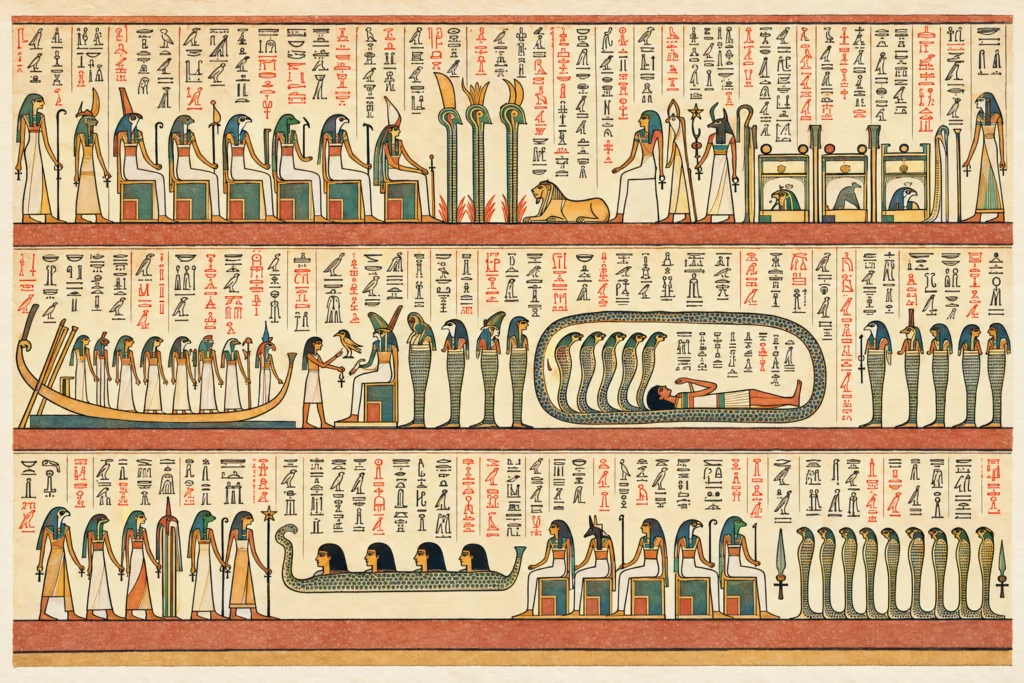
The sixth hour is the centre of the book. The sun finds water again, deep water, that of Nun, the ocean of origins. It is here that the soul of the sun (its ba) unites with its body, which is also the body of Osiris. One image says it without words: a recumbent body with a scarab’s head, protected by a great many-headed serpent. This body is that of Khepri, ‘he who comes into being’. At midnight, the blackest night already holds the seed of day. On the banks stand kings of Egypt, the four sons of Horus and Thoth.
In KV 34: south wall, around the entrance to an annexe.
Seventh hour: the victory over Apophis
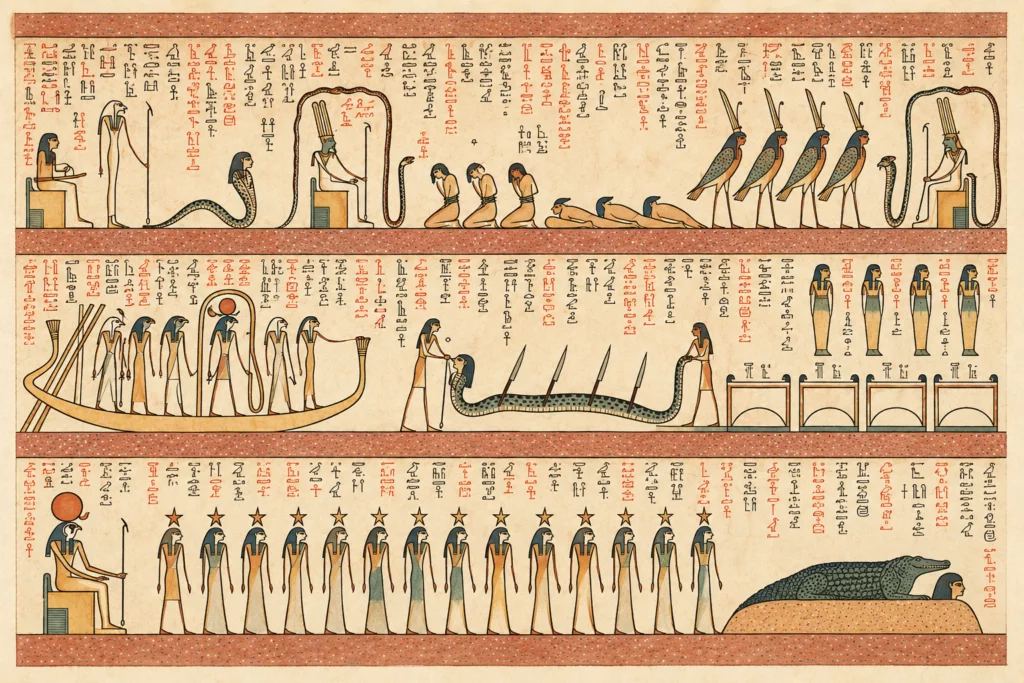
After the union at midnight comes the crisis. The serpent Apophis, enemy of the sun and figure of chaos, stretches out on a sandbank and tries to stop the barque by drinking the water beneath it. The magic of Isis, standing at the prow, and that of the ‘Eldest Magician’ neutralise him; Serqet and a god ‘who is on his knives’ pin him down and pierce him. In the barque, Mehen wraps his coils around the sun to protect it. In the upper register, Osiris, seated beneath another Mehen, sees his enemies beheaded. In the lower register, Horus sits enthroned facing the star gods and goddesses who lead the hours.
In KV 34: beginning of the north wall, near the entrance to the chamber.
Eighth hour: the caverns of the gods
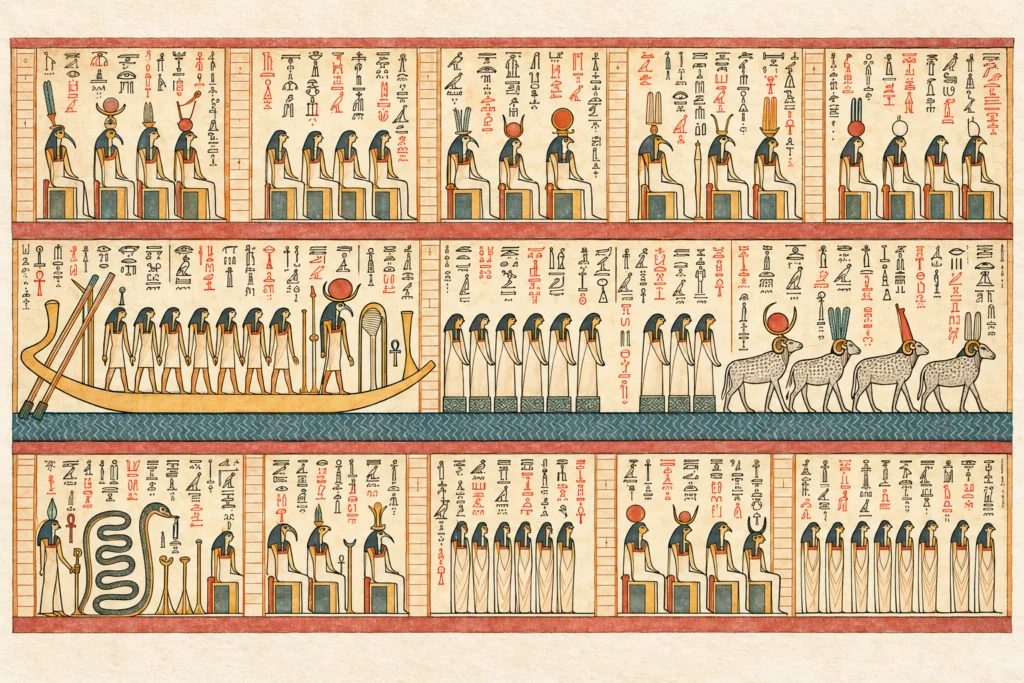
The barque is towed again. It is preceded by four crowned rams, forms of Tatenen, the god of the land risen from the waters. On the banks, the inhabitants live in caverns closed by gates. Each is seated on the sign for cloth, for the sun brings them garments, that is, the dignity of the dead. When the god passes and calls them, their voices answer him; the text compares them to the humming of bees, the cries of tomcats or laments.
In KV 34: north wall, between two annexes.
Ninth hour: the rowers of the sun
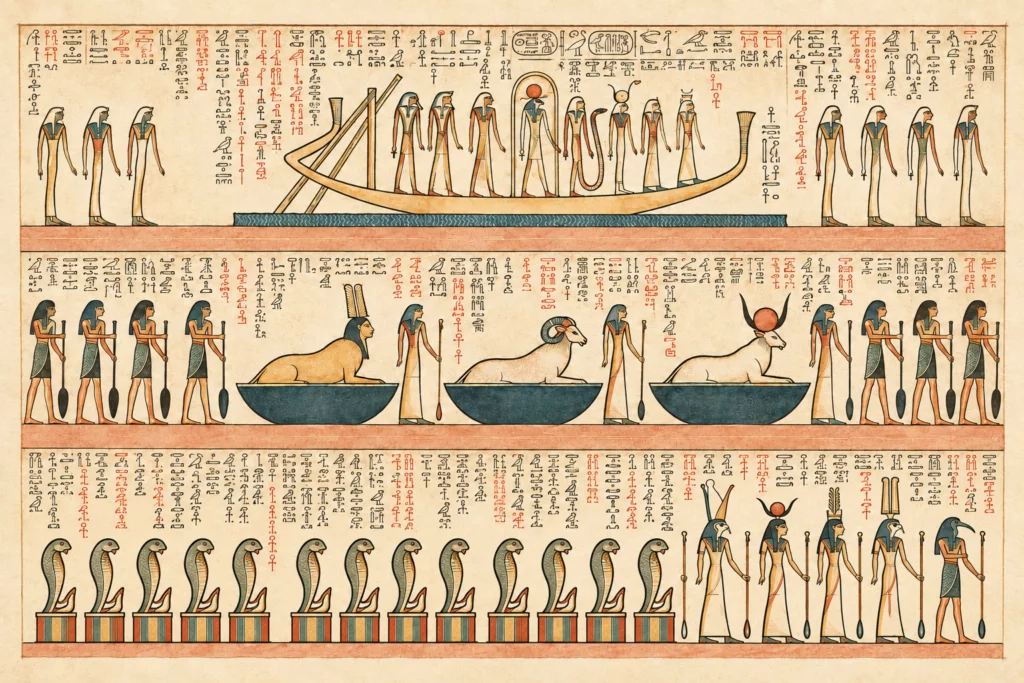
The sun finds water again. Twelve rowing gods stand on the banks, oar in hand: their task is to move the barque forward and to pour water for the inhabitants of the region. Twelve cobras spit fire to protect Osiris, and deities seated on the cloth sign receive bread and beer. The night changes rhythm: from now on it turns towards morning.
In KV 34: north-east corner of the chamber.
Tenth hour: the drowned and the guardians
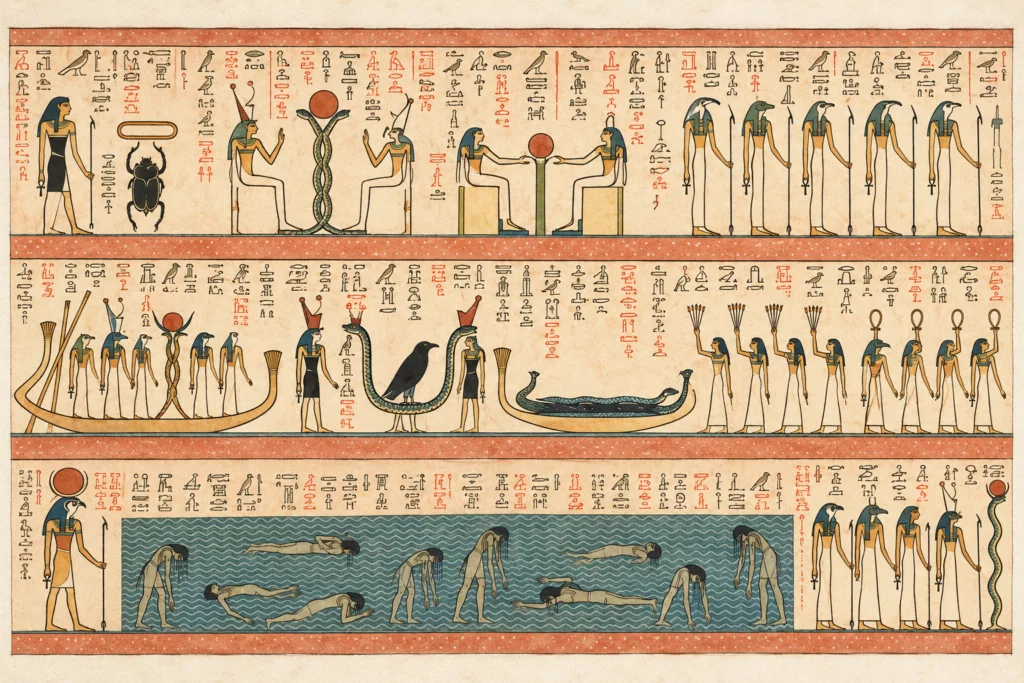
The tenth hour prepares rejuvenation. A scarab pushes an oval in front of it, an image of the sun about to be born. In the waters of Nun, in the lower register, float the drowned: deprived of burial, they are nevertheless gathered up by Horus and saved. Archers, spearmen and javelin bearers, armed for the sun, guard the route against its enemies. There is also a two-headed serpent, guardian of this passage.
In KV 34: north-east corner, then east wall.
Eleventh hour: the pits of fire
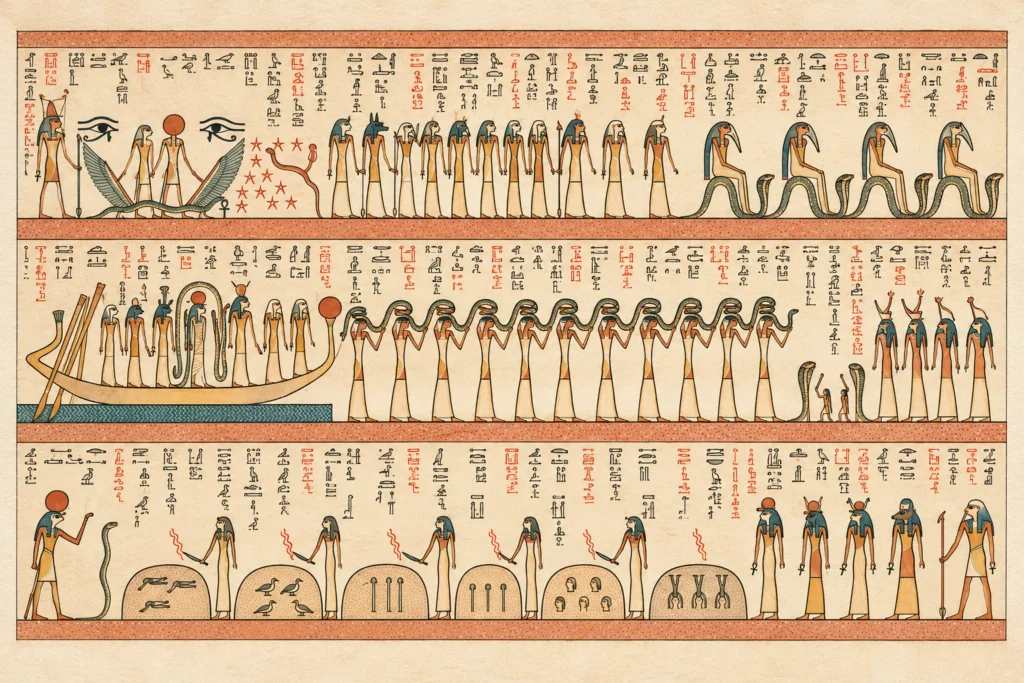
In front of the barque, gods carry a long serpent, and the sun disc shines at the prow. The eleventh hour is that of punishment: in the lower register, Horus has the enemies of the sun destroyed in pits of fire, where their bodies, their souls, their shadows and their heads burn, guarded by goddesses who spit flames. The order of the world, which the sun will restore at dawn, demands that disorder be annihilated.
In KV 34: east wall, behind the sarcophagus.
Twelfth hour: rebirth
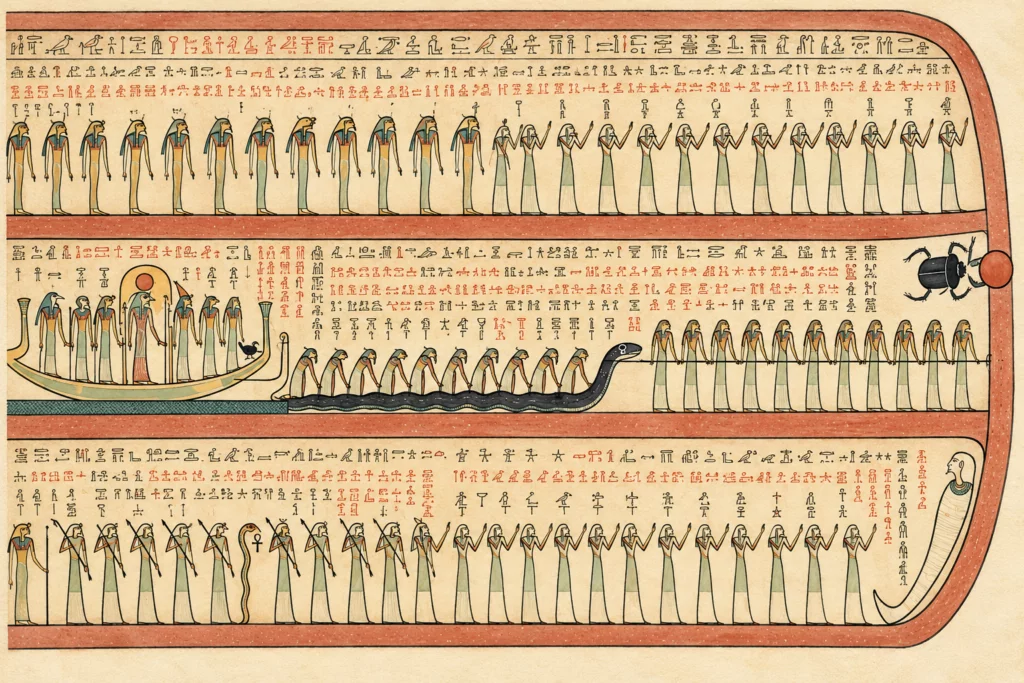
The last hour is played out inside an immense serpent called ‘Life of the Gods’. The barque, towed by gods and goddesses, enters by its tail and comes out through its mouth: the backward journey through the serpent’s body wipes away old age. The sun emerges as the scarab Khepri and rises towards the eastern horizon. At the far edge of the wall, a great mummiform figure closes the night: the body remains in the Duat, while the rejuvenated sun climbs into the morning sky.
In KV 34: east wall, above the king’s sarcophagus.
The whole cycle at a glance
Read in sequence, the twelve hours trace a simple curve. The first three hours are those of water and abundance. The fourth and fifth go down into the desert of Sokar, where the barque has to be dragged. The sixth touches bottom, where the sun unites with Osiris. The seventh and eighth face chaos and visit the dead. The last four prepare the exit: rowers, guardians, punishment of the enemies and the passage through the serpent. The whole book follows the same movement: going down into the depths of death to find there the strength of life.
Before and after Thutmose III
The tomb of Thutmose III preserves the oldest complete version, but it is not the first. Fragments of the Amduat painted on limestone blocks come from tomb KV 20, used for Thutmose I and Hatshepsut. In 2025 the tomb of Thutmose II, identified in a wadi of the Theban mountain west of the Valley of the Kings, in turn yielded fragments of plaster bearing the text, beneath a blue ceiling scattered with yellow stars. The book therefore existed from the beginning of the 18th Dynasty.
After Thutmose III, it remained the book of the royal burial chamber. Amenhotep II took up the same unrolled-papyrus style; then, in the Ramesside period, the Amduat was painted in colour and shared the walls with other compositions, the Book of Gates, the Book of Caverns or the Book of the Earth. In the tomb of Ramses VI (KV 9) it is no more than one part of a vast ensemble of books of the afterlife.
In the 21st Dynasty it went down on papyrus into the tombs of the priests of Amun. A papyrus from the cache of the priests at Deir el-Bahri, kept in the Antiquities Museum of the Bibliotheca Alexandrina, measures 4.80 metres: it reproduces only hours 9 to 12, those of rebirth, which is common at this period. In the Late Period, the Amduat was carved on stone sarcophagi, such as that of Nectanebo II, and copied on papyrus down to the Ptolemaic Period. The papyrus of Nesmin, c. 300 BC, now in the Royal Collection, probably contained all twelve hours originally; only eight survive. No known ancient roll today brings together all twelve illustrated hours in full: the tomb of Thutmose III remains the reference.
Copying the twelve hours, from Bonaparte to digital photography
The Description de l’Égypte. The scholars of the French expedition to Egypt did not know KV 34. They did, however, copy in Ramesside tombs of the Valley of the Kings scenes that belong to the books of the afterlife. A thesis from the University of California identifies in plate 86 of the second volume of the Antiquités the great many-headed serpent that protects Khepri at the end of the sixth hour. The draughtsmen reproduced it without knowing which book it belonged to: hieroglyphs could not yet be read.
Budge, 1905. Ernest Alfred Wallis Budge published in London The Egyptian Heaven and Hell, whose first volume, The Book of Am-Tuat, gives the twelve hours with drawings of the scenes and an English translation. Available online, the work remains useful for seeing the whole cycle, but its translation and commentary are now out of date.
Bucher, 1932. Paul Bucher published, at the Institut français d’archéologie orientale (IFAO, French Institute of Oriental Archaeology) in Cairo, the texts of the tombs of Thutmose III and Amenhotep II, with photographs of the walls. This was the first complete photographic record of the Amduat of KV 34.
Hornung, 1963–7 and 2007. Erik Hornung, professor at the University of Basel, produced the critical edition of the text, comparing all the witnesses then known, with a translation and commentary in German. It is still the basis of all studies. In 2007, with Theodor Abt, he published an edition illustrated with colour photographs of the decoration of Thutmose III, accompanied by the hieroglyphs, the transliteration and an English translation.
The Factum Arte facsimile. The Madrid workshop Factum Arte has made a full-size facsimile of the burial chamber, from a digital recording of the walls, retouched to restore cracks, irregularities and graffiti. It allows the twelve hours to be seen without exposing the original tomb to the heat and humidity of visitors, from which glass panels now protect it.
Today. The Amduat remains an active field of research. In September 2025 an international conference held in Lausanne was devoted entirely to it: the origins of the book, comparison between KV 34 and the Ramesside tombs, papyri in the British Museum and in Turin, new fragments from the tomb of Thutmose II.
What the Amduat says
The Amduat answers a question that every sunset raises: how can what dies come back? Its answer does not go through an easy victory. The sun ages, sinks, loses its light, has to be dragged through the sand and defended against Apophis; it is renewed only by uniting with the body of Osiris, in the depths of the night. Life is born of the encounter with death, not of flight from it.
The book also says that this route is ordered. Each region has its measure, each gate its name, each being its place and function. To know this order is to be able to enter it. The king who has the Amduat painted around his sarcophagus is not only asking for protection: he places himself within the cycle of the sun, and his own rebirth takes the form of the day’s.
To go further
- Thutmose III
- The Valley of the Kings
- Ra, Khepri and Osiris
- Apophis and Mehen
- Sokar
- The colours of the Description de l’Égypte (in French)
- Arts and knowledge: all articles
Sources
- Paul Bucher, Les Textes des tombes de Thoutmosis III et d’Aménophis II, Cairo, IFAO (MIFAO 60), 1932.
- Erik Hornung, Das Amduat. Die Schrift des verborgenen Raumes, Wiesbaden, Harrassowitz (Ägyptologische Abhandlungen 7 and 13), 1963–7.
- Erik Hornung, The Ancient Egyptian Books of the Afterlife, Ithaca, Cornell University Press, 1999.
- Theodor Abt and Erik Hornung, The Egyptian Amduat. The Book of the Hidden Chamber, Zurich, Living Human Heritage, 2007.
- Jan Assmann, Mort et au-delà dans l’Égypte ancienne, Monaco, Éditions du Rocher, 2003.
- The Book of Amduat in Ancient Egypt, international conference, Lausanne, 11 and 12 September 2025 (abstracts published by the IFAO).
- Theban Mapping Project / American Research Center in Egypt, entry and photographs of tomb KV 34.
- Bibliotheca Alexandrina, Antiquities Museum, papyrus of hours 9 to 12 of the Amduat, No. 1323.
- Royal Collection Trust, Amduat papyrus of Nesmin, RCIN 1145261.
- Factum Arte, facsimile of the burial chamber of Thutmose III.
- Ernest Alfred Wallis Budge, The Egyptian Heaven and Hell, vol. I, The Book of Am-Tuat, London, 1905 (old edition, consulted for the drawings).
- Description de l’Égypte, Antiquités, plates, vol. II, pl. 86.
- Watercolour after the tomb of Thutmose III (KV 34).