A god linked to the necropolises
Sokar, also written Sokaris, belongs to the world of the Egyptian necropolises. The Metropolitan Museum presents him as an ancient funerary power linked in particular to the region of Memphis. His relationship with the dead does not make him merely a guardian of tombs: the images and objects that bear his name express the hope of a renewed existence. The desert of the burials, the rites and the protection of bodies meet around him. Depending on the period and the medium, his identity can be expressed by a falcon, a human figure with a falcon’s head or a composite form.
An object in the Metropolitan Museum shows a falcon associated with Sokar on a coffin. The bird refers to a deity able to dominate space and to cross the boundaries that separate the living from the dead. This reading remains tied to the funerary context of the object; not every falcon in Egyptian art designates Sokar. Horus, Ra and other gods can also take this form. The inscribed name, the position and the neighbouring figures make it possible to understand which power is being invoked.
The associations with Ptah and Osiris
At Memphis, the name of Sokar comes close to that of Ptah, the great god of the city. On funerary objects he is also associated with Osiris, whose fate of death and rebirth gives the hope of the deceased a powerful language. The compound form Ptah-Sokar-Osiris should not erase the distinct histories of these three gods. It brings their strengths together for a particular use. A small figure in the Metropolitan Museum bears precisely this multiple identity and shows how a theology could take the form of an object that could be handled and placed beside a dead person.
The museum also holds a hollow figure of Ptah-Sokar-Osiris linked to grain. The presence of cereals brings out an analogy: a buried seed can germinate, while the body entrusted to the tomb awaits another form of life. This comparison does not imply that every statuette had the same contents or the same ritual. The material, the cavity and the findspot are clues to be checked separately. They show, however, that rebirth was not only told in words; it could be evoked by concrete objects.
Recognising the figure
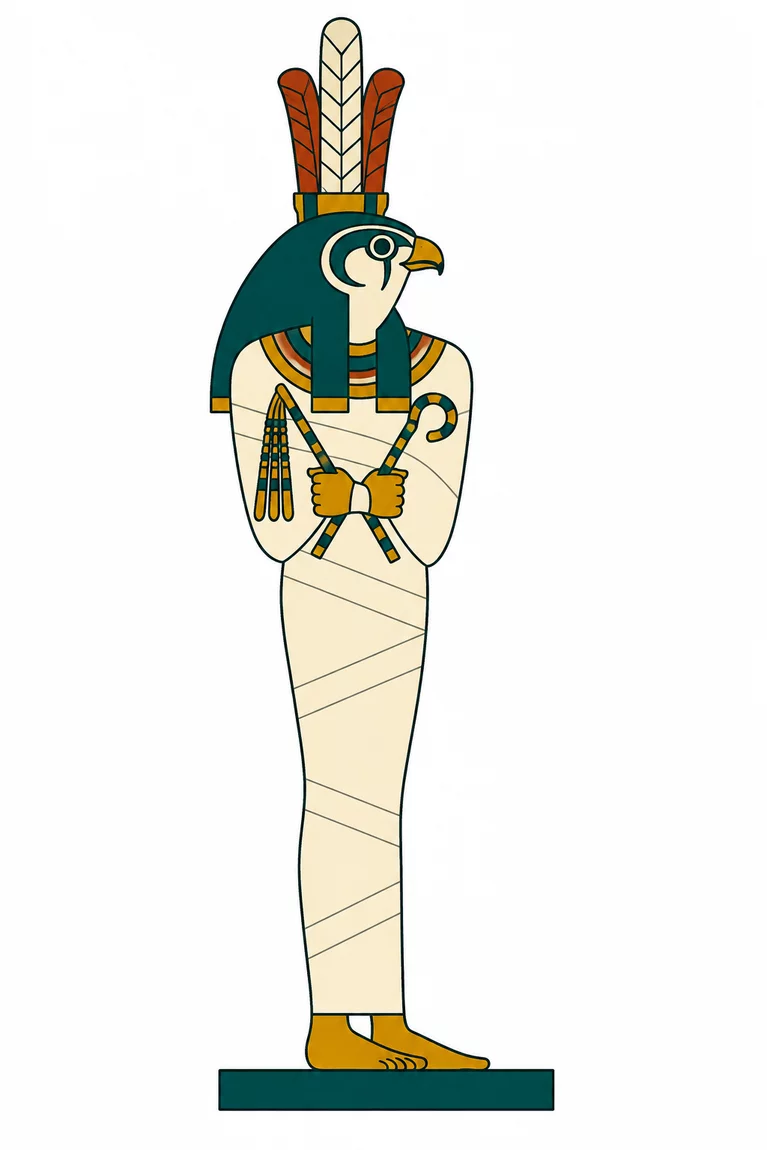
Our contemporary illustration chooses a falcon-headed Sokar, wrapped in a pale garment, with insignia held in front of the body. This choice places him within the series of standing deities while recalling his funerary role. Ancient works offer other solutions: a whole falcon, a composite figure or an emblem placed on tomb equipment. A single image therefore does not sum up the whole of his cult. The name Sokaris, common in French publications, here designates the same deity as Sokar, without creating a second page.
The festival of Sokar and certain representations of his barque link the god to ritual journeys. The museum notes solar associations in this context, but the documents do not justify turning Sokar into simply another name for Ra. His own strength lies in the meeting of the funerary place, ritual movement and the regeneration hoped for. Before a statuette, the right question is for whom it was made and where it was placed. It is this setting that makes legible the promise of protection attached to the god.
Sources and references
- Metropolitan Museum, figure of Sokar as a falcon
- Metropolitan Museum, Ptah-Sokar-Osiris
- Metropolitan Museum, hollow figurine and grain
Reference works
- Richard H. Wilkinson, The Complete Gods and Goddesses of Ancient Egypt, London, Thames & Hudson, 2003, entry Sokar
- Christian Leitz (ed.), Lexikon der ägyptischen Götter und Götterbezeichnungen, 8 vols, Leuven, Peeters, 2002–2003 (Orientalia Lovaniensia Analecta 110–116 and 129)