The scorpion and protection
Serqet, also called Selket, is a goddess linked to the scorpion. The British Museum presents her as a protector against stings and poisons, but also as a funerary figure. Her emblem therefore does not express danger alone. The scorpion can threaten, while the divine power associated with this animal is sought to ward off that very danger. This relationship between risk and protection often appears in Egyptian religion: naming a feared force makes it possible to ask it to become favourable.
The museum notes the role of priests and practitioners associated with Serqet in treating bites and stings. It would be anachronistic to separate a medical domain strictly from a religious one for this period. Ritual words, observation and remedies could come together. The goddess’s name is a reminder that people sought as much to understand and treat a concrete danger as to call on a protective power. The sources do not, however, allow each individual treatment to be reconstructed.
A guardian of the tomb
Serqet also accompanies funerary practice. The British Museum entry associates her with embalming and with the protection of the ruler. In the arrangement of the four sons of Horus, she is often linked to Qebehsenuef. The protective goddesses take their places around the organs, the canopic jars and the coffin. Their action is thought of as collective: no single figure carries all the care owed to the deceased. The scorpion then becomes a sign of watchfulness, meant to keep dangers at a distance.
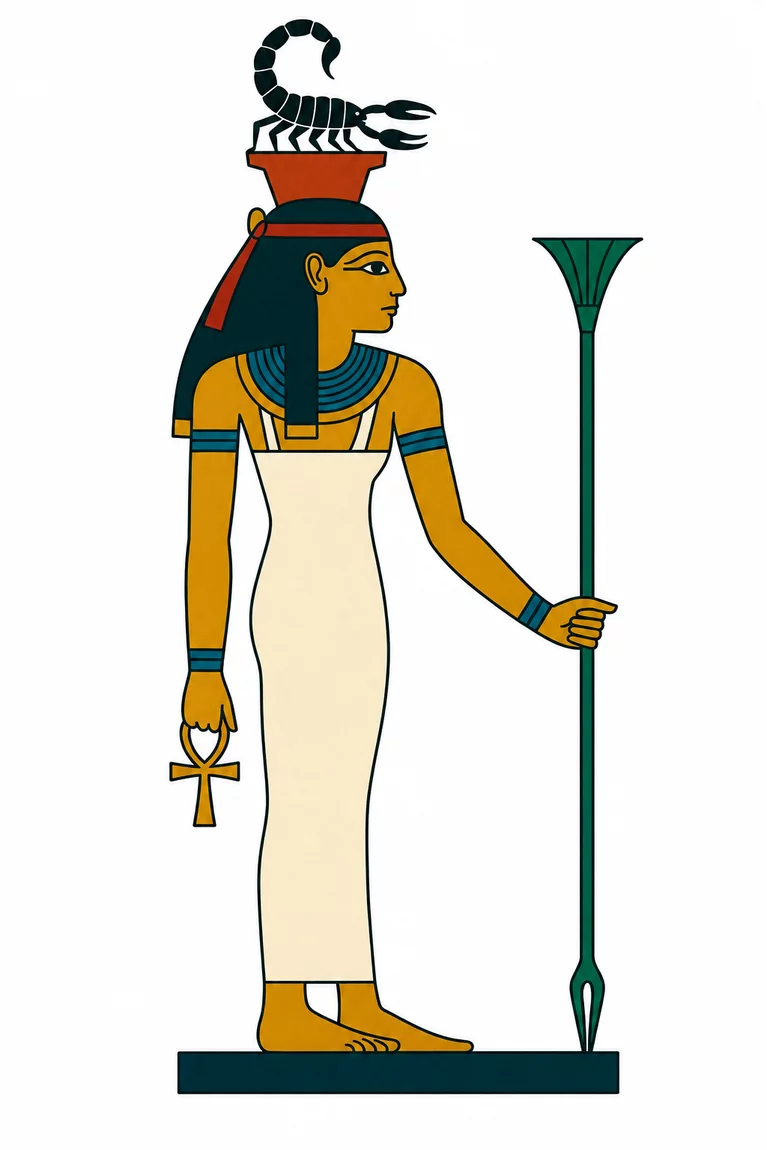
Funerary objects can present variable arrangements. Identifying Serqet on a piece requires considering her written name, her place in the composition and the form of the animal on her head. A small scorpion figure is often enough to recognise her, but there are associations with others. The British Museum, for example, holds a statue of Isis-Serqet, a compound name that shows a particular association. This work does not prove that the two goddesses were merged everywhere.
Reading an image of Serqet
Serqet is often shown as a woman wearing a scorpion on her head. This sign recalls her relationship with venoms and protection against their effects. In funerary scenes, her place beside the other protective goddesses brings out another side of her role: watching over the deceased and the organs entrusted to the sons of Horus. The inscribed name makes it possible to confirm the figure’s identity.
Serqet is a good example of a deity met in several areas of life. The same name refers to the injuries possible in daily life, to the specialists called to treat them and to the protections of the tomb. The feared animal makes these links immediately perceptible. To go further with the goddess, though, we have to go beyond the symbol and observe the objects, texts and contexts that tell us how her power was called upon.
The compound name Isis-Serqet also illustrates the care needed in linking one deity to another. An association of two goddesses does not erase their particular cults or their usual images. On the statue cited, the scorpion becomes a clue to be compared with an inscription and a material description. This method guards against generalisations: it starts from a real object, then compares its signs with other sources. The richness of Serqet is discovered through this patient work.
Sources and references
Reference works
- Richard H. Wilkinson, The Complete Gods and Goddesses of Ancient Egypt, London, Thames & Hudson, 2003, entry Serqet
- Christian Leitz (ed.), Lexikon der ägyptischen Götter und Götterbezeichnungen, 8 vols, Leuven, Peeters, 2002–2003 (Orientalia Lovaniensia Analecta 110–116 and 129)