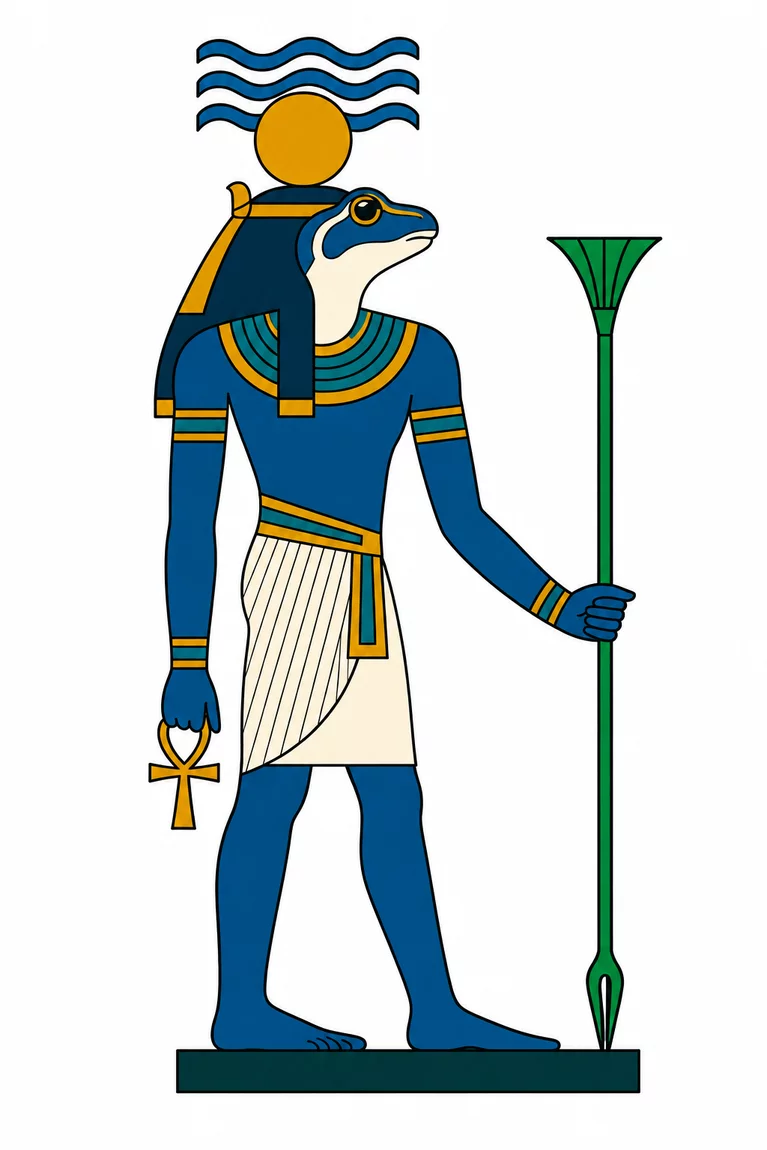
The waters before the world
Nun designates the primordial waters in several Egyptian descriptions of the origin of the world. We should not imagine an ocean placed on an ancient map. This expanse expresses a state prior to the ordering of sky, earth and light. The habitable world emerges from it without the waters necessarily disappearing. Creation is thus often understood as the passage from the undifferentiated to an ordered space, rather than as the making of matter out of nothing.
In the stories of Heliopolis, Atum rises up at the beginning and sets off the generation of the other gods. Speaking of Nun helps us understand the symbolic setting of this appearance. It remains wise to keep the traditions apart: not every text explains origins in the same way, and local theologies cannot be reduced to an official version. The image of the waters serves as the starting point for several formulations. It does not impose a single chronology that each sanctuary would then have repeated identically.
The couple of the Ogdoad
In the tradition of Hermopolis, Nun forms with Naunet one of the couples of the Ogdoad, a group of eight primordial powers. The couples join male and female names to evoke qualities of the state preceding the visible world. This structure is not a family like a human one. It makes it possible to think of complementary forces and bring them into play at the threshold of the appearance of light, land and living beings.
Representations of the Ogdoad often give a frog’s head to the male figures and a serpent’s head to the female ones. This convention makes the group recognisable, but it does not mean that Nun was an ordinary animal. The drawing is a religious language. Our image keeps the frog form to signal the Hermopolitan tradition, while keeping a human body and the visual attributes of the series. On an antiquity, the name and the context remain decisive.
A depth always present
Nun does not necessarily disappear after the first stage of a creation story. The water that surrounds or supports the world can remain a cosmic horizon. Images of the sun’s birth recall the idea of renewal every day: each morning the light reappears. Nun thus represents less a distant ancestor than a depth always available in religious thought, from which the order of the world can be affirmed anew. This continuity differs from a story told only once.
Nun must also be distinguished from the Nile and its flood. The Egyptian experience of water certainly helps us grasp the force of the image, but the river is an observable phenomenon, linked to the fields and the seasons, while the primordial waters belong to cosmology. Confusing them would lose the scope of the myth. Going through the other pages on origins, we find that the Egyptians had several ways of representing a beginning that could not be observed directly.
The representation of Nun in the Ogdoad does not sum up every evocation of the primordial waters. Depending on the document studied, the word can work as a divine name, as a cosmic milieu or as part of a scene of the sun’s birth. These uses answer one another without merging. This flexibility is one of the reasons why the stories of origins resist overly rigid definitions.
Sources and references
Reference works
- Richard H. Wilkinson, The Complete Gods and Goddesses of Ancient Egypt, London, Thames & Hudson, 2003, entry Ogdoad
- Christian Leitz (ed.), Lexikon der ägyptischen Götter und Götterbezeichnungen, 8 vols, Leuven, Peeters, 2002–2003 (Orientalia Lovaniensia Analecta 110–116 and 129)