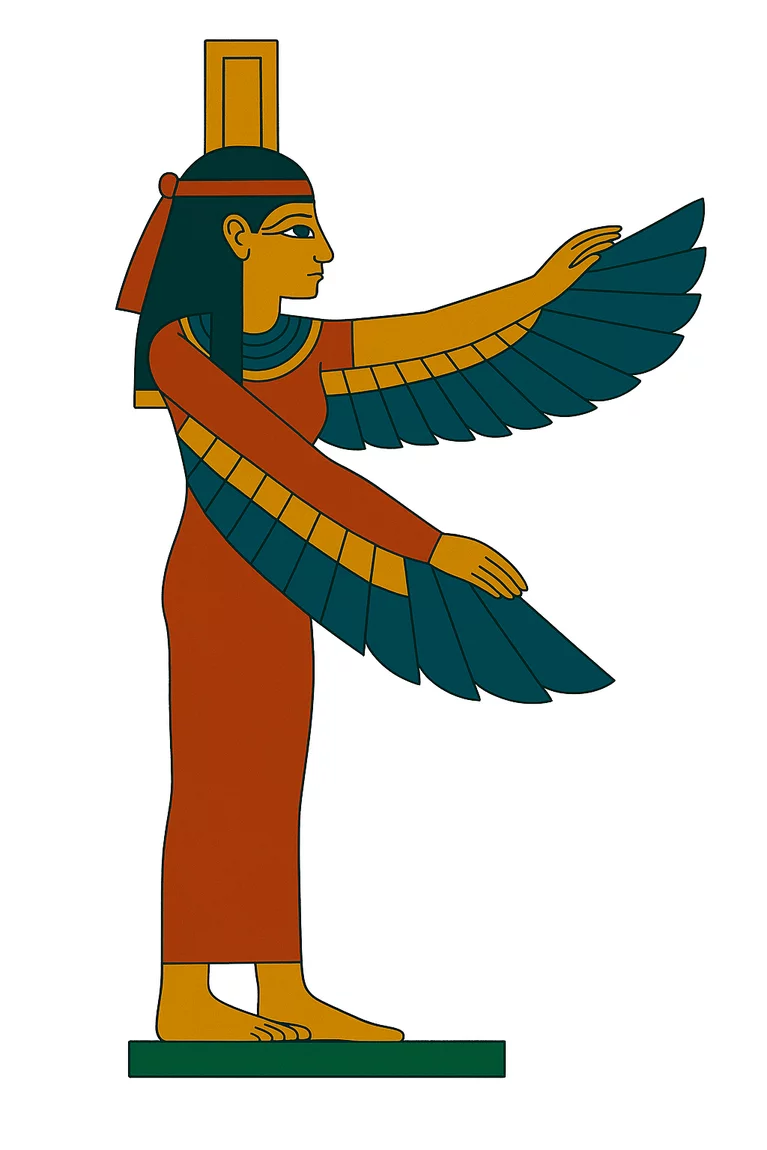
Isis is one of the most famous deities of ancient Egypt. In the cycle of Osiris she searches for Osiris after his death, protects him and raises their son Horus. This story explains part of her reputation as an attentive mother and a power able to restore life. But her cult reaches far beyond the divine family: her images, her names and her sanctuaries had a very long history in Egypt and beyond.
The search for Osiris
In the Egyptian narratives, the death of Osiris does not close the story. Isis acts with perseverance to find and gather what remains of him. Her sister Nephthys appears beside her in the laments and in funerary protection. Versions of the myth differ from text to text; the best-known continuous account was handed down, among others, by a late Greek author. It would therefore be misleading to attribute every detail of that version to every pharaonic period.
The wings of Isis can evoke the breath and the protective shade she brings to Osiris. On coffins and tomb objects, her presence helps the deceased to place themselves under a similar protection. Yet the image of a winged goddess should not be identified by its feathers alone: the position, the other figures and the inscriptions all count. Funerary religion uses a visual language shared by several powers.
Protecting the child Horus
After the birth of Horus, Isis hides him in the marshes of the Delta to keep him away from Seth. The young god remains exposed to snakes, scorpions and crocodiles. This situation feeds many stories of healing and protection. On late magical stelae, the mother able to save her child becomes an ally for families who fear similar dangers. The strength of the myth lies in this movement between a divine episode and a concrete human concern.
Isis also bears the title ‘Great of Magic’. Her knowledge of names and effective words links her to Heka, the power of ritual action. She is not, however, a ‘sorceress’ in the sense of a fairy-tale character. The texts describe a divine competence to protect, heal and transform a situation. Her acts belong to rites, objects and traditions handed down.
Headdresses, places and the long view
The throne sign can stand on the head of Isis. In many images she also wears the horns and sun disc associated with Hathor. Borrowing an attribute shows that certain maternal and royal functions are close; it does not mean that the two goddesses were always interchangeable. Late statuettes show Isis suckling Horus, a theme easy to recognise but one that represents only one aspect of her cult.
Isis was honoured in many places, notably at Philae, near Aswan. Her cult went on growing in the Hellenistic and Roman periods, until it reached other regions of the Mediterranean. This success did not erase the older Egyptian traditions: it adapted them to new contexts. Reading an image of Isis therefore means knowing whether it comes from a pharaonic tomb, a late temple or another setting within the Roman Empire.
Our drawing shows her standing, in the graphic language of the series. The historical and religious figure of Isis, however, does not fit into a single headdress or pose. She brings together funerary action, the protection of childhood, kingship and the power of words. It is this capacity to connect several areas of life that explains her lasting presence in the history of religions.
Sources and references
Reference works
- Richard H. Wilkinson, The Complete Gods and Goddesses of Ancient Egypt, London, Thames & Hudson, 2003, entry Isis
- Christian Leitz (ed.), Lexikon der ägyptischen Götter und Götterbezeichnungen, 8 vols, Leuven, Peeters, 2002–2003 (Orientalia Lovaniensia Analecta 110–116 and 129)