Amun is one of the great gods of ancient Egypt, but his name first invites us to look at what escapes the eye: it means ‘the Hidden One’. His history links several religious landscapes. He belongs to the primordial powers of the Ogdoad of Hermopolis, becomes the leading god of Thebes, and is then closely associated with the sun under the name Amun-Ra. These stages do not simply replace the earlier ones. They show how a deity could take on new interpretations as the centres of power and the traditions of the temples changed.
The hidden god of Thebes
The sources connect Amun with the air, with the breath of life and with the invisible. These terms should not be reduced to a physical definition of the wind: they also designate a power that acts without allowing itself to be grasped directly. At Thebes his importance grew during the Middle Kingdom. The city then became a political centre of the first rank, and the prestige of its god accompanied that rise. The names of several rulers include that of Amun, a sign of his presence in the image of royal power.
At Karnak, on the east bank of Thebes, the great sanctuary of Amun received buildings, statues and offerings over many centuries. The complex visible today is therefore the result of successive additions, not of a single building project. The rulers of the New Kingdom left their mark there in particular. The temple shows at once a religious practice, considerable resources and the kings’ wish to place themselves in continuity with the god.
Amun-Ra and the divine family
The coming together with Ra gave birth to Amun-Ra. This association expresses both the hidden nature of Amun and the visible light of the sun. It does not mean that the two gods never existed separately: Egyptian traditions could distinguish or unite them depending on the context. Amun then received royal and cosmic titles, while his cult spread far beyond the Theban region.
At Thebes he forms a triad with Mut and Khonsu. Mut holds the place of the great goddess associated with the god, and Khonsu that of the divine child. Amaunet belongs to a different relationship: she is his female counterpart in the Ogdoad, a group of eight powers linked to the state of the world before creation. She can also appear from time to time beside Amun at Thebes. These two religious groupings must not be confused.
Recognising Amun in images
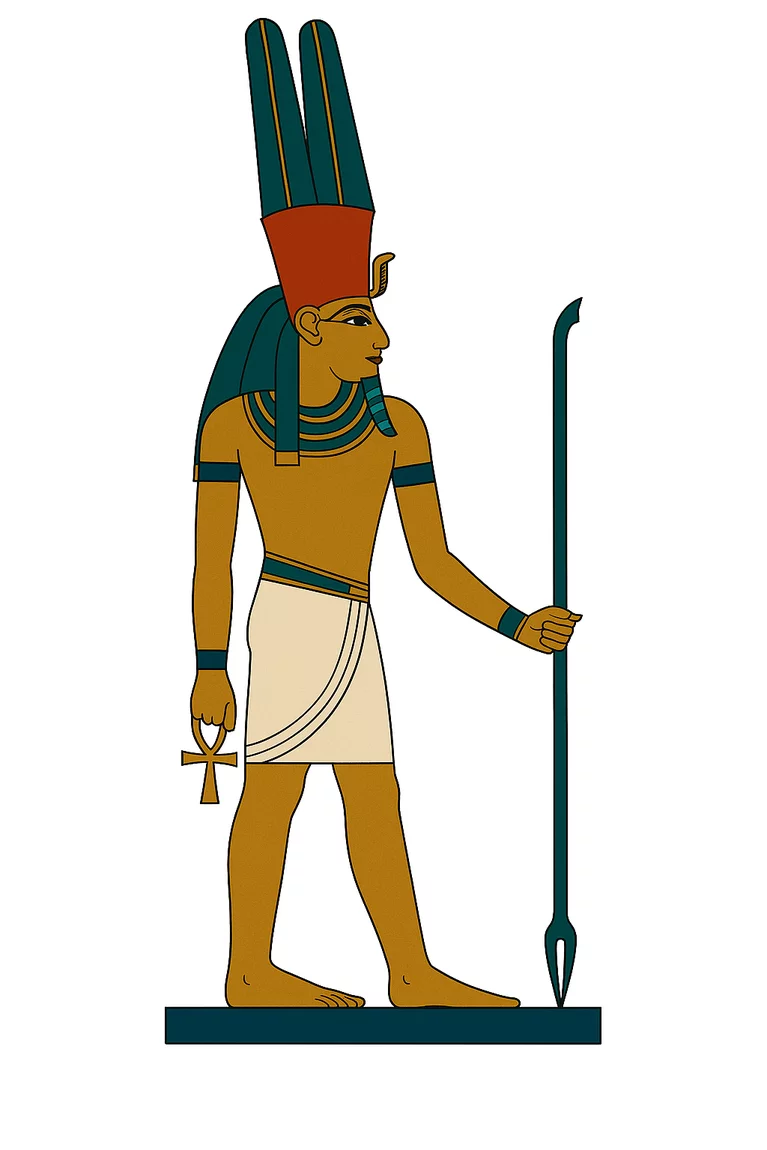
Amun is often shown as a man crowned with two tall plumes, with a ribbon hanging down behind his head. His skin may be painted blue. The ram and the goose are also associated with him. These visual signs help to recognise him, but identifying an ancient work always requires reading its inscription and its context: a crown or an animal may be shared by several gods.
The drawing shows Amun in human form, crowned with two tall plumes: a recognisable type that does not reproduce any particular statue. In the temples, moreover, the divine figure was not merely a portrait. Its crown, its colour, its posture and the objects it held expressed functions and relationships with other powers.
Festivals, power and time
At the Opet festival, the divine image of Amun was carried from Karnak to the temple of Luxor. The processional way linked the two sanctuaries. Such a journey made the god present in the space of the city and placed royal power at the heart of the ritual. It is a reminder that Egyptian religion was limited neither to creation stories nor to images fixed on walls: it involved acts, routes and a calendar of celebrations.
The power of Amun went through changes. His influence depended on the history of Thebes and of the dynasties; his priesthood at times played a considerable political role. Yet this history cannot be summed up as a steady rise. Texts, objects and monuments preserve several Amuns: the god of breath, the member of the Ogdoad, the lord of Karnak, the partner of Mut and the form united with Ra. Reading them together helps us understand why the same name stayed alive for so many centuries.
Sources and references
Reference works
- Richard H. Wilkinson, The Complete Gods and Goddesses of Ancient Egypt, London, Thames & Hudson, 2003, entry Amun
- Christian Leitz (ed.), Lexikon der ägyptischen Götter und Götterbezeichnungen, 8 vols, Leuven, Peeters, 2002–2003 (Orientalia Lovaniensia Analecta 110–116 and 129)