A place in the divine family
Nephthys belongs to the divine genealogy of Heliopolis. The British Museum presents her as the daughter of Geb and Nut, sister of Isis and Osiris, and consort of Seth. In the stories linked to Osiris she appears beside Isis. This closeness helps us understand her place: Nephthys is not merely a secondary silhouette. She takes part in protecting the dead and in the continuity of life hoped for beyond loss. Her presence completes the acts and words of her sister.
The divine genealogy does not, however, make a stable biography in the modern sense. Texts may keep some ties and leave others aside depending on the rite or the place. We should avoid turning all the traditions into a single novel. On funerary objects, the gesture of Nephthys beside Isis is often more important than a list of kinships. Together the two goddesses surround, mourn and protect the deceased. The relationship is read in the very arrangement of the images.
The name become a headdress
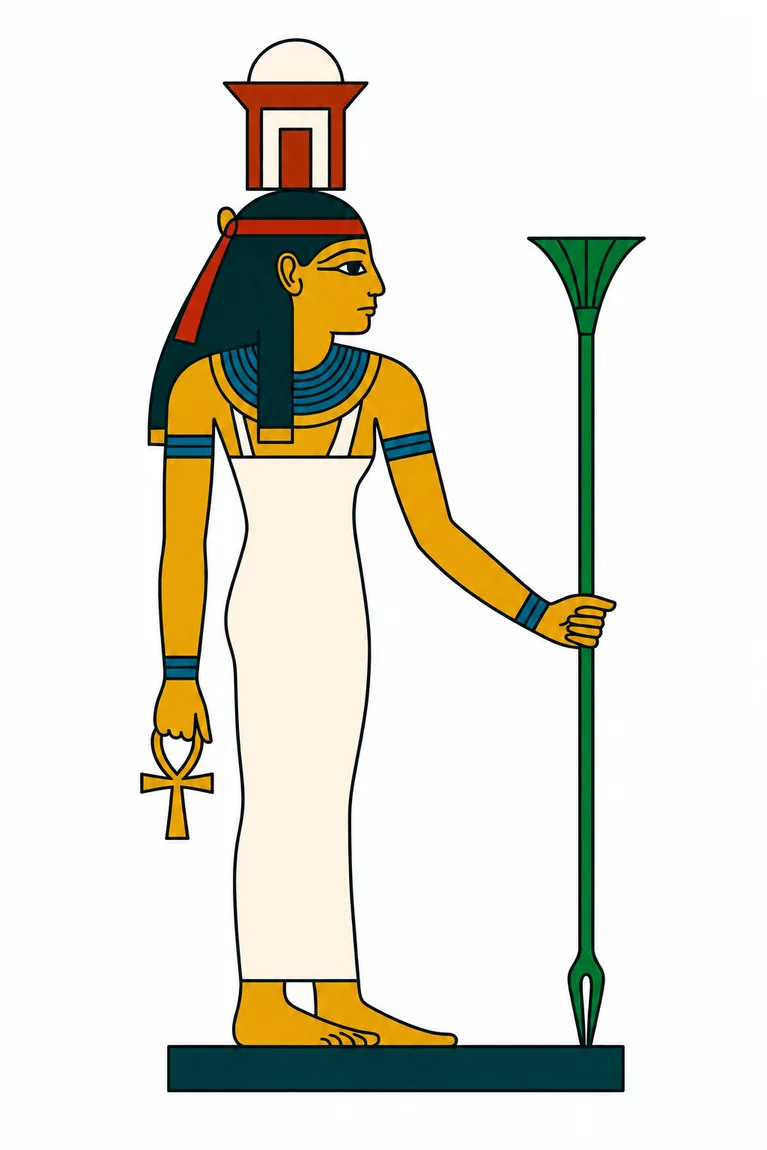
Nephthys usually wears on her head the hieroglyphic signs that write her name, combining a house and a basket. The British Museum describes an amulet on which this headdress allows her to be identified. It is not a simple ornament added to the costume. In Egyptian art, writing and image work together: the name can become a crown and make a figure legible even on a very small object. The shape of the headdress counts as much as the colour.
The goddess can also take a winged form, like other protectors of the tomb. The wings suggest enfolding and defence. Placed on a coffin, they address the dead as much as the living who perform the rites. An isolated image does not, however, yield its whole meaning. We must look at its place on the object, the neighbouring inscriptions and the presence of Isis or of the sons of Horus. The whole explains her function better than a detached attribute.
Mourning and hope
A papyrus in the British Museum contains songs of Isis and Nephthys. This source is a reminder that mourning was also expressed through ritual speech. Weeping for Osiris is not only a matter of showing emotion: in the logic of these texts, the laments take part in an action favourable to his rebirth. Words and images support each other. The goddess helps to maintain a presence at the very moment when the disappearance seems final.
Our illustration takes up the signs of the name and the posture of a standing goddess. It helps the reader to tell Nephthys from Isis, but the colour of the dress is not a compulsory ancient criterion. Funerary protection did not depend on a single power. Several deities cooperated around the body, the offerings and the texts. Nephthys embodies this vigilance at the threshold of the tomb: a presence that accompanies separation and gives shape to the hope of the deceased.
The small amulet in the museum and the songs on papyrus did not fulfil the same function. The one gives a portable body to the goddess’s presence; the others hand down ritual words. Bringing them together lets us measure the variety of media in funerary religion. Each piece of evidence must nevertheless keep its own context and its limits.
Sources and references
- British Museum, Nephthys
- British Museum, amulet of Nephthys
- British Museum, songs of Isis and Nephthys
Reference works
- Richard H. Wilkinson, The Complete Gods and Goddesses of Ancient Egypt, London, Thames & Hudson, 2003, entry Nephthys
- Christian Leitz (ed.), Lexikon der ägyptischen Götter und Götterbezeichnungen, 8 vols, Leuven, Peeters, 2002–2003 (Orientalia Lovaniensia Analecta 110–116 and 129)