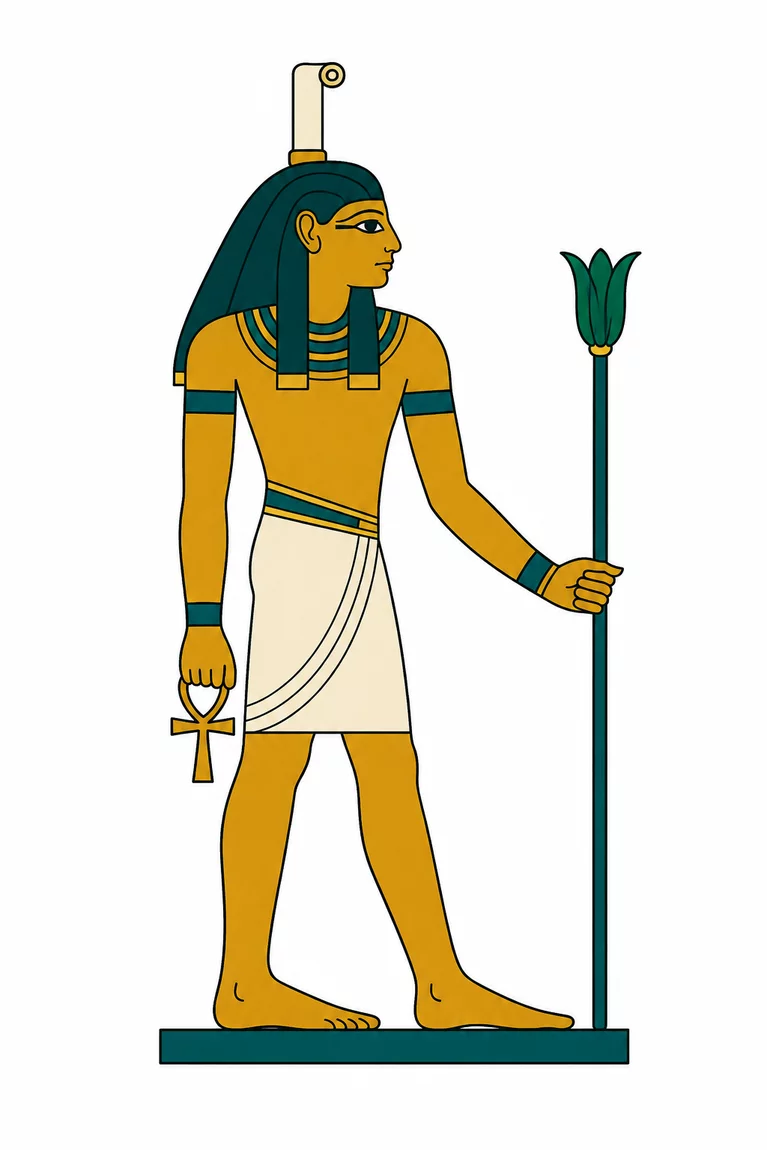
Hu, written Hou in French, personifies authoritative speech in Egyptian religious thought. This is not simply the fact of speaking. His function concerns a word that orders, affirms and makes an action effective. In texts where he accompanies Sia, the personification of perception, he helps us understand the relationship between knowing a situation and being able to act on it through the right utterance.
A word that acts
In many cultures words can describe the world; in Egyptian rites some words were also meant to produce an effect. Naming, declaring, blessing and giving an order were not interchangeable acts. Hu embodies authoritative utterance in particular. A text from the Oriental Institute of the University of Chicago explains the pair Hu and Sia as two capacities associated with the sun god: effective expression and the understanding of what must be done.
The comparison with a simple modern ‘voice’ falls short. A royal command, a temple formula and a funerary utterance do not have the same place. Their effects are conceived within a given ritual, political or cosmic framework. It would also be unwise to attribute every effective word in ancient Egypt to Hu. The power of Heka, often translated as magic, runs through many of these practices without being the same as the god of utterance.
Beside Sia and the sun
Hu and Sia are sometimes presented among the companions of Ra. In the image of the solar barque, each participant can represent a power needed for the crossing and for keeping order. Sia grasps or recognises; Hu proclaims. This pair gives divine form to intellectual and verbal capacities without separating them entirely. Understanding and speaking are two moments of the same right action.
Representations of the barque are not all identical, and the sources do not always stress the same figures. We should avoid saying that Hu speaks a single sentence each morning to ‘create’ the sun materially. The evidence rather supports a role of authority and effectiveness of speech in the solar and royal narratives. Modern explanations must stay close to the scenes and texts in which his name appears.
A god without a fixed emblematic animal
Hu takes a human form in religious representations. He has no emblematic animal as instantly recognisable as the falcon of Horus or the canine of Anubis. His inscribed name and his place among the companions of the sun god are therefore essential for identifying him. This presence beside other powers is a reminder that authoritative speech acts together with perception and the capacity to accomplish.
Hu is often linked to the ‘creative word’. The expression is useful if it keeps its precise meaning: the word of a god or a ruler can establish a state of affairs in a religious context. It becomes misleading if ideas from other, later traditions are imported without care. Egyptian religion has its own concepts, words and material supports. A relief, a papyrus or a funerary inscription each shed light on one aspect of this power.
Hu finally reminds us that the Egyptian pantheon includes figures who personify capacities rather than animals, cities or natural phenomena. His relationship with Sia and Heka shows a deep interest in knowledge, expression and action. In the tomb as in the temple, the right word had a value that could be made visible in the form of a god.
Sources and references
- Institute for the Study of Ancient Cultures, University of Chicago, Hu and Sia
- Archaeopress, study of Hu, Sia and authoritative speech
Reference works
- Richard H. Wilkinson, The Complete Gods and Goddesses of Ancient Egypt, London, Thames & Hudson, 2003, entry Hu
- Christian Leitz (ed.), Lexikon der ägyptischen Götter und Götterbezeichnungen, 8 vols, Leuven, Peeters, 2002–2003 (Orientalia Lovaniensia Analecta 110–116 and 129)