A god of life after death
Osiris holds a major place in Egyptian beliefs about death and the possibility of a renewed life. Museums describe him as ruler of the afterlife and a figure of rebirth. His name appears on a wide range of funerary objects, from stelae to coffins. We should not assume, however, that all Egyptians shared one identical doctrine. Texts and images change with the period, the means of each family and local traditions. The importance of the god does not erase this diversity.
Abydos became one of his great cult centres. The British Museum stresses the importance of this landscape of temples, chapels and tombs, visited over many centuries. A stela in its collection shows a deceased man presenting an offering to Osiris in mummiform shape. The gesture links the ritual life of the family to the hope of a future for their dead. Sanctuaries, pilgrimages and dedications kept the god present among the living, long after the moment of burial.
Rupture and rebirth
The traditions tell of the violence of Seth against Osiris and of the efforts of Isis to find and protect her husband. Nephthys takes part in the acts of mourning and safekeeping. Horus, son of Isis and Osiris in the best-known version, then defends his father’s inheritance. These episodes exist in various forms, scattered across texts and images. Gathering them into a continuous story can help us grasp the characters, provided it does not hide the ancient variants.
The strength of the myth lies in the passage from rupture to renewal. Osiris does not return to reign among the living as before; he becomes lord of another realm. This transformation is the ground for the hope of an existence after death. The acts of Isis and Nephthys give religious power to the care of the body, to words and to mourning. Separation is acknowledged, but it must not destroy every possibility of a future for the deceased. The myth gives shape to that expectation.
Germination and justice
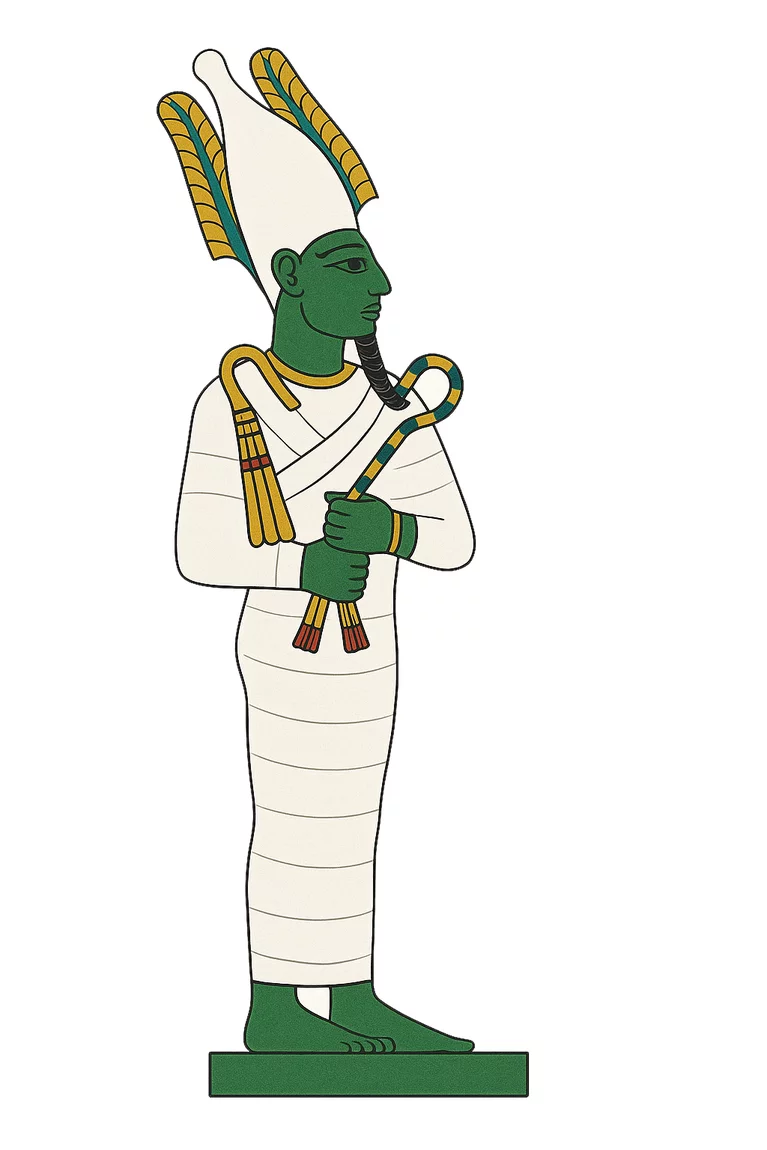
Osiris is often shown as a wrapped body holding the crook and the flail, with the atef crown. His green or dark skin can evoke regeneration. The British Museum also describes seed beds in the shape of Osiris, filled with earth and sown with plants. Germination makes the possibility of renewal visible. This symbol does not allow us to reduce the god to a simple image of agriculture: it belongs to a wider body of funerary thought.
In judgement scenes Osiris presides while the heart of the deceased is weighed in relation to Maat. Anubis and Thoth may take part in the composition. The rebirth hoped for is bound to a demand for order and right conduct. Our illustration keeps the god’s recognisable signs, in particular his crown and insignia. Before an ancient object, the inscriptions and the other figures always complete his silhouette. Osiris is never just a portrait: his place in the scene is part of his meaning.
The colours of Osiris also carry symbolic weight, but ancient pigments have not always survived. The green skin of our portrait evokes regeneration without claiming to fix every ancient representation. A statuette, a stela and a manuscript may choose other effects. The variety of media goes with the long history of a god present in many settings.
Sources and references
Reference works
- Richard H. Wilkinson, The Complete Gods and Goddesses of Ancient Egypt, London, Thames & Hudson, 2003, entry Osiris
- Christian Leitz (ed.), Lexikon der ägyptischen Götter und Götterbezeichnungen, 8 vols, Leuven, Peeters, 2002–2003 (Orientalia Lovaniensia Analecta 110–116 and 129)