The sun as a divine power
Ra is one of the great names of the Egyptian sun god. The sun makes life possible and governs the succession of days; its movement gave rise to many religious narratives. The Metropolitan Museum sums up the cycle of his birth in the morning, his crossing of the sky by day and his night journey through the afterlife. This sequence keeps the world in order. It should not be read as a treatise on astronomy, but as a way of representing both the regularity and the fragility of light.
The sanctuaries did not all present one single version of the sun god. In the traditions of origin, Atum can take the place of creator, and Khepri brings to the fore the sun that rises in the morning. These names are not mere synonyms to be swapped freely. They point to distinct moments or aspects of a solar power. Their relationships change with the text, the period and the place. To understand an image, then, you must look at the name inscribed beside it as much as at its disc.
The barque and the night
The sun often travels in a barque. The Metropolitan Museum points out that the deceased hoped to join Ra on his journey and to share in the rhythm of disappearance and rebirth. The barque makes the movement visible and gives shape to the crossing of regions the living cannot reach. Night is not simply the absence of day: it holds encounters and dangers, over which the morning return must triumph. The solar cycle thus becomes a source of funerary hope.
The goddess Nut can be said to swallow the sun in the evening and give birth to it at dawn. This image adds a maternal dimension to the movement of Ra. Other scenes show the disc above a falcon or above a falcon-headed man. No single figure sums up every tradition. Artists chose forms suited to the ritual, the temple and the medium. Funerary objects often give the cycle a personal meaning for the person who owned them.
The image of Ra-Horakhty
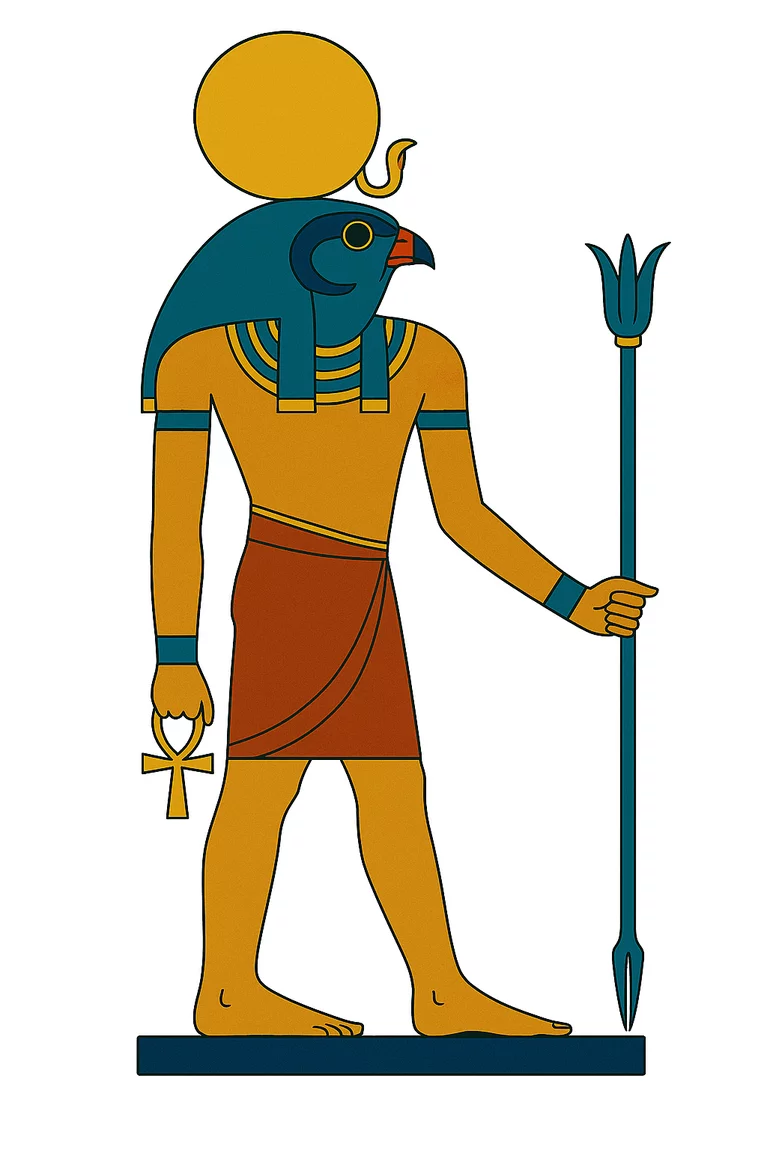
Ra-Horakhty joins the sun god to Horus of the horizons. The falcon head and the sun disc make this relationship visible. This form does not sum up the whole iconography of Ra: the disc, the barque and, in night-time compositions, the ram’s head express other aspects of his presence. The form chosen depends on the divine name, the scene and the moment of the solar cycle.
The central place of Ra rests on the very repetition of the day. Each sunrise shows that order is maintained and that a new beginning is possible. Yet in the narratives this continuity is never automatic: the night crossing has to succeed. Images and hymns thus bring together confidence and vigilance. By comparing Ra, Atum, Khepri and Ra-Horakhty, the reader discovers a way of thinking able to describe several faces of one phenomenon visible to all.
The forms of the sun answer one another in the images, but how they are read depends on the inscriptions. A disc can crown a god other than Ra, and a falcon can signal an association with Horus. Ra-Horakhty expresses this meeting between solar power and the god of the horizons. Compound names thus show how theologies bring deities together while keeping their functions and their places of worship.
Sources and references
- Metropolitan Museum, the cycle of the sun god
- Metropolitan Museum, the sun and the solar barque
- UCL Digital Egypt, creation narratives
Reference works
- Richard H. Wilkinson, The Complete Gods and Goddesses of Ancient Egypt, London, Thames & Hudson, 2003, entry Re
- Christian Leitz (ed.), Lexikon der ägyptischen Götter und Götterbezeichnungen, 8 vols, Leuven, Peeters, 2002–2003 (Orientalia Lovaniensia Analecta 110–116 and 129)