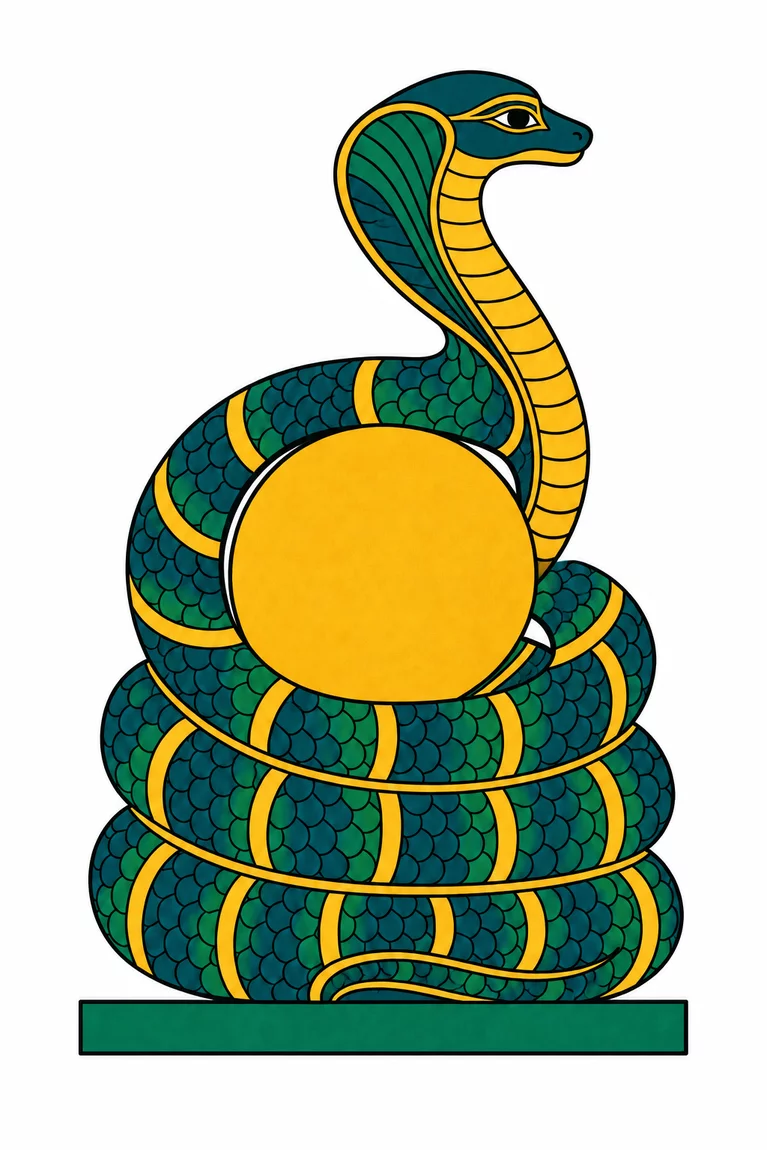
Mehen is a protective serpent associated with the night journey of the sun. His coiled body can surround the sun god and form a barrier against the dangers of the underworld. The image is striking because, within the same religion, a serpent can be a feared enemy or an indispensable ally. Mehen belongs to the second group. To understand him, we must look at the funerary books, the scenes of the solar barque and the objects on which his spiral form appears.
A circle around the sun
In some compositions of the Amduat, Ra crosses the hours of the night by boat. Deities accompany him and obstacles threaten his progress. Mehen forms a protective envelope around the god or his cabin. The movement of the serpent, coiling and uncoiling, gives an image of active guard. A scene in the collections of Eton College shows precisely the ram-headed night sun protected by Mehen.
The journey is not just an adventure told for its own sake. The crossing of the night prepares the next sunrise and, in tombs, can serve as a model for the hope of rebirth of the king or the deceased. The hours, the gates, the names of the beings encountered and the power of the images make up a complex route. Mehen takes part in it as one of the protectors, not as the single figure who would on his own make the sun rise.
Serpent ally, serpent enemy
Apophis is another great serpent of the solar narratives, but he seeks to stop the barque of Ra. Confusing the two would lose an essential distinction. The Carlos Museum of Emory University insists on this variety of roles: serpents could be dangerous and useful, threatening and protective. Their shared animal form does not give them an identical religious function. We have to follow the name and the place of the serpent in the scene.
The protection of Mehen does not imply that all living snakes were honoured as he was. The Egyptians knew snakebite and developed practices to guard against it. The animal world supplied powerful images because it was closely observed. The coiled serpent could evoke a boundary, a force that encircles or a threat, depending on the direction given by the text and the rite.
A name carried by objects
The name Mehen is also associated with an ancient board game in the shape of a spiral serpent. Examples appear as early as the Old Kingdom. The Fitzwilliam Museum holds and describes one of these boards. The exact relationship between the rules of the game, the religious symbol and the funerary representations calls for caution: the complete rules have not come down to us. The spiral form and the name point to a relationship, but they do not allow us to reconstruct fully what the players thought of the god.
Our illustration therefore chooses a large serpent figure coiled around a sun disc, without giving him a human body. This matches his most telling way of protecting the sun and fits the graphic models of the series. The drawing is not a copy of a vignette from the Amduat. Ancient images can place Mehen on a barque, beside other deities and among the inscriptions needed to understand which hour is shown.
Mehen is a reminder that Egyptian religion does not sort animals into fixed moral categories. The same serpentine silhouette can encircle to save or block to destroy. In the night crossed by Ra, the difference lies in the role, the name and the relationship with the sun. Mehen turns the serpent’s coil into a space of protection.
Sources and references
- Eton College Collections, scene from the Amduat with Mehen
- Michael C. Carlos Museum, protective and hostile serpents
- Fitzwilliam Museum, Mehen game board
Reference works
- Richard H. Wilkinson, The Complete Gods and Goddesses of Ancient Egypt, London, Thames & Hudson, 2003, entry Mehen
- Christian Leitz (ed.), Lexikon der ägyptischen Götter und Götterbezeichnungen, 8 vols, Leuven, Peeters, 2002–2003 (Orientalia Lovaniensia Analecta 110–116 and 129)