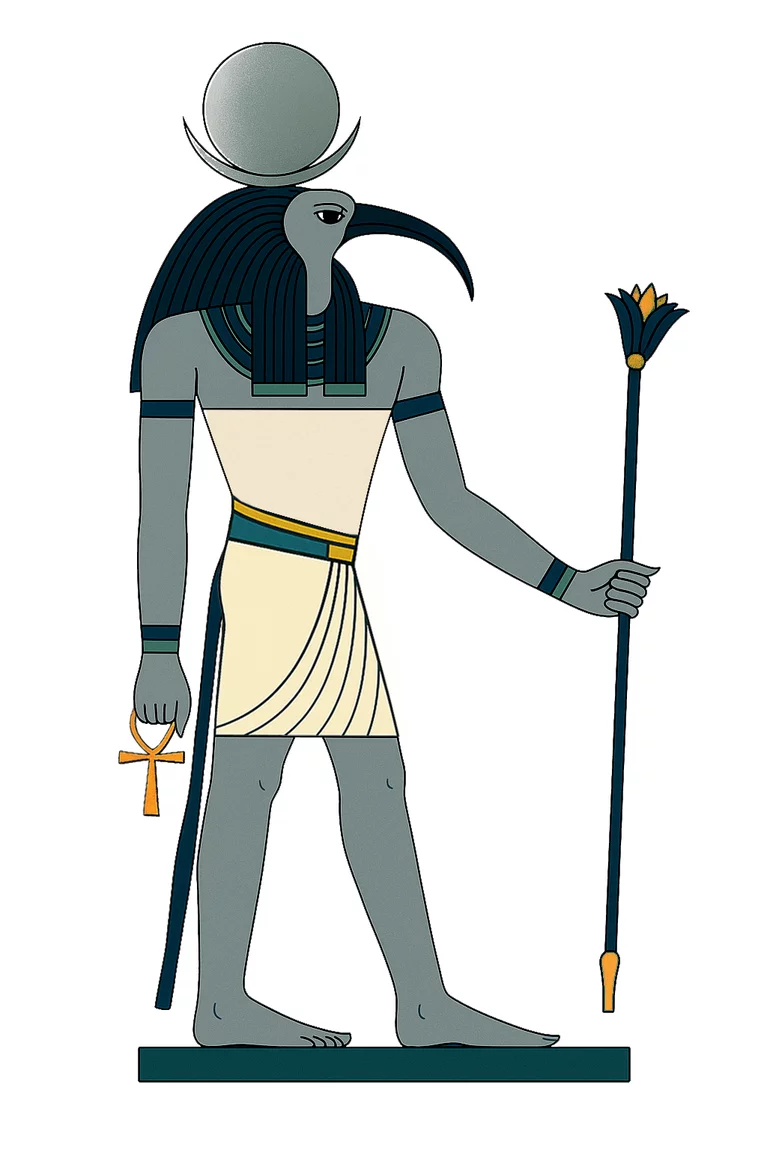
The god of words and measures
Thoth, called Djehuty in Egyptian, is linked to writing, knowledge and the measuring of time. The British Museum presents him as a lunar god and as the patron of scribes. His domain, though, goes well beyond the work of a man seated before a papyrus. Writing a name, keeping an account, reciting a formula correctly and preserving a decision are all acts that give knowledge a lasting form. The Egyptians thus placed Thoth beside activities in which the exact word and memory carry religious weight.
The functions of Thoth link the moon, writing and right measure. The phases of the moon provide landmarks for counting time; the scribe’s work makes it possible to fix a calculation, a spoken word or the outcome of a judgement. These domains meet in one deity whose attributes vary from scene to scene. Thoth can thus act as a scribe, as a lunar power or as a mediator between the gods.
Ibis, baboon and lunar disc
The most famous form of Thoth is that of a man with the head of an ibis. The British Museum and the Metropolitan Museum also list the baboon among his appearances. The lunar crescent and disc can crown his head. This variety rules out locking the god into a single portrait. Our image shows the ibis crowned with the moon, as a full figure suited to the series. It is a contemporary evocation. To name an antiquity, you must always compare the form with the inscription and the context of discovery.
A statuette in the Metropolitan Museum gives a material example of this iconography. The object has a date, a technique and a history of conservation that set it apart from the drawing on this page. Another object in the same museum brings the ibis together with the feather of Maat, a sign associated with right measure and order. It would be too simple to deduce a complete courtroom story from a single feather. The visual association rather draws attention to the precision and truth that go with certain roles of Thoth.
The memory of the judgement
In funerary scenes, Thoth is often presented as the one who records the outcome of the judgement of the deceased. Osiris presides over another part of this group of images, while Maat is linked to the rightness of the weighing. The divine scribe replaces none of these actors: he ensures that the outcome is fixed and acknowledged. The British Museum notes this place in the afterlife. The scenes vary from papyrus to papyrus and tomb to tomb, and do not form an identical illustration repeated everywhere. The detail of the gestures matters when reading them.
Thoth also appears in stories where intelligence and speech act in the face of other gods. Some traditions of the Distant Goddess bring him into contact with Tefnut. You need to say which version is being told before giving him a universal role. His name can suggest a scholar, a calculator or a mediator, but these modern words are ways in, not complete definitions. Moving from the ibis to the moon, then from the papyrus to the judgement, we discover a god of knowledge put into action.
Sources and references
- British Museum, Thoth
- Metropolitan Museum, statuette of Thoth
- Metropolitan Museum, ibis and feather of Maat
Reference works
- Richard H. Wilkinson, The Complete Gods and Goddesses of Ancient Egypt, London, Thames & Hudson, 2003, entry Thoth
- Christian Leitz (ed.), Lexikon der ägyptischen Götter und Götterbezeichnungen, 8 vols, Leuven, Peeters, 2002–2003 (Orientalia Lovaniensia Analecta 110–116 and 129)