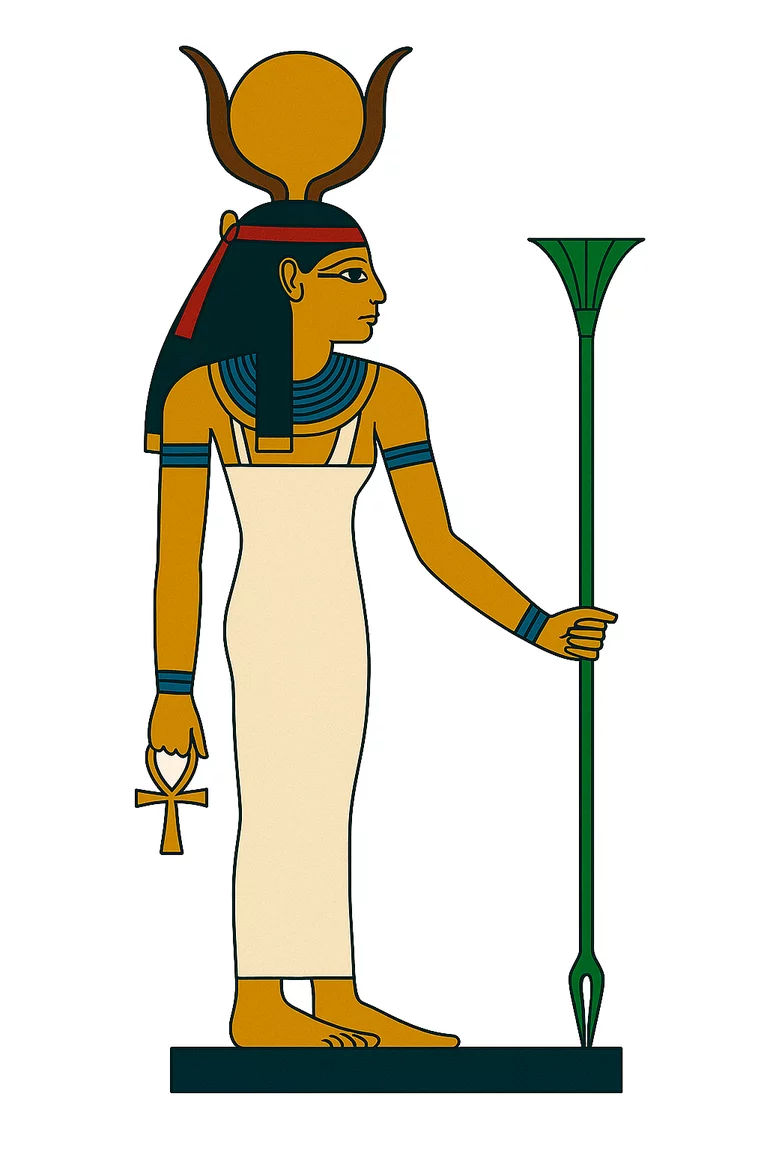
Hathor is a great goddess of ancient Egypt, whose name means ‘house of Horus’. She appears as a cow, as a woman wearing horns around a sun disc, or as a face with bovine ears. Her domain goes beyond motherhood alone: she is linked to music, festivity, kingship, birth and the welcoming of the dead.
Dendera and the other places of worship
The great centre of Hathor was Dendera, in Upper Egypt. The temple seen there today bears witness to a long and complex cult, even if its visible architecture belongs mostly to the late periods. Festivals linked Dendera to Edfu, where Horus was worshipped. The geography of the sanctuaries gave shape to the relationships between gods: journey, meeting and return could become ritual events.
Hathor was honoured far beyond Dendera. The Global Egyptian Museum mentions Nubia, Byblos and Sinai in particular. At Serabit el-Khadim, near the turquoise mines, she bore the title ‘Lady of Turquoise’. This presence on the roads and at the places of extraction is a reminder that deities also went along on journeys, at work and in the search for precious materials. She was not confined to the royal family or to the ceremonies of a single temple.
Music, joy and protection
The sistrum, an instrument shaken to make a sound, is closely associated with Hathor. Some sistra bear her cow-eared face. Music and dance were part of ritual practice; they expressed joy and took part in worship. The menat necklace is another object linked to her world. These attributes explain why the contemporary illustration insists on the colours, the jewellery and the luminous presence of the goddess.
Hathor is also a maternal and nurturing power. As a cow she can suckle a ruler; in some contexts she protects birth. Her relationship to Horus and to kingship is not, however, a single genealogy to be applied everywhere. The goddess’s name, the titles of ‘mother’ and the temple scenes fulfil different theological functions in different periods. Isis can even take on a headdress of horns and sun disc: the attribute alone is therefore not always enough to identify the figure.
A goddess for the dead
In tombs, Hathor can appear as a cow emerging from the western mountain, close to the funerary world. She welcomes and feeds the deceased; as a goddess associated with a tree, she can offer them water and coolness. These acts of offering and regeneration extend her nurturing power into the afterlife. The scenes vary with the monument and the period, without laying down a uniform route for all the dead.
Her gentleness also has a fearsome other side. In one version of the story of the destruction of humankind, the enraged goddess is calmed with beer dyed red to look like blood. This story brings her close to the other forms of the Eye of Ra, among them Sekhmet. It is a reminder that a protector can become dangerous if the balance of the world is broken. Reducing Hathor to beauty or love would erase this part of her power.
Our drawing keeps the headdress of horns and sun disc, the human body and the ritual attributes. It is a way into a much wider repertoire: a whole cow, a face on an instrument, a tree goddess or a lioness figure. Through these forms, Hathor links human experiences as different as birth, celebration and the passage to the afterlife.
Sources and references
The functions and places of worship of Hathor are presented on the basis of the following entries.
Reference works
- Richard H. Wilkinson, The Complete Gods and Goddesses of Ancient Egypt, London, Thames & Hudson, 2003, entry Hathor
- Christian Leitz (ed.), Lexikon der ägyptischen Götter und Götterbezeichnungen, 8 vols, Leuven, Peeters, 2002–2003 (Orientalia Lovaniensia Analecta 110–116 and 129)