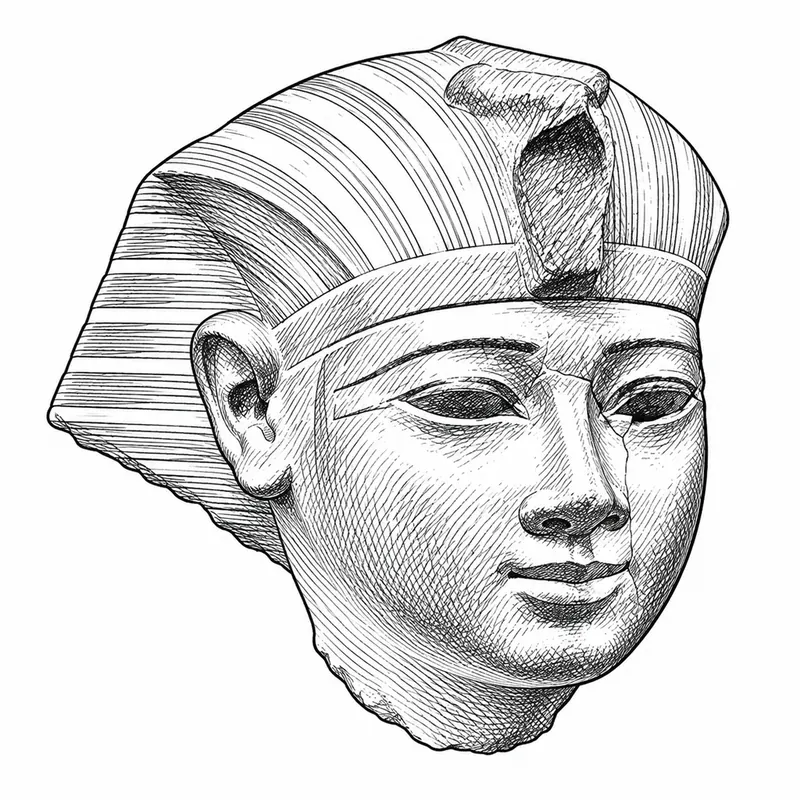
The son of Thutmose III
Amenhotep II was the son of Thutmose III and of a secondary wife, Merytre-Hatshepsut. He was not the eldest son: a brother, Amenemhat, had first been designated heir before disappearing. Associated with the throne by his father for a little over two years, Amenhotep II then reigned alone for about twenty-six years, c. 1427–1401 BC. He inherited an empire built by his father’s campaigns, from present-day Sudan to the Euphrates. His reign is often summed up by the image of an athlete and warrior king, an image he carefully constructed himself.
An athlete king
More than any other pharaoh, Amenhotep II highlighted his physical prowess. A great stela set up near the Great Sphinx of Giza relates that he came to the throne at the age of eighteen and boasts of his strength: he rowed longer than his crews, trained the horses of the royal stable and shot arrows through copper targets. The Metropolitan Museum points out that he prided himself on being a hunter, archer and charioteer. These accounts belong to royal propaganda. They show how a young king asserted his authority by presenting himself as the strongest man in his kingdom.
The campaigns in Syria
From year 3 of his reign, Amenhotep II led a campaign in the Near East to maintain Egyptian authority over the Syrian cities. Stelae, notably the one in the temple of Amada in Nubia, relate that he killed seven rebel princes with his own hand and had their bodies hung from the prow of his ship. Six were displayed on the walls of Thebes, the seventh sent to Nubia, as a warning. Other campaigns followed in years 7 and 9. The stelae of Memphis and Karnak list booty and prisoners whose figures must be read with caution.
Peace with Mitanni
Egypt’s great adversary in the Near East at that time was the kingdom of Mitanni, in Upper Mesopotamia. After the campaigns of Amenhotep II, the two powers stopped fighting each other. The Egyptian texts present Mitanni as coming to ask for peace, in the usual language of royal victory. In practice, a balance was established. This peace would be consolidated under his successors by diplomatic marriages. The reign of Amenhotep II thus marks the passage from a period of conquest to a period of diplomacy between great powers.
Building works and temples
Amenhotep II continued the building projects of his predecessors. In Nubia, he completed the temple of Amada, where he placed his campaign stela. At Karnak, he worked in the temple of Amun (in French) and added several monuments. At Giza, he had a small temple built near the Sphinx, then honoured as a form of the god Horus (in French). This choice reflects the court’s attachment to the Memphite region, where the young prince had grown up. These works do not rival those of his father or of his grandson Amenhotep III, but they show a king present throughout the country.
Tomb KV35 and the royal cache
Amenhotep II was buried in the Valley of the Kings, in tomb KV35, discovered by Victor Loret in 1898. His mummy still lay there in his own sarcophagus, a rare occurrence for a New Kingdom king. Towards the end of the New Kingdom, the tomb had also served as a cache for the mummies of other kings, moved by the priests to protect them from robbers: among others, Thutmose IV, Amenhotep III and several Ramesside kings were found there. Since 2021, the mummy of Amenhotep II has been displayed in the National Museum of Egyptian Civilization in Cairo.
What this reign reveals
The portrait of Amenhotep II handed down by his monuments is that of a strong and victorious king. Behind this discourse, his reign marks a transition. He preserved the empire of Thutmose III, but he also opened the way to peace with Mitanni, which would characterise the following reigns. The head in the Metropolitan Museum, which served as the model for the portrait on this page, shows moreover a young and serene face, far from the brutality of some inscriptions. His son Thutmose IV, who was not the intended heir, succeeded him.
Main sources
- Metropolitan Museum of Art, head of Amenhotep II, 66.99.20
- UCL Digital Egypt, chronology of the Egyptian kings
Reference works
- Ian Shaw (ed.), The Oxford History of Ancient Egypt, Oxford, Oxford University Press, 2000, chronology pp. 479–483
- Aidan Dodson and Dyan Hilton, The Complete Royal Families of Ancient Egypt, London, Thames & Hudson, 2004