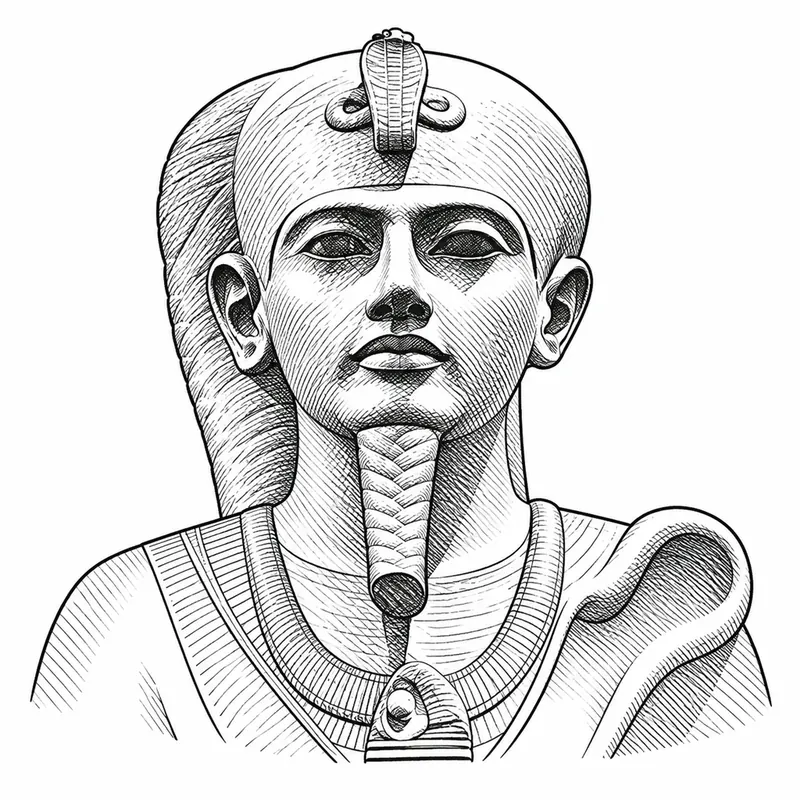
A reign begun in childhood
Thutmose III, Menkheperre, came to the throne while still a child. Hatshepsut first governed for him, then reigned with a royal titulary until her death. The king then continued alone in a long reign, placed by UCL between about 1479 and 1425 BC. This chronology explains why his accession to the throne must be separated from the beginning of his independent rule. His monuments and annals provide an exceptional record for the 18th Dynasty. They describe campaigns towards Palestine and Syria, offerings to Amun (in French) and numerous building projects. The real operations must nevertheless be distinguished from the staging of victory, which was an essential function of royal inscriptions.
Megiddo and military strategy
The Megiddo campaign, recounted in the annals carved at Karnak, is the best-known episode of his external action. The account emphasises the choice of a risky route, the battle and the siege of the city. It reveals the logistics of an army able to cross Sinai, supply itself and maintain distant positions. The version inscribed in the temple naturally puts the king at the centre of the decisions. The details of topography and booty are valuable, but they must be compared with the conventions of the genre. The victory at Megiddo did not settle all the balances of power in the Levant at a stroke. It opened a series of campaigns intended to impose and maintain Egyptian influence.
Seventeen campaigns and the Euphrates
UCL credits Thutmose III with at least seventeen campaigns in Palestine and Syria. The operations took him as far as the Euphrates. This frequency shows that control of the cities and routes did not rest on a single victory. The expeditions served to receive tribute, punish resistance, renew alliances and assert the royal presence. The annals record place names and quantities of goods, but their selection follows the temple’s programme. The modern vocabulary of ‘empire’ is useful for summarising a regional domination; it should not make us imagine an identical administration everywhere. Relations between Egypt and its eastern partners varied from one territory to another.
Karnak, a monumental archive
The long inscriptions at Karnak report campaigns and gifts made to the temple of Amun. They link war directly with religious resources: what was acquired abroad could be dedicated to the god and made visible at Thebes. The king also built the Akh-menu, a vast festival hall, and developed other parts of the sanctuary. These works give architectural form to his power. They are not mere commemorative decoration; they organised rites and processional routes. The obelisks raised for Karnak, some of which were moved far outside Egypt much later, show the complex material afterlife of the monuments. Their present location is not enough to understand their original function.
Nubia and the sanctuaries
Inscriptions of Thutmose III are found in Nubia, notably at Semna, Kumma and Wadi Halfa. A stela from Gebel Barkal contributes to the representation of his southern authority. The construction and restoration of temples served to inscribe the monarchy in territories where Egyptian administration was meant to last. They help to study the relationships between conquest, cult and control of resources. Nubia was not merely a backdrop to his Asian campaigns; it formed a central space in the policy of the New Kingdom. The royal inscriptions speak mainly of the court’s successes. To understand the local societies, they must be compared with the sites, the objects and the region’s own traditions.
The tomb and the memory of Hatshepsut
Thutmose III was buried in tomb KV34 in the Valley of the Kings. His reign is also linked to the later interventions on the memory of Hatshepsut. The erasure of her names and images is real, but its motives and timing cannot be reduced to a story of resentment. The long initial coexistence of the two rulers and the king’s later independent action must be studied separately. The reused monuments, the displaced blocks and the surviving inscriptions make the enquiry possible. They invite us to see Thutmose III both as the heir to a singular dynastic situation and as the author of his own political programme, carried out over several decades.
A power documented with precision
The importance of Thutmose III rests on the exceptional density of his sources: annals, the monuments of Karnak, Nubian attestations, museum objects and private testimony. They allow us to follow the repetition of the campaigns and the way external gains were linked to the cult of Amun. They also show the limits of a narrative written by the victors. The strategy can be explained without turning the lists of booty into exact accounts, and the ‘empire’ can be described without erasing the diversity of local relations. This reading makes the reign more interesting than the image of an isolated conqueror: he was also an organiser of sanctuaries, networks and royal memory.
Main sources
- UCL Digital Egypt, Thutmose III and his attestations
- UCL Digital Egypt, Hatshepsut and the first years of the reign
- Metropolitan Museum of Art, study of a statuette of Thutmose III
- Model for the line portrait: IFAO catalogue of the Karnak Cachette, CG 42054 / JE 36927.
Reference works
- Ian Shaw (ed.), The Oxford History of Ancient Egypt, Oxford, Oxford University Press, 2000, chronology pp. 479–483
- Aidan Dodson and Dyan Hilton, The Complete Royal Families of Ancient Egypt, London, Thames & Hudson, 2004