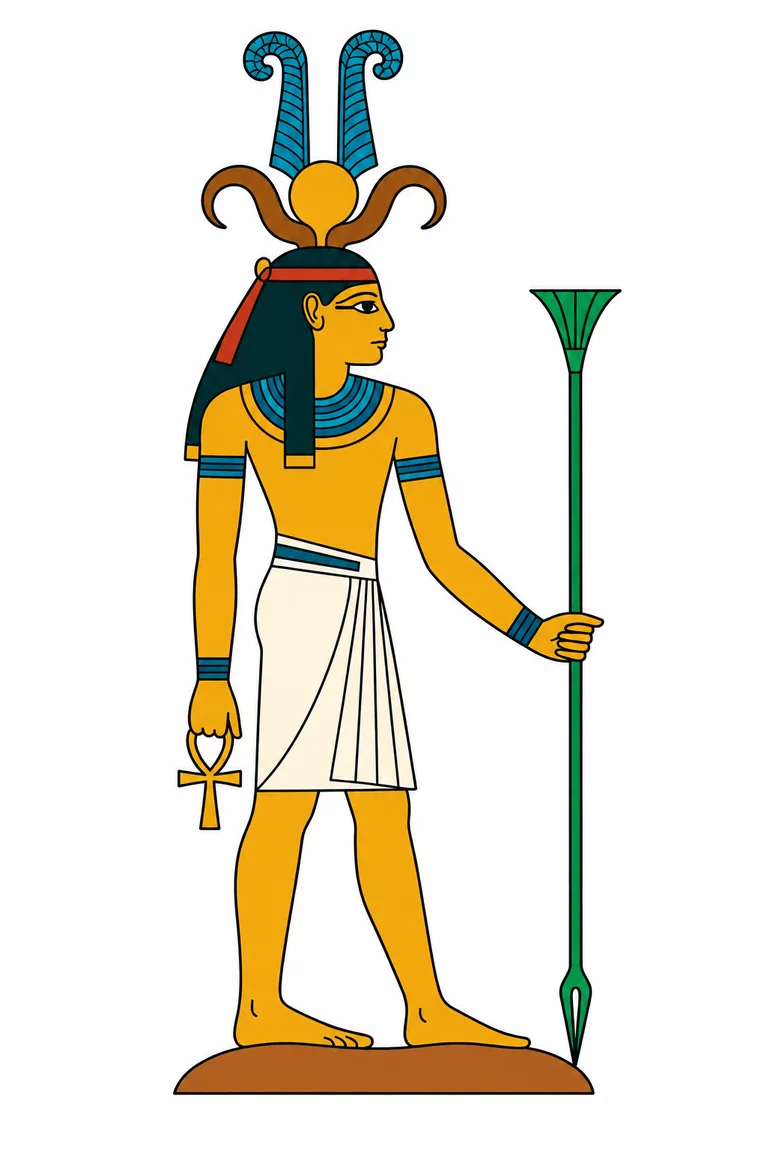
The earth that rises
The name Tatenen evokes the land that rises. The Metropolitan Museum links him to the first mound that emerged from the primordial waters in certain creation traditions. This image gives a tangible form to the beginning: where there was only an expanse of water, a stable place appears and makes the world habitable. Nun designates the primordial waters in other formulations of this landscape of origins. The Egyptians did not preserve a single account of the birth of the world. The emerging mound is one of the ways of thinking about the passage from the undifferentiated to an organised space.
Speaking of the earth with Tatenen does not mean confusing him with Geb, who represents the earth in another great family of gods. The two names belong to different networks of stories and images. Tatenen stresses in particular the first appearance of ground. A statue or an inscription can combine several traditions without making them strictly interchangeable. For the reader, the interest lies in following the role the god plays in the object being studied: foundation of the world, power springing from the soil or association with a local creator.
Ptah-Tatenen and Memphis
At Memphis, Tatenen is brought together with Ptah. The Metropolitan Museum explains that a faience tile bearing a characteristic crown may represent either Tatenen or Ptah-Tatenen. This uncertainty is not a weakness of the enquiry; it reflects an ancient association between the two powers. Ptah is a great creator of the Memphite tradition, while Tatenen evokes the emerging earth. Their union makes it possible to express creation in several aspects. It does not remove the need to read the inscriptions where they survive.
The Shabaka Stone, in the British Museum, is a major witness to Memphite thought. Its text places Ptah at the centre of an explanation of the world, but its interpretation and dating call for careful reading. It would be unwise to make every sentence of the monument a direct story about Tatenen. The object serves here as a landmark for the religious milieu in which the association with Ptah makes sense. Comparing the monument and the faience tile avoids turning a theological formula into a fixed portrait of a god.
A distinctive crown
The Metropolitan Museum entry for the faience tile describes a headdress combining curved ram’s horns, plumes and a disc. These signs catch the eye, but they do not replace the name. Our drawing takes them up to offer a full figure consistent with the series. His sceptre, his palette and his posture are choices of contemporary illustration. When looking at an antiquity, one must also consider the material, the breaks, the restorations and the place where it was found. A similar crown may serve several powers linked by a shared religious history.
Tatenen helps us understand why the Egyptians could tell the story of origins through the ground beneath their feet. Dry land rises and becomes the condition for temples, cities and human lives. This reading should not be projected onto all the cosmogonies of the country. Atum, for example, holds a different place in the stories of Heliopolis. By keeping these traditions distinct and observing where they meet, we discover a pantheon that reflected on the beginning in several ways. The name Tatenen gives this reflection the simple force of a land that appears.
Sources and references
Reference works
- Richard H. Wilkinson, The Complete Gods and Goddesses of Ancient Egypt, London, Thames & Hudson, 2003, entry Tatenen
- Christian Leitz (ed.), Lexikon der ägyptischen Götter und Götterbezeichnungen, 8 vols, Leuven, Peeters, 2002–2003 (Orientalia Lovaniensia Analecta 110–116 and 129)