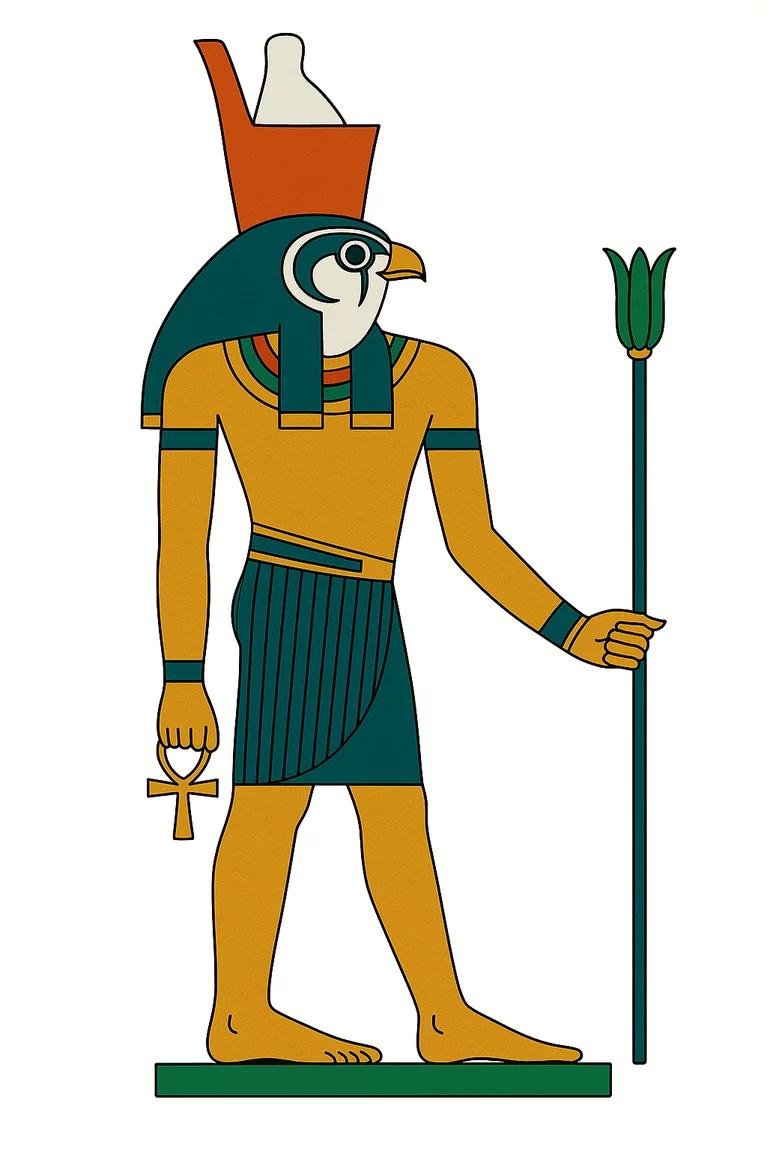
Horus is among the most important and the oldest deities of Egypt. His falcon image appears in royal art from the first dynasties onwards. Yet ‘Horus’ does not name a single character whose biography stayed fixed. The sky god, the protector of kingship, the child of Isis and Osiris, or again the lord of Edfu belong to traditions that cross one another. Reading them together means respecting their differences.
The falcon of the sky and of the king
The name Horus is often explained as ‘the one who is far off’, in relation to his celestial dimension. The falcon can dominate a scene from a barque or perch on the serekh, the frame that writes one of the ruler’s names. This association does not mean that every king claimed to be the biological son of the same mythical story. It expresses the royal office under a recognisable divine sign. The Horus name was part of the pharaoh’s titulary.
The full animal form is not the only one. Horus can have a human body and a falcon’s head, as in our illustration. Some childlike forms, by contrast, show him as a little boy with a sidelock of youth and a finger near his mouth. A falcon image on its own must be read with its inscription, its place and its neighbours: other gods use birds of prey too.
The son who claims the throne
In the cycle of Osiris, Isis protects her son Horus after the death of Osiris. Raised away from danger, he claims the power disputed by Seth. The clashes can be physical or take the form of a trial before the gods. The sources do not give a single version: the place, the period and the genre of the text all shape the story. Some myths also distinguish Horus son of Isis from Horus the Elder, a relative of the previous generation.
One of the most enduring episodes concerns the eye of Horus, injured and then restored. Thoth or Hathor may take part in the healing, depending on the tradition. The eye made whole again becomes a symbol of integrity and an offering able to restore vigour to Osiris. The amulet of the wedjat eye extends this idea of protection. Its presence on an object does not, however, automatically tell the whole conflict with Seth; it can work as an effective sign in its own right.
Edfu and the local forms
Edfu is one of the great cult centres of Horus. The temple that survives today belongs mainly to the Ptolemaic Period and presents several forms of the god, including Horus of Behdet. The Global Egyptian Museum explains that local traditions developed the struggle for kingship and the relationship with Hathor of Dendera. The two sanctuaries were linked by festivals. This shows that the myth lived in a calendar, an architecture and processions, not only in books.
Hierakonpolis and Letopolis offer other anchors. Place names added to that of Horus make it possible to recognise these forms without merging them entirely. The falcon links traditions, but each sanctuary could stress a different aspect: sky, kingship, victory, protection or descent. It would therefore be an oversimplification to sum Horus up as the mere ‘victory of good over evil’. Even Seth can have protective roles in other contexts.
The contemporary portrait on this page chooses the falcon head and the crown to make two major traits visible: his celestial power and his closeness to kingship. Ancient images are far more varied. Looking at Horus, we learn to tell apart a divine name, a local form and the function an image fulfils on an object or in a temple.
Sources and references
Reference works
- Richard H. Wilkinson, The Complete Gods and Goddesses of Ancient Egypt, London, Thames & Hudson, 2003, entry Horus
- Christian Leitz (ed.), Lexikon der ägyptischen Götter und Götterbezeichnungen, 8 vols, Leuven, Peeters, 2002–2003 (Orientalia Lovaniensia Analecta 110–116 and 129)