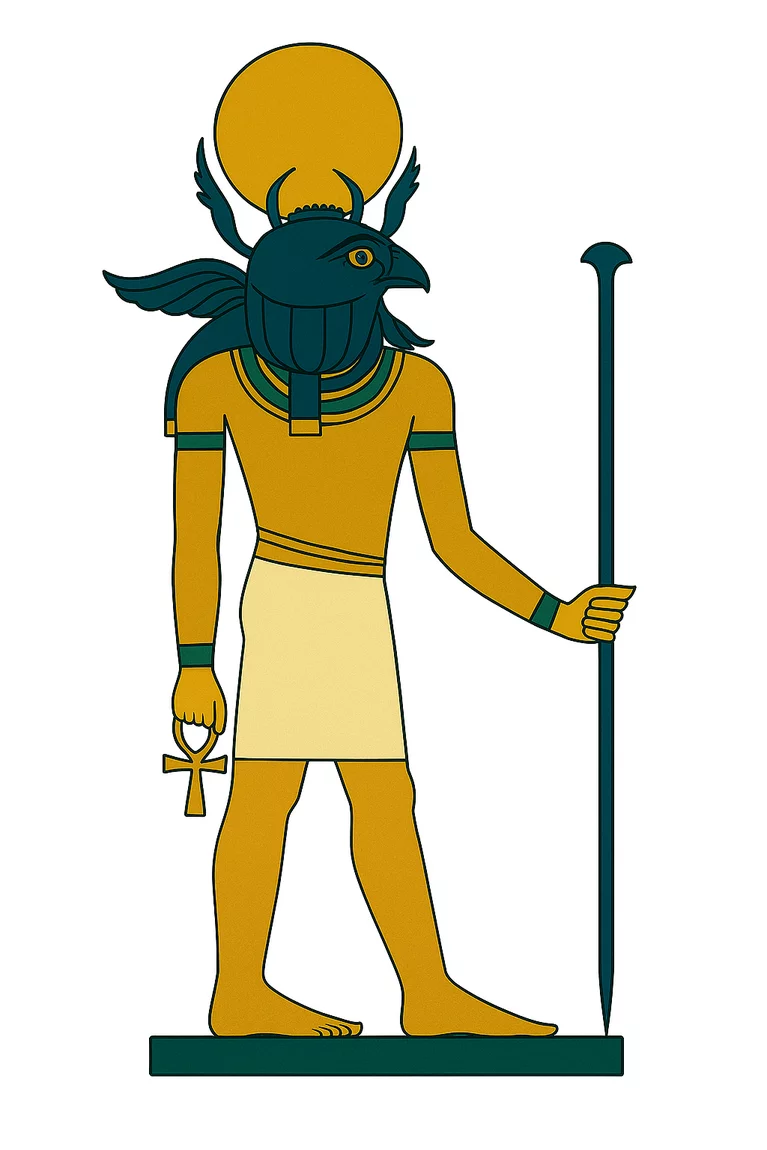
Khepri is a form of the sun at the moment of its daily birth. His name is connected with the Egyptian verb meaning ‘to come into being’ or ‘to become’. The scarab is his best-known sign: it can appear alone, winged, pushing the sun disc, or as the head of a human body. Watching this insect, the Egyptians found a tangible image of transformation and new beginnings. Khepri thus belongs to the rhythm of the day as much as to the hopes of rebirth.
The scarab and the rising sun
The scarab rolls a ball in which it lays its eggs. To ancient observation and belief, the new insect seemed to spring spontaneously from the earth. The Egyptians compared this movement to the appearance of the sun on the horizon and to the path of its disc across the sky. The Global Egyptian Museum explains this play between the animal called kheper, the verb ‘to become’ and the god Khepri. The comparison does not describe a science of insects in the modern sense; it reveals a way of giving shape to the daily miracle of sunrise.
A scarab shown on a ring or an amulet does not always represent the god directly, however. The image can serve as a seal, bear a royal name or express a protection linked to transformation. The medium and the inscription change its function. Some funerary scarabs were placed near the heart of the mummy and bear texts intended for the judgement of the dead. This practice extends the idea of rebirth, but it should not be confused with a simple image of the rising sun.
The hours of the night
In the books that describe the sun’s night crossing, the rebirth of the sun is prepared during the last hours before dawn. Khepri appears at the end of this journey. The Amduat describes the succession of hours, the deities met and the obstacles overcome. Apophis can stop the barque from moving forward, while protectors help the sun on its way. The new appearance of Khepri is therefore not a matter of course: it belongs to a cosmic drama played out again and again.
The sun has several names and forms. Ra designates a great solar power, and Atum can be associated with the evening sun. These are not necessarily three different suns. The names express moments, powers and cult traditions. Egyptian thought could also present the sun as born of Nut, goddess of the sky, without seeing any contradiction with the idea of a god who creates himself.
An image of transformation
The drawing on this page chooses the form of the winged scarab with the disc rather than a human body with an insect’s head. It is a choice consistent with the ancient repertoire. It shows at a glance the link between the insect and the sun. The wings, the colours and the base of our image belong to a contemporary interpretation; ancient objects can offer very different compositions.
Khepri helps us understand that creation is not only an event placed at the beginning of time. Each dawn can be thought of as a new ‘becoming’. For the living it ensures the return of light; for the dead it offers an image of continuity after the passage through darkness. The scarab thus brings together an observed natural phenomenon, a play on language and a religious hope.
Its popularity on portable objects bears witness to the power of this image. A small amulet could be held in the hand or go with a person into the tomb, while evoking the immense course of the sun. The size of the object does not limit its meaning. Khepri turns the visible everyday into the sign of a cosmic cycle.
Sources and references
Reference works
- Richard H. Wilkinson, The Complete Gods and Goddesses of Ancient Egypt, London, Thames & Hudson, 2003, entry Khepri
- Christian Leitz (ed.), Lexikon der ägyptischen Götter und Götterbezeichnungen, 8 vols, Leuven, Peeters, 2002–2003 (Orientalia Lovaniensia Analecta 110–116 and 129)