Giving perception a name
Sia personifies a capacity for knowledge and perception in Egyptian texts. He is not simply a ‘god of intelligence’ in the modern sense, a formula too broad to describe his attestations. The Book of the Dead, in a version presented by UCL Digital Egypt, names him beside Hu and Ra in the following of Atum. This precise source places Sia within a divine network; it does not on its own provide a detailed biography or a fixed portrait.
The Egyptians could give a name and a presence to faculties that we now describe with abstract words. Perceiving and understanding are not objects to be set down in a temple; representing them in divine form lets them take part in a story or a procession. Sia is thus a reminder that the pantheon does not bring together only the visible forces of nature. It also includes capacities needed to guide action and recognise the order of the world.
Sia, Hu and speech
The passage of the Book of the Dead associates Sia with Hu, a figure linked to effective utterance. Their closeness invites us to distinguish between grasping a thing and putting it into words. This reading is a way of explaining the relationship, not a literal translation of every ancient scene. The text places them in the entourage of the sun god. In this setting, knowledge and speech take part in a daily divine action. Cosmic order does not depend on strength alone: it also requires discernment and expression.
The presence of Atum in the same passage links these figures to reflection on origins. Egyptian traditions about creation are varied; a name can change function from one document to another. We should therefore cite the text being commented on rather than reconstruct a single doctrine of Sia. His association with the solar following is attested in this source. Other interpretations must be tied to their own contexts, not deduced automatically from this one extract.
Representing an idea
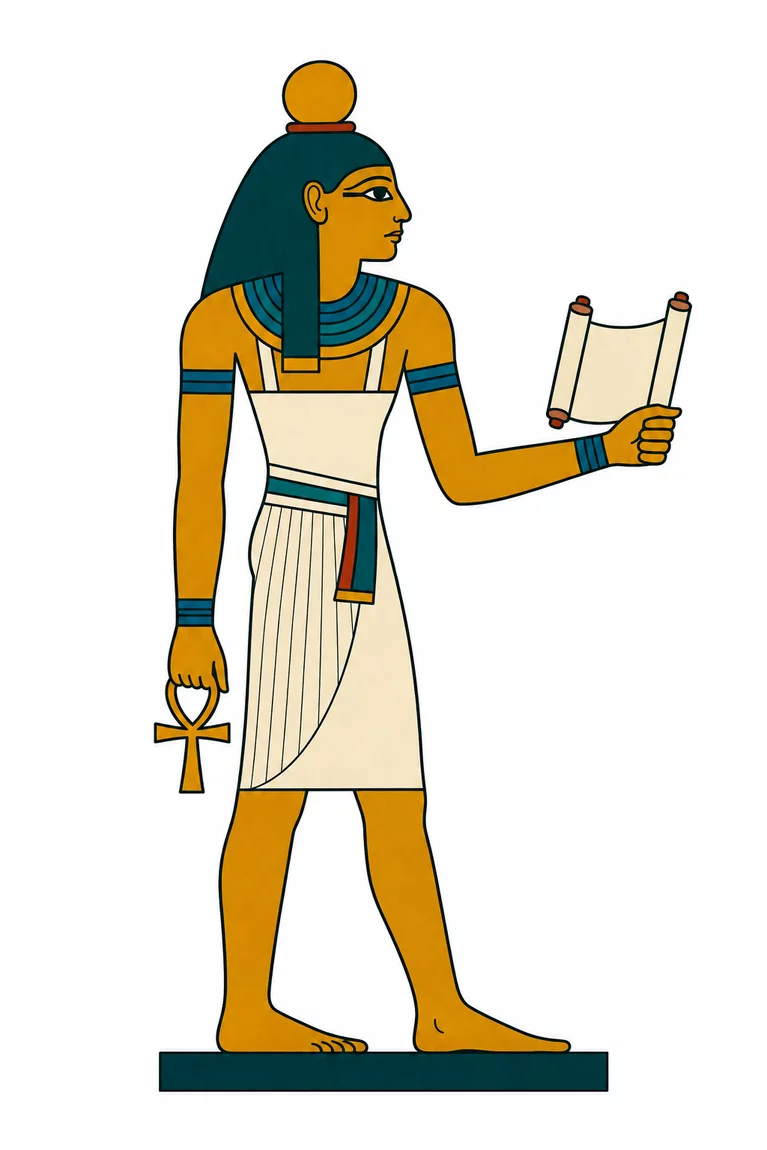
Our illustration shows Sia as a man holding a papyrus and an ankh. These are editorial signs chosen to evoke knowledge and divine action in the shared style of the series. The papyrus is not presented here as a compulsory attribute of every ancient figure of Sia. The personification of a faculty can receive a human form with few distinguishing marks; the inscription then becomes essential to identify it with confidence.
Comparing Sia with Thoth helps to measure this caution. Thoth is widely associated with writing, calculation and the figure of the scribe, while Sia names a capacity for perception in another register. The two are not interchangeable. Their domains can touch, but works and texts must be read according to their own composition. Sia shows how rich a page about a deity can be even when the evidence is less plentiful than for the great temple gods.
The relative rarity of secure images of Sia calls for a different method from that used for Sekhmet or Osiris. A named text gives solid support, while the contemporary illustration offers an evocation. The two must not be confused. The papyrus held by our figure helps to tell of perception and knowledge, but it is not iconographic proof. This openness allows a little-known deity to be included without inventing undocumented ancient attributes for him.
Sources and references
Reference works
- Richard H. Wilkinson, The Complete Gods and Goddesses of Ancient Egypt, London, Thames & Hudson, 2003, entry Sia
- Christian Leitz (ed.), Lexikon der ägyptischen Götter und Götterbezeichnungen, 8 vols, Leuven, Peeters, 2002–2003 (Orientalia Lovaniensia Analecta 110–116 and 129)