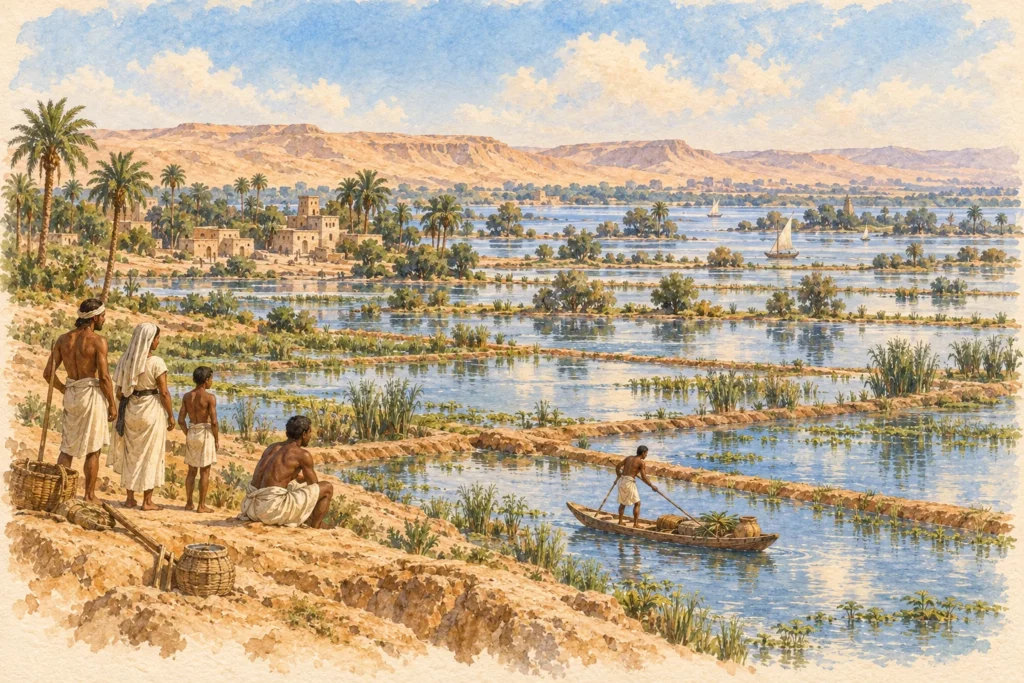
In ancient Egypt the year began neither in winter nor in spring, but in high summer, when the river started to rise. It almost never rains in the valley; all life depended on this water coming from the south. The Egyptians therefore organised their time around it. Their calendar counted three seasons of four months, each named after the state of the river and the fields.
Where the flood came from
The Egyptians did not know the real origin of the flood. They placed it in the caverns of the First Cataract, near Elephantine, from which Khnum was believed to release the waters. Hapy, the personification of the flood, shown as a man with a round belly and heavy breasts, embodied this abundance.
We now know that the flood is born of the monsoon rains that fall every summer on the highlands of Ethiopia. Swollen by these rains, the Blue Nile and the Atbara carry northwards an enormous volume of silt-laden water. The White Nile, fed by the great lakes of central Africa, provides a steadier flow. The question of these sources long fascinated travellers, down to the 19th-century explorers.
Akhet, the season of inundation
The first season was called Akhet, ‘inundation’. It corresponds roughly to the period from July to November. The water rises at Aswan from June, reaches Memphis a few weeks later and peaks in September. It then covers the low-lying land of the valley, held in vast basins by dykes.
During these months the fields are inaccessible. Farmers mend their tools, maintain the canals or are called up for the great royal building works. Depending on the height of the water, the year promises to be good or bad. A flood that is too low leaves land dry and brings shortage; one that is too high sweeps away dykes and villages. Nilometers, such as those of Elephantine, made it possible to measure the rise of the waters and to set taxes accordingly.
Peret, the coming forth of the land
The second season, Peret, means ‘coming forth’. It runs roughly from November to March. The waters withdraw and leave moist soil covered with a layer of black silt. It is this fertile earth that gave the country its name of Kemet, ‘the Black Land’, as opposed to the desert, the Red Land.
Farmers sow barley, emmer, flax and vegetables. Herds sometimes trample the seed to push it into the mud. The land registry scribes redraw the field boundaries erased by the water. Irrigation remains modest: the moisture left by the flood is largely enough to make the crops grow.
Shemu, the time of harvest
The third season, Shemu, corresponds to low water, from about March to July. Grain is reaped with the sickle, threshed on the threshing floor, winnowed and stored in granaries. Tomb scenes, notably at Thebes, describe this work in detail, with scribes counting the sacks under the eye of the owner.
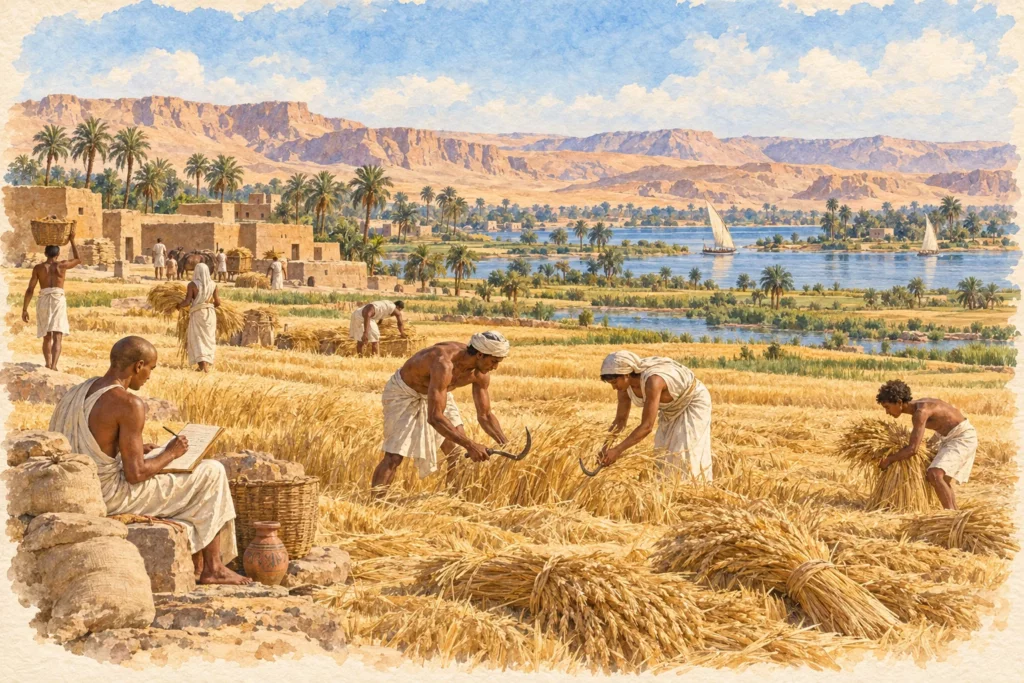
At the end of Shemu the river is at its lowest and the heat overwhelming. Everyone waits for the water to return.
A calendar set by the stars
In Antiquity, the return of the flood coincided with a celestial event: the reappearance at dawn of the star Sirius, which the Egyptians called Sopdet, after several weeks of invisibility. This heliacal rising ideally marked the New Year, the festival of the ‘opening of the year’.
The civil calendar counted twelve months of thirty days, divided into three seasons, to which were added five extra days, known as epagomenal days, devoted to the birth of Osiris, Horus, Seth, Isis and Nephthys. With no leap year, this 365-day calendar slipped by one day every four years against the real seasons. It took about 1,460 years for the civil New Year to coincide again with the rising of Sirius. The names of the seasons were therefore sometimes out of step with the real state of the river.
The end of an age-old rhythm
This cycle lasted through the dynasties, Roman rule and the Islamic period. It came to an end in the 20th century with the Aswan High Dam. Since the late 1960s the flood no longer passes Aswan: the water is stored in Lake Nasser and released all year round. The Egyptian countryside now has several harvests a year, but the silt no longer settles on the fields. The Coptic calendar, still used by farmers for agricultural work, nevertheless keeps month names inherited from ancient Egypt, such as Thout, the first month of the year.