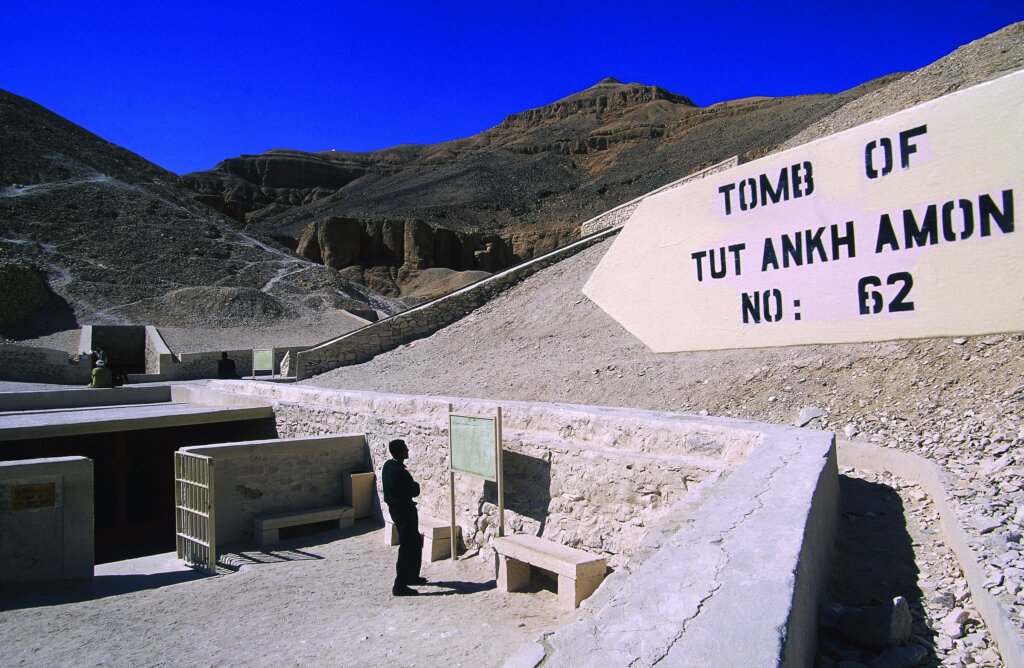
The Valley of the Kings brings together the tombs of many New Kingdom rulers, cut into the Theban mountain. Its name covers several centuries of work: an 18th Dynasty tomb and a Ramesside tomb cannot be read as a single project.
In brief
The valley is a dry wadi on the west bank, opposite ancient Thebes. It served as the royal necropolis of the 18th, 19th and 20th Dynasties, between about 1550 and 1069 BC. The Egyptian Ministry of Antiquities counts more than sixty tombs there and some twenty others left unfinished, little more than shafts. The first king buried there was Thutmose I, the third ruler of the 18th Dynasty.
What you discover
The corridors and chambers give access to texts, images and funerary programmes intended to accompany the king into the afterlife. Their dimensions, decoration and state of preservation differ greatly from one tomb to another. A tomb that is famous today may be so as much for the story of its discovery as for its owner’s place in the chronology: this is the case with that of Tutankhamun, whose entrance is shown in the photograph.
The present-day visit does not reproduce the ancient routes. The fittings, walkways and lighting are modern; they protect fragile walls as much as they guide visitors.
What to look at
The tomb of Seti I (KV17) is one of the longest, deepest and most beautiful in the valley. According to the ministry, it was the first fully decorated tomb and the first to have a vaulted burial chamber. Its chamber brings together the Litany of Ra, the Amduat and the Book of Gates, beneath an astronomical ceiling depicting the night sky. Discovered by Giovanni Battista Belzoni, it was reconstructed in London in 1821 and helped to awaken public interest in ancient Egypt.
Its history
Above the valley rises a pyramid-shaped peak, which the ministry points out as a landmark of the landscape. The New Kingdom kings, who gave up built pyramids, chose tombs cut and hidden in the mountain, while their cult took place in the mortuary temples of the plain. The excavations of the 19th and 20th centuries made the valley famous, but many questions of dating and attribution remain open for the earliest tombs.
How to explore the articles
The article on the first royal tombs presents the beginnings of the valley and the questions of dating. The tombs of Tutankhamun and Seti I each have their own article. Tomb C4, attributed to Thutmose II, lies in Valley C, to the west: it is linked to the Theban necropolis without falling within the limits of the Valley of the Kings.
Sources
Egyptian ministry, Valley of the Kings: https://egymonuments.gov.eg/archaeological-sites/valley-of-the-kings
UNESCO, Ancient Thebes with its Necropolis: https://whc.unesco.org/en/list/87
Egyptian Ministry of Tourism and Antiquities, tomb of Seti I (KV17): https://egymonuments.gov.eg/monuments/tomb-of-sety-i-kv17/