A reign under Persian threat
Nectanebo II, Nakhthorheb in Egyptian and Senedjemibre as throne name, reigned from 360 to 343 BC. He was the last independent Egyptian ruler to control the whole country in antiquity. His accession followed the overthrow of Teos, and his reign unfolded under the persistent threat of the Achaemenid empire. UCL Digital Egypt stresses the scale of his building works, despite this military context. The king’s history should not be read only from the standpoint of his final defeat: for nearly two decades, his court governed, built, honoured the gods and maintained alliances. The sources are numerous for the monuments, more fragmentary for day-to-day political decisions.
Temples as a network of power
Nectanebo II worked at Karnak, Edfu, Armant and on Elephantine (in French). The temple of Khnum on Elephantine bears an important architectural and decorative programme. These projects continued the effort of Nectanebo I while giving the new king his own presence in the sanctuaries. Each place linked the court to priests, craftsmen and local resources. Building was a religious and political act. Reused or destroyed blocks require precise attribution; a cartouche does not always prove that a whole building was created under the same king. The distribution of the monuments nevertheless shows a will to have his power recognised in the Delta and in the south of the valley.
Behbeit el-Hagar and Isis
The great temple of Isis (in French) at Behbeit el-Hagar, in the central Delta, is closely linked to Nectanebo II. The Metropolitan Museum of Art holds a relief showing him making an offering to Osiris (in French)-Hemag and emphasises that a large part of the building was constructed of dark granite. The king had almost completed the decoration of a chapel associated with the temple. The present ruins, made up of huge fallen blocks, give an idea of the ambition of the project, but not of its complete appearance. The sanctuary shows the growing place of the cults of Isis and Osiris at the end of the pharaonic era. Its study links the history of a king to that of a religious tradition that would continue for centuries to come.
Art and the royal image
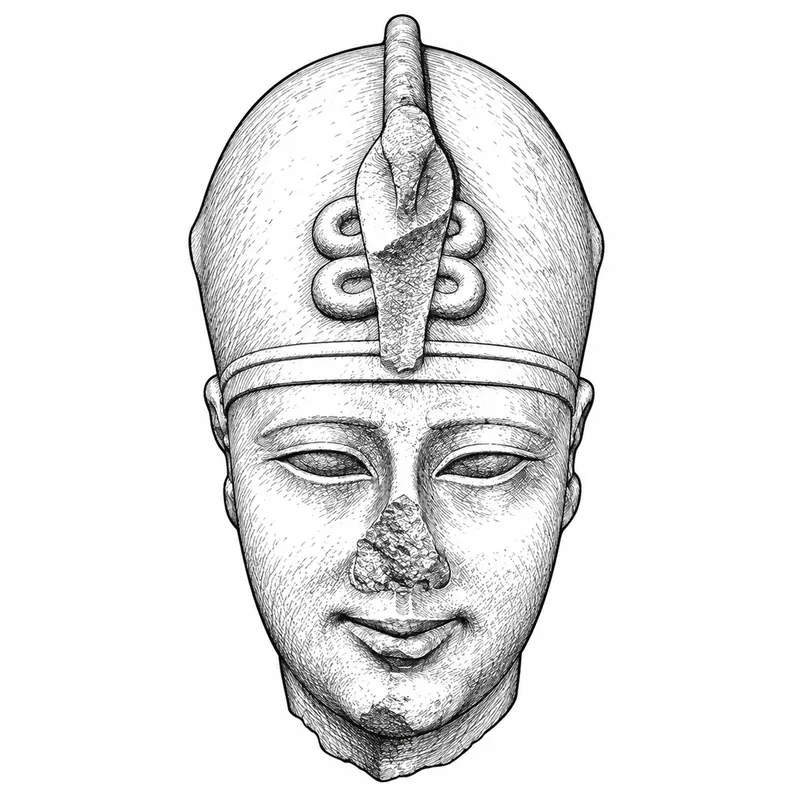
The portraits and statues of Nectanebo II belong to a refined artistic culture that quotes ancient models while developing forms of the 30th Dynasty. The representation of the ruler can associate him with protective deities and with the ideal of the king making offerings. These images are not psychological portraits; they create a ritual presence in the temples. Their material, size and original location count as much as their style. The inscribed royal name allows them to be dated, but some objects have changed place or function. Art history thus complements the political texts: it shows how the court sought to make visible an independent and lasting Egyptian kingship.
The reconquest by Artaxerxes III
In 343 BC, Artaxerxes III retook Egypt for the Persian empire. The accounts of the campaign come mainly from Greek traditions, which must be compared with the Egyptian and Persian evidence. Nectanebo II lost power; the accounts differ about where he later took refuge. UCL mentions traditions that have him leave for the Macedonian court or for Nubia, without these allowing a certain biography. His tomb has not been identified with certainty. The conquest was a break in sovereignty, but the sanctuaries he built continued to be used and were sometimes enlarged. His material work thus survived the end of political independence.
The Alexander legend
Late traditions would make Nectanebo II the father of Alexander the Great or attribute magical powers to him. These stories belong to the literary reception of the king and seek to link the Macedonian conquest to an Egyptian continuity. They are not proof of his life or of his movements after 343. Distinguishing them from the contemporary monuments is essential. The existence of such legends nevertheless shows that Nectanebo remained a useful figure for thinking about the end of independence and the arrival of a new dynasty. These legends, once dated, do not replace the more solid evidence of the temples and inscriptions of the reign.
The significance of a last reign
The reign of Nectanebo II represents both a political end and a peak of building. The temples of Elephantine, Karnak and Behbeit el-Hagar bear witness to a monarchy still capable of great projects. The Persian reconquest is a reminder of the limits of its defence in a wider imperial world. These two facts go together, and the reign cannot be reduced to a simple decline. The later traditions about his flight and about Alexander must be identified as such. His most tangible legacy lies in the stones of the sanctuaries, which continued to bear his name long after the disappearance of the independent 30th Dynasty.
Main sources
- UCL Digital Egypt, Nectanebo II and his attestations
- Metropolitan Museum of Art, relief from Behbeit el-Hagar
- UCL Digital Egypt, the last independent dynasties
- Model for the line portrait: royal head attributed to Nectanebo II, Penn Museum, E14303.
Reference works
- Ian Shaw (ed.), The Oxford History of Ancient Egypt, Oxford, Oxford University Press, 2000, chronology pp. 479–483
- Aidan Dodson and Dyan Hilton, The Complete Royal Families of Ancient Egypt, London, Thames & Hudson, 2004