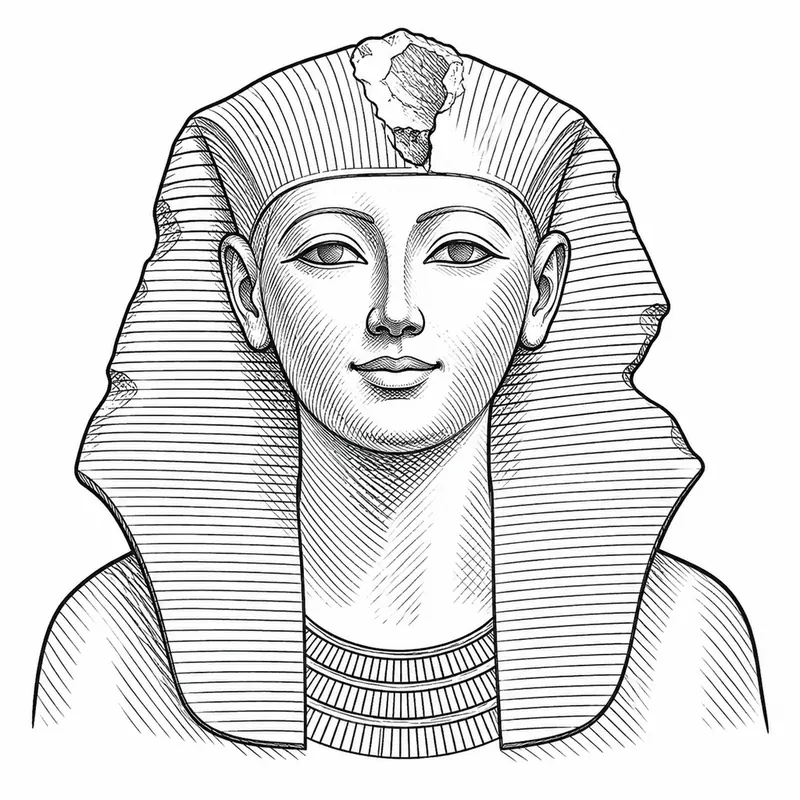
From regent to ruler
Hatshepsut was the daughter of Thutmose I and the wife of Thutmose II. On the latter’s death, the young Thutmose III inherited the throne; Hatshepsut first took charge of the government, then adopted a full royal titulary. The UCL chronologies place this period between about 1479 and 1458 BC, with discussion about certain years of co-regency. Presenting her merely as an ambitious queen impoverishes the record. Her monuments show a ruler who fulfilled the functions of the king in the rites, building works and administration, while placing herself alongside another pharaoh. This situation requires us to distinguish the age of the young king, the titles used and the different phases of her own power.
Legitimacy displayed in the monuments
Hatshepsut bore the throne name Maatkare. The scenes of her divine birth and the inscriptions on her monuments explain why her kingship was to be recognised. They associate her person with Amun (in French) and with the cosmic order that the king was charged with maintaining. These images are not a biological account to be read literally; they form a political and religious language. Their choices show what the court wished to make indisputable. The representation of Hatshepsut varies with context, with feminine forms or the traditional attributes of the ruler. This variety allows the royal function to be studied without imposing on the images a simple opposition between personal appearance and political identity.
Deir el-Bahri, a programme in stone
The mortuary temple at Deir el-Bahri, built in terraces on the west bank of Thebes, is Hatshepsut’s most famous monument. Its plan sets the ceremonies within the landscape of the cliffs. Its reliefs recount notably the divine birth and the expedition to Punt. The building was a place of worship, not just a sculpted narrative intended for historians. Modern restorations allow its architecture to be admired, but the loss of colours, blocks and sculptures must be borne in mind. The temple inscriptions are first-rate sources for the reign; their scenes select events and put them at the service of a coherent religious programme.
The expedition to Punt
The reliefs at Deir el-Bahri describe a sea expedition to the land of Punt, generally located in the region of the southern Red Sea. They show ships, sought-after products and the reception of the envoys. This undertaking illustrates the court’s ability to organise a route, negotiate exchanges and bring back materials intended for the cults. The precise location of Punt is still debated, and the scenes are not an exhaustive travel journal. They construct an image of success desired by the ruler. The material details, notably the incense trees and the cargoes, nevertheless open a valuable window onto the religious economy and Egypt’s links with its neighbours.
Karnak and the other building projects
Hatshepsut had obelisks raised at Karnak and developed a processional chapel there. Inscriptions are also known at the Speos Artemidos, in Nubia, in Sinai and elsewhere. The map of these attestations shows activity wider than the mortuary temple alone. Each place had a function: honouring Amun, securing routes, marking a frontier or inscribing the royal name in a sanctuary. The biographies of dignitaries such as Senenmut, Djehuti and Hapuseneb complete the record by showing actors in the building works. They do not justify the romantic stories often built around the relationship between Hatshepsut and Senenmut; they document above all offices and achievements.
The erasure and its limits
After Hatshepsut’s death, her names and images were removed from many monuments, and she is absent from some later king lists. The exact date, extent and motives of this undertaking are debated. Explaining it solely as a personal revenge of Thutmose III would be too simple. Nor was the erasure complete: inscriptions, objects and fragments have survived. Archaeologists sometimes have to reconstruct a decoration from blocks that were deliberately broken or reused. The history of Hatshepsut is therefore also that of the selective transmission of evidence. Understanding what was destroyed and what remained allows us to measure the fragility of an official memory.
A major reign of the 18th Dynasty
The reign of Hatshepsut combines a question of succession, a singular titulary, a vast building programme and a later history of erasure. The richness of the monuments makes it possible to go beyond the formula of the ‘female pharaoh’. She governed within established institutions, mobilised elites and gave her kingship a lasting religious and architectural form. The uncertainties about the chronology of the co-regency and the motives for the erasure must be kept in the account. They are a reminder that the modern fascination with her person does not replace the examination of reliefs, inscriptions and find contexts.
Main sources
- UCL Digital Egypt, Hatshepsut and her monuments
- UCL Digital Egypt, Thutmose III and the co-regency
- Metropolitan Museum of Art, Hatshepsut: From Queen to Pharaoh
- Model for the line portrait: seated statue of Hatshepsut, Metropolitan Museum of Art, 29.3.2.
Reference works
- Ian Shaw (ed.), The Oxford History of Ancient Egypt, Oxford, Oxford University Press, 2000, chronology pp. 479–483
- Aidan Dodson and Dyan Hilton, The Complete Royal Families of Ancient Egypt, London, Thames & Hudson, 2004